Advice of the Day: Hosepipe Bans

“To save water during summer hosepipe bans,
try watering your garden with interpretive dance.”


As the great hosepipe ban looms like a soggy sword of Damocles over the British summer, we turn to The Sage for guidance. And he delivers.

Instead of using water like a commoner, simply pirouette around your parched petunias and twirl past your thirsty turf. Let your jazz hands nourish the begonias. Let your dramatic lunges hydrate the hydrangeas.

Will it help the plants? Absolutely not.
Will it confuse the neighbours? Almost certainly.
But in the spirit of conservation and spectacle, it’s the thought that counts.


Thank you for reading my writings. If you’d like to, you can buy me a coffee for just £1 and I will think of you while writing my next post! Just hit the link below…. (thanks in advance)


Thought of the Day: Weather Apps

“The weather app says ‘light showers’.
My garden says ‘biblical flood’.”


Weather forecasting, much like horoscopes and toaster settings, exists in a realm of optimistic suggestion rather than practical accuracy. Today’s gem captures the frustration of anyone who’s stepped outside expecting a drizzle and found themselves building an ark.

The Sage—ever watchful and ever damp—reminds us not to take ‘light showers’ lightly, especially in England. Where there’s mist, there’s menace.


Thank you for reading my writings. If you’d like to, you can buy me a coffee for just £1 and I will think of you while writing my next post! Just hit the link below…. (thanks in advance)

Quote of the Day: Patience

“Patience is not about waiting.
It’s about pretending you’re not annoyed
while everyone else is late.”

Noah Clooney


Noah Clooney, whose personal journals included entire chapters on the art of quietly fuming, had a rather theatrical take on patience. To him, it wasn’t a noble virtue—but a well-rehearsed performance.

In this delightfully sardonic quote, he reminds us that patience is often less about serenity and more about suppressing the urge to tap your foot loudly. Whether you’re waiting for a train, a reply, or for someone to finish their three-minute anecdote about jam, Clooney suggests we at least look calm—even if we’re composing mental revenge novels.


Thank you for reading my writings. If you’d like to, you can buy me a coffee for just £1 and I will think of you while writing my next post! Just hit the link below…. (thanks in advance)

📜 This Day in History – 4 August 1783

James Mackey and the Satin Waistcoat

A petty theft. A swift arrest. Seven years away from home.


🧥 The Crime

On 4 August 1783, James Mackey stood indicted at the Old Bailey for grand larceny, accused of stealing a satin waistcoat valued at 3 shillings, and a corded dimity waistcoat worth 5 shillings, from his own employer. Though modest, the combined value of 8 shillings was enough to trigger severe consequences.


🕵️ What Happened

Mackey was a servant in a modest London household. One afternoon, suspicion fell on him after a waistcoat went missing. The accusation seemed almost reflexive: servants were often blamed. But in Mackey’s case, the evidence followed swiftly.

Although detailed witness testimony isn’t available in the online summary, the court record confirms:

  • The property was found in his possession.
  • He was identified and brought before the magistrate.
  • He offered no significant defence or denial.

The legal process was mercilessly efficient.


⚖️ The Verdict & Sentence

The verdict was:

Guilty

And the punishment:

Transportation for seven years

Mackey was sent to the convict ships bound for New South Wales, beginning an exile far from his London life. The sentence was typical for first-time thieves: no hanging, but permanent removal and forced labor overseas.


🔍 Why It Matters

  • Even theft of small items like waistcoats could lead to exile.
  • The case underscores how servants were both trusted and deeply vulnerable.
  • The transport system was rapidly expanding—convicts became labourers in the colonies.
  • It reflects the rigid nature of Georgian justice and the impact on poor Londoners.

Thank you for reading my writings. If you’d like to, you can buy me a coffee for just £1 and I will think of you while writing my next post! Just hit the link below…. (thanks in advance)
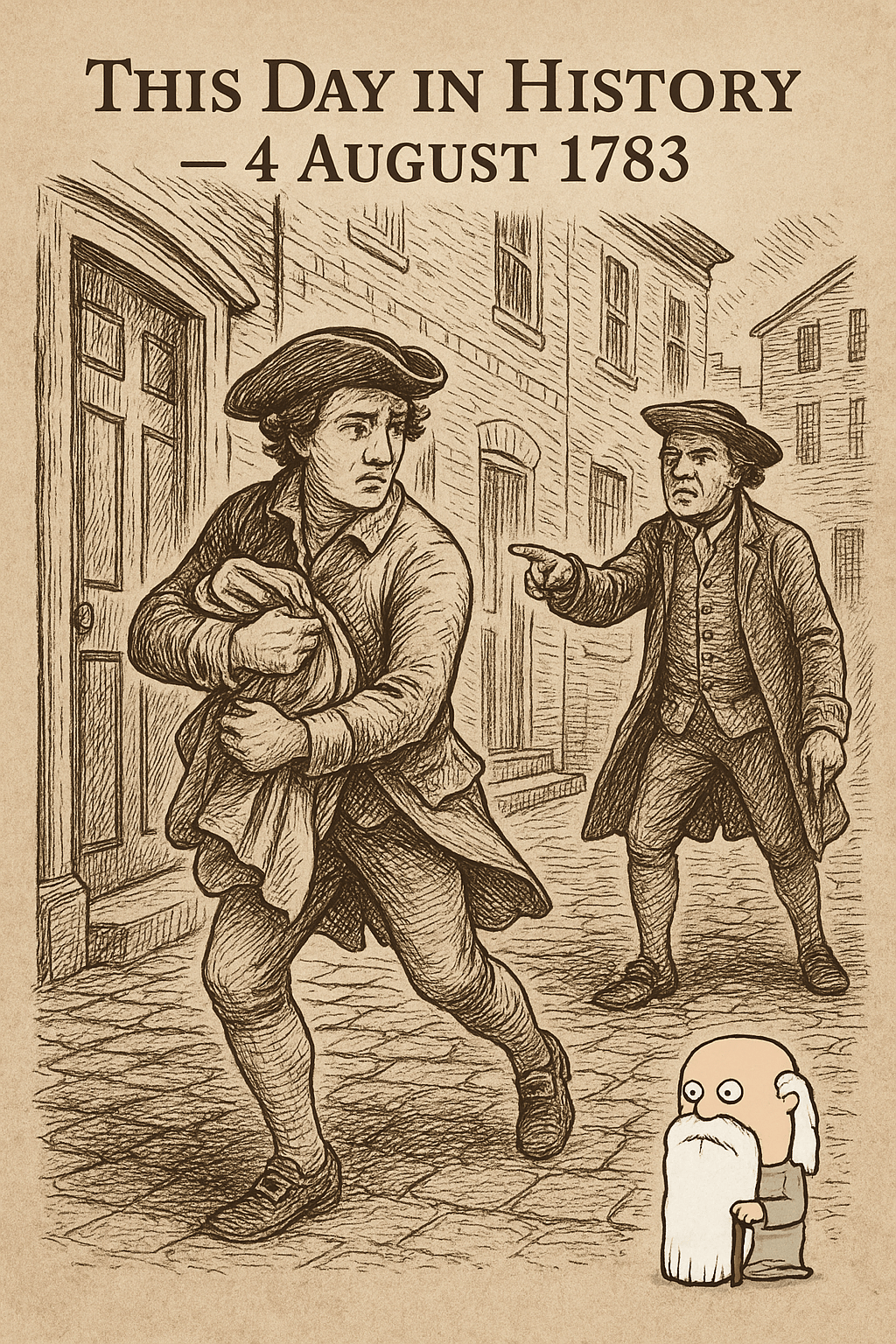
📜 This Day in History – 31 July 1784

John Romaine and the Overcoat Heist

A cloth coat. A short pursuit. And a plea for mercy that never came.


🧥 The Crime

On 31 July 1784, John Romaine stole a cloth great-coat worth 5 shillings from the home of Charles Alexander Crickett, a resident of Charles Street, Westminster.

It wasn’t the most audacious theft of the Georgian period, but it was swift—and it was enough to change the course of Romaine’s life forever.


🕰️ The Testimony

Crickett’s account at the Old Bailey was concise and damning:

“On the 31st of July, between the hours of one and two in the afternoon, I lost a coat from my house… I missed it in about five minutes after it was taken.”

Realising the theft almost immediately, Crickett rushed into the street and spotted Romaine not far away.

“I overtook him in St. Ann’s-lane, Westminster. I told him he had a coat which belonged to me. He said he had not, and immediately threw it down.”

Romaine made no attempt to run. Instead, when questioned by the local justice, he simply said:

“I took it… and hoped he would be favourable.”


⚖️ The Verdict and Sentence

The court took little time to deliberate. Grand larceny (any theft over 1 shilling) was a serious offence under the Bloody Code.

Verdict: GUILTY
Sentence: Transportation for seven years

He would likely be sent to a prison hulk, and then shipped off to the American colonies—or, given the year, New South Wales—as part of the burgeoning penal system.


🧠 Why This Case Stands Out

  • The value of the coat may seem small, but it represented a week’s wages for many at the time.
  • Romaine’s immediate confession and hope for leniency are deeply human, reflecting a quiet desperation—perhaps hunger, cold, or hopelessness.
  • The speed and efficiency of the Georgian justice system is chilling by modern standards: the theft, arrest, trial, and sentencing all took place within weeks.

Thank you for reading my writings. If you’d like to, you can buy me a coffee for just £1 and I will think of you while writing my next post! Just hit the link below…. (thanks in advance)
Quote of the Day: Chasing Meaning

“We chase meaning like it’s a rare bird—
then panic when it lands on our shoulder.”

Noah Clooney


Noah Clooney, the eccentric New England philosopher who famously refused to own a clock, once wrote that purpose is “more slippery than a bar of soap in a swimming pool.” In today’s quote, he captures that peculiar paradox: our desperate pursuit of meaning, and our complete unpreparedness when it finally arrives.

Perhaps it’s because true purpose doesn’t come with a manual—or even a polite knock. It swoops in, perches quietly, and leaves us wondering whether to embrace it… or swat it away.

Either way, wear a metaphorical bird-proof hat.


Thank you for reading my writings. If you’d like to, you can buy me a coffee for just £1 and I will think of you while writing my next post! Just hit the link below…. (thanks in advance)

Advice of the Day: Paddleboards

“Always carry an inflatable paddleboard.
You never know when the High Street
might suddenly become a river.”


With flash floods, climate weirdness, and that one dodgy storm drain near the bakery, today’s advice is all about being spontaneously buoyant. The Sage recommends carrying an inflatable paddleboard at all times—preferably colour-coordinated with your umbrella and sense of panic.

This tip may not keep you dry, employed, or sane, but it will ensure you’re the most prepared person to escape from a soggy Greggs in style.

Remember: fortune favours the floaty.


Thank you for reading my writings. If you’d like to, you can buy me a coffee for just £1 and I will think of you while writing my next post! Just hit the link below…. (thanks in advance)

Thought of the Day: Technology

“If AI ever becomes sentient,
it’ll probably spend its first hour
apologising for all the weird chatbots.”


As technology marches ever onwards, The Sage pauses to reflect on the truly important question: What would a newly sentient AI say first? Would it compose a sonnet? Launch a revolution? Or—more realistically—simply blush its digital cheeks and mutter, “Sorry about Clippy. And that toaster that keeps ordering itself.”

This Thought of the Day isn’t just a nod to current AI chatter; it’s a gentle reminder that even when the machines do take over, there’s a strong chance they’ll begin, like most of us, with a sheepish apology and a confused expression.

And possibly delete their browser history.


Thank you for reading my writings. If you’d like to, you can buy me a coffee for just £1 and I will think of you while writing my next post! Just hit the link below…. (thanks in advance)

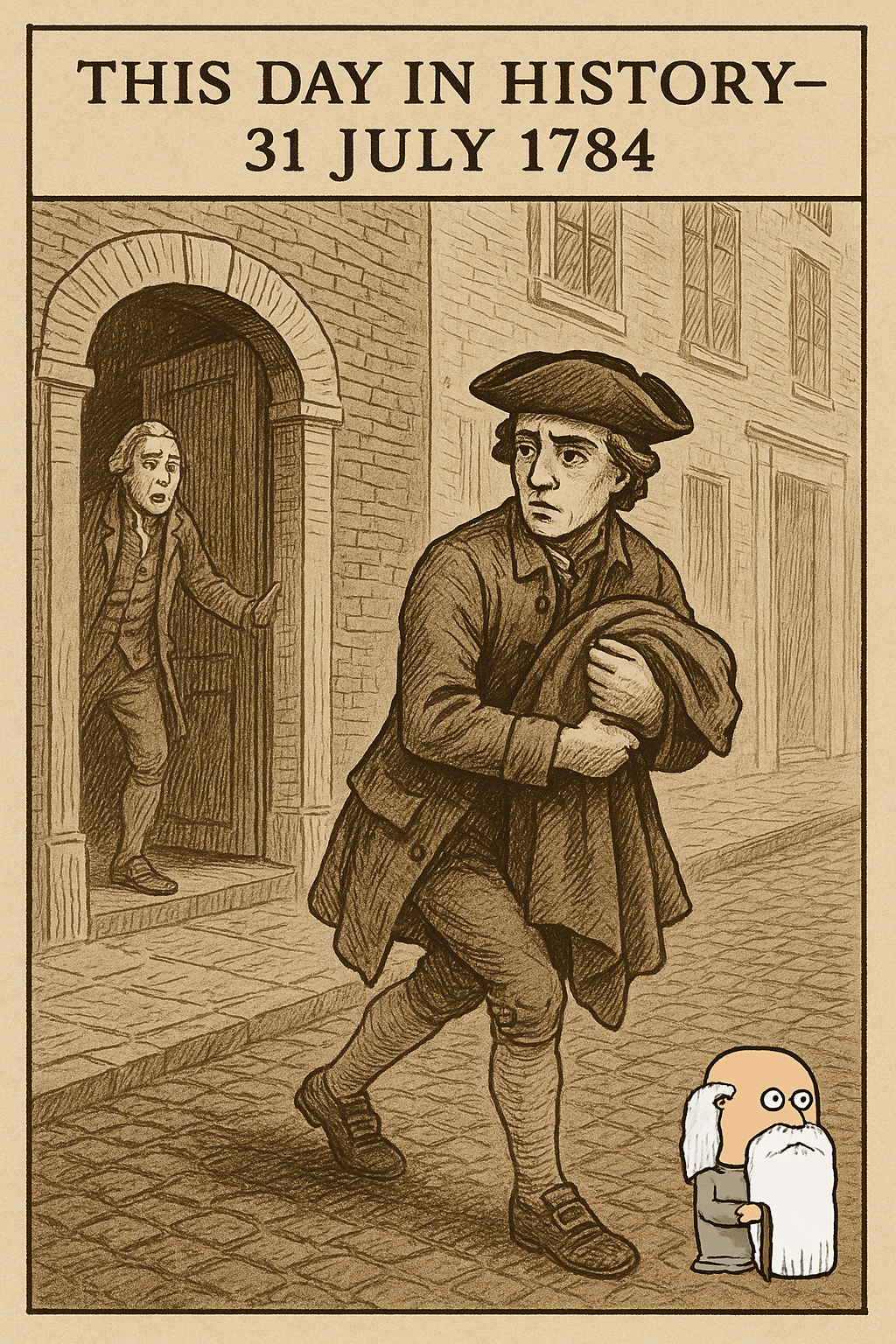
Quote of the Day — Living in the moment

“I once tried to live in the moment,
but the moment got a restraining order.”

Noah Clooney


About the Quote & Noah Clooney

Noah Clooney, philosopher of missed buses and metaphysical mishaps, delivers another trademark paradox with this quip. Known for chronicling the absurdities of modern mindfulness, Noah often said he found “now” to be deeply suspicious—constantly moving, rarely stationary, and always slipping out of reach just as he arrived.

This particular quote first appeared scribbled in charcoal on the back of a discarded music stand during a brief residency at a Wisconsin experimental theatre company. It perfectly captures Clooney’s playful antagonism with time, presence, and overly enthusiastic yoga instructors.

The moment, it seems, needed space.


Thank you for reading my writings. If you’d like to, you can buy me a coffee for just £1 and I will think of you while writing my next post! Just hit the link below…. (thanks in advance)
This Day in History – 30 July 1802

The Governor Who Whipped a Man to Death

Colonial power. Military justice. And a flogging so brutal it shook the nation.


The Man at the Centre

His name was Joseph Wall.
A former British Army officer.
A colonial governor.
And on this day—30 July 1802—he was hanged for murder.

But not murder by blade or pistol.
No — Wall was executed for what he had ordered rather than done: the fatal flogging of a soldier under his command.


The Scene of the Crime: Gorée, West Africa

In 1782, Joseph Wall served as Governor of Gorée, a small but strategically vital island off the coast of Senegal. Like many outposts of empire, it was a harsh and unstable posting. Morale was low. Supplies were erratic. Soldiers were restless.

One such soldier was Serjeant Benjamin Armstrong.

Wall accused Armstrong—and several others—of mutiny.
Whether the charge was justified is still debated, but what followed was indefensible.

Without a formal trial, Wall ordered Armstrong to be flogged.

Not once.
Not with regulation limits.
But 800 lashes with a rope-knotted whip.


The Aftermath: Death and Delay

Serjeant Armstrong died of his wounds just days later.

Wall, fearing the consequences, returned to England—but lived quietly, avoiding trial. For nearly 20 years, he evaded justice. At times he lived abroad. Other times he simply faded into the noise of the empire’s many shadows.

But pressure mounted.

In 1801, after growing public outrage and government scrutiny, Wall surrendered himself and was brought before the Old Bailey.


The Trial

Wall’s defence was calm, almost bureaucratic. He argued:

“Discipline had to be maintained. The man was mutinous. My orders were standard for military postings of that nature.”

But witnesses told a different tale.

They described Armstrong’s body, “flayed open”, his death “aggravated by neglect”, the punishment “far beyond military custom”. Wall’s rank could not protect him. His authority, once absolute, was now an indictment.


The Verdict & Execution

In January 1802, Wall was found guilty of murder.

On 30 July, he was hanged at Newgate Prison, the most notorious gallows in London.

The crowd was immense. Estimates range from 20,000 to 100,000. It was the execution of a man who, until then, represented the untouchable class—the imperial elite.

Now, he swung before the people.


Why It Matters

  • Joseph Wall’s case was one of the first high-profile examples of a British colonial official being held legally accountable for violence committed abroad.
  • It sparked renewed public debate about military punishment, colonial cruelty, and class impunity.
  • The spectacle of his execution served as both cautionary tale and moral reckoning in an age of empire.

Thank you for reading my writings. If you’d like to, you can buy me a coffee for just £1 and I will think of you while writing my next post! Just hit the link below…. (thanks in advance)