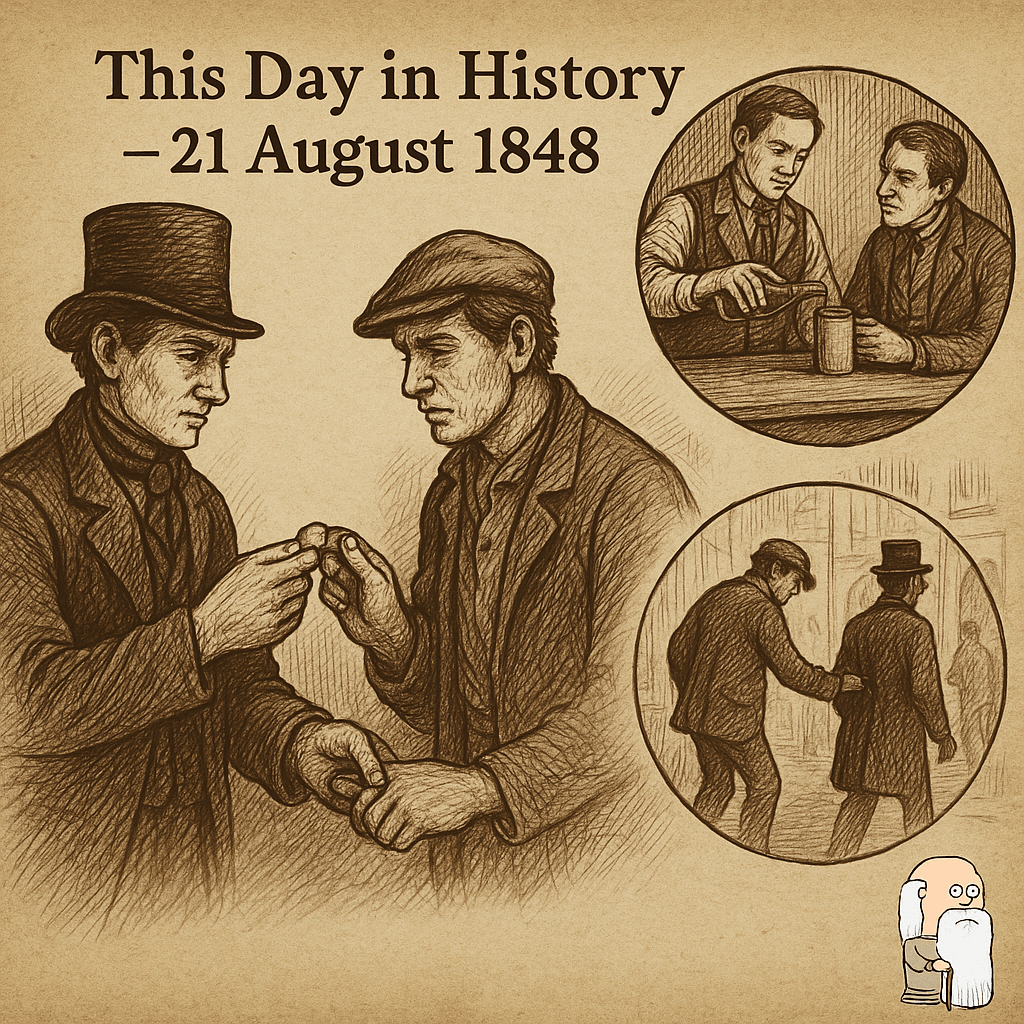
This Day in History – 21 August 1848

Thomas Lancaster & the Art of Counterfeit Coining

When one face could cover many crimes—and one forged coin meant a judge’s suspicion.


The Case

On 21 August 1848, Thomas Lancaster was indicted at the Old Bailey on charges of coining offences—that is, the intentional manufacture or uttering of counterfeit money, a grave royal offence under Victorian law. The trial transcript (reference t18480821-1805) reflects the gravity of coining—an attack not just on merchants but on the Crown’s authority itself.

At the same session:


Waxing Punishment

  • Coining was punishable by transportation or death, depending on severity. It was seen as undermining economic and social order.
  • Poisoning—especially using lead—was treated as attempted murder, often resulting in long imprisonment or execution.
  • Larceny, especially repeat offenses, commonly led to imprisonment, transportation, or even branding.

Why This Session Stands Out

  • The contrasting cases—from counterfeit coin to poisoning to theft—offer a cross-section of Victorian crime.
  • Thomas Lancaster’s coining offence shows how financial destabilization was regarded as a serious political as well as criminal threat.
  • Albert Brown’s poisoning case speaks to domestic betrayal or stealth, echoing domestic tension in 19th-century homes.
  • Boosey’s pickpocketing reminds us that even small thefts were rigorously prosecuted in a crime-ridden metropolis.

Thank you for reading my writings. If you’d like to, you can buy me a coffee for just £1 and I will think of you while writing my next post! Just hit the link below…. (thanks in advance)



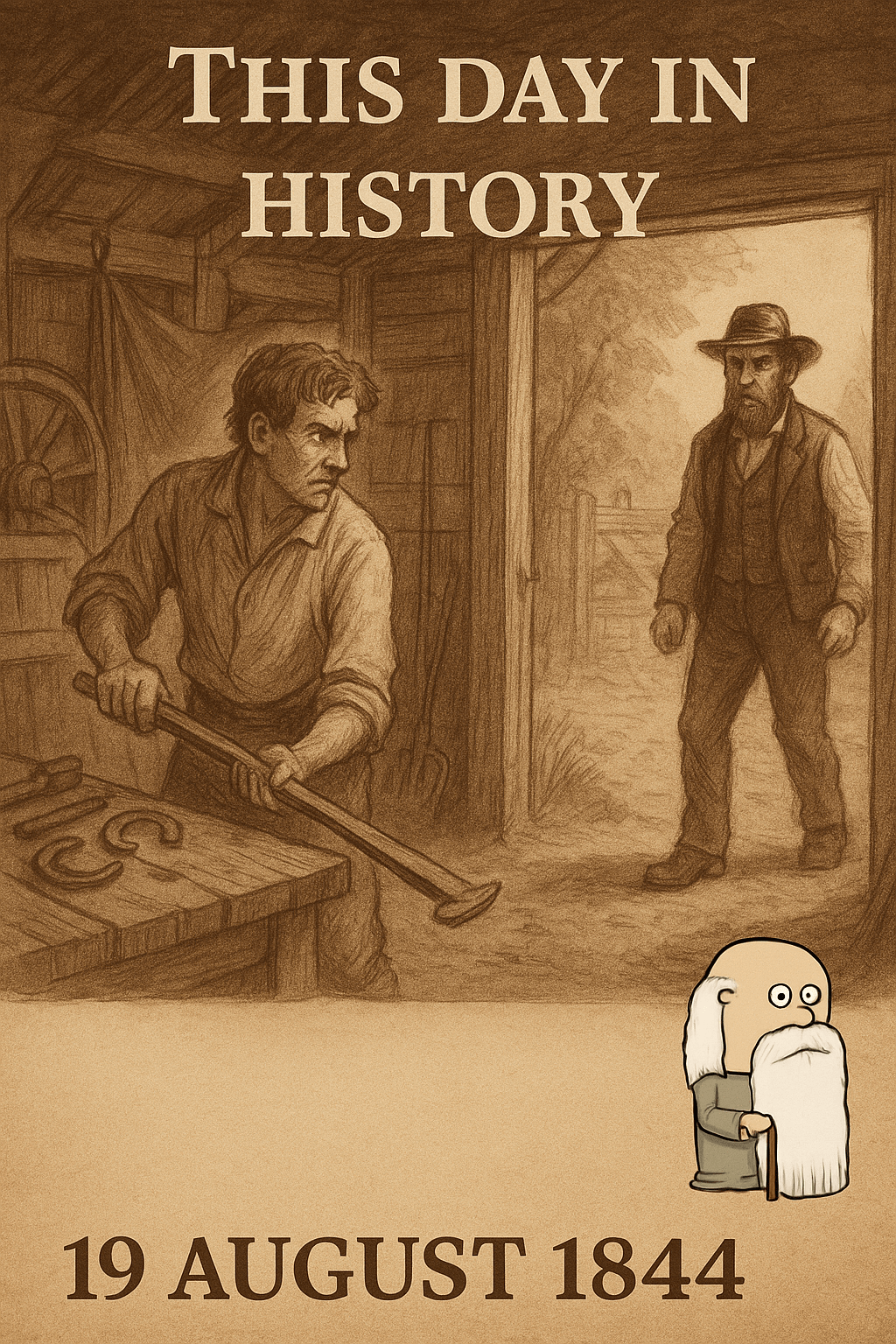
This Day in History – 19 August 1844

Tools of Betrayal – The Case of John Morphew

A stolen rasp, a line drawn in grief—and a laborer’s broken promise.


The Crime

On 19 August 1844, John Morphew was indicted for stealing a farmer’s iron tools: specifically, 19 horseshoes (2s 4d), a rasp (1l 10s), and a trimming iron (4d), all belonging to his employer, James Arscott, while in her service.
(oldbaileyonline.org)

The theft of tools—so essential to rural labour—was not just criminal: it was sabotage of livelihood.


The Trial

At the trial, Arscott testified with quiet hurt:

“I missing them soon after sending John to help round the stable. I valued the rasp particularly—it was lent to me and irreplaceable.”

Despite his service, Morphew was found to have betrayed his employer’s trust. The jury returned:

Guilty.


The Sentence

Though detailed sentencing isn’t in the brief abstract, theft of this nature typically led to a prison sentence—often a year or more, depending on remorse and prior record—rather than transportation or execution. The loss of tools and the breach of trust, however, would have marked him for harsh reproof from peers.


Why It Matters

  • Tools stolen are livelihoods stolen: These implements were essential for rural labour and valuable. Without them, work couldn’t proceed.
  • Class and intimacy: Working within a household or farm entwined professional and personal trust—making betrayal feel deeply personal.
  • Proportional punishment: Unlike capital thefts, this one likely led to imprisonment—a reminder of the degree of crime and the justice system’s scaling.

Thank you for reading my writings. If you’d like to, you can buy me a coffee for just £1 and I will think of you while writing my next post! Just hit the link below…. (thanks in advance)
Advice of the Day: Hide and Seek Champion

Advice: “Always win at hide and seek by moving house during the game.”


Explanation: The Sage has discovered the ultimate strategy for those who simply cannot bear the humiliation of being “found.” Forget cupboards, wardrobes, or under the stairs — true mastery of hide and seek lies in the logistics of a full-scale house move while your opponent counts to ten.

Admittedly, this approach requires some commitment. Removal vans, estate agents, and a new forwarding address may be considered by some as “excessive.” But what is a little upheaval compared to the glory of remaining undiscovered indefinitely? Victory, after all, has no fixed postcode.

While critics may say this ruins the spirit of the game, The Sage insists it actually elevates it. Hide and seek becomes not a children’s pastime, but a lifelong lifestyle choice. The only risk is forgetting where you now live — but then, that only makes you harder to find.


Thank you for reading my writings. If you’d like to, you can buy me a coffee for just £1 and I will think of you while writing my next post! Just hit the link below…. (thanks in advance)

Thought of the Day: Snacks and Happiness

Thought: “You can’t buy happiness, but you can buy snacks — which is nearly the same.”


Explanation: The Sage has long observed that while philosophers argue endlessly about the meaning of life, the rest of us are usually content with a packet of crisps. Happiness may be elusive, but snacks are available at every corner shop and require no deep meditation to acquire.

Some will protest that true joy lies in love, purpose, or enlightenment. Yet even the most profound moments of human experience can be enhanced by the timely arrival of biscuits. The Sage argues that while snacks cannot solve all of life’s problems, they can certainly make waiting for solutions more bearable.

Of course, there is wisdom in moderation — though The Sage is quick to point out that moderation itself can also be enjoyed with a snack in hand. After all, life’s greatest truths are rarely found on an empty stomach.


Thank you for reading my writings. If you’d like to, you can buy me a coffee for just £1 and I will think of you while writing my next post! Just hit the link below…. (thanks in advance)


Quote of the Day: Eric Shinn on Patience

Quote: “Patience is a virtue — mostly because it takes so long to learn.”
— Eric Shinn


Eric Shinn, celebrated in legend as a philosopher who never rushed for anything other than pudding, understood the cruel irony of patience. It’s praised as one of the noblest virtues, but also happens to require a painfully slow apprenticeship. Nobody becomes patient quickly — that would defeat the point entirely.

In his whimsical way, Eric points out that patience is a skill sharpened only by long queues, buffering wheels, and the slow boil of life’s kettles. If you find yourself frustrated by delays, you’re not failing at patience — you’re simply still enrolled in the advanced course.

And perhaps that’s the joke at the heart of it: patience isn’t something you achieve, but something you practice — forever. The Sage would likely agree, albeit while tapping his staff impatiently and muttering about the Wi-Fi.


Thank you for reading my writings. If you’d like to, you can buy me a coffee for just £1 and I will think of you while writing my next post! Just hit the link below…. (thanks in advance)


Thought of the Day: The Judging Kettle

Thought: “A watched kettle never boils… unless it’s judging you.”


Explanation: The Sage reminds us that time is a slippery concept — especially in the kitchen. We’ve all stared impatiently at a kettle, willing it to boil, only to be met with an unchanging, suspiciously smug silence. In those moments, it’s hard not to feel that the kettle is quietly questioning your life choices.

Of course, science will tell you that boiling water is a matter of heat transfer and patience, but The Sage suspects there’s more to it. Perhaps kettles possess a sly intelligence, choosing their moment to bubble over not when they’re ready, but when you’ve finally looked away.

So next time you need boiling water, resist the urge to glare. Give the kettle some privacy, hum a little tune, and step out of the room. You might just return to find it boiling — or at least feeling slightly guilty for keeping you waiting.


Thank you for reading my writings. If you’d like to, you can buy me a coffee for just £1 and I will think of you while writing my next post! Just hit the link below…. (thanks in advance)


Advice of the Day: Key Security

Advice: “Never lose your keys by welding them to your car.”


Explanation: The Sage prides himself on offering practical solutions to life’s little problems, even if those solutions are wildly impractical. This advice, for example, guarantees that your keys will always be exactly where you left them — attached to your car in a permanent display of forward thinking.

Of course, there are a few trade-offs to consider. You might struggle with things like unlocking doors from the inside, or explaining to your local mechanic why your car now resembles a piece of modern art. But these are minor inconveniences compared to the peace of mind of knowing your keys are safe.

And while some will argue that this advice could be costly, time-consuming, and potentially hazardous, The Sage insists it’s an investment in security. After all, you can’t misplace something you can’t remove — though you might end up having to park in very unusual places.


Thank you for reading my writings. If you’d like to, you can buy me a coffee for just £1 and I will think of you while writing my next post! Just hit the link below…. (thanks in advance)


This Day in History – 13 August 1818

The One-Pound Forgery

A small note, a sharp eye, and a charge that could cost a life.

On 13 August 1818, a £1 Bank of England note (serial No. 75,121) dated that day was passed in payment. To the casual observer, it was simply currency. But to the trained eye of a London tradesman, it was suspicious—and later confirmed as forged. That single banknote became the centrepiece of a prosecution for uttering a forged banknote (passing a note knowing it to be false).

By the time the case reached the Old Bailey on 28 October 1818, the accused faced the full force of the law. In early 19th-century England, uttering forged notes was a capital offence. While juries were sometimes reluctant to convict when the gallows loomed, the courts treated such crimes as a threat to the very stability of the nation’s currency.

The name of the August 13 passer is lost to the shorthand Proceedings, but the crime itself is a textbook example of how a trivial purchase could spiral into a felony trial. In this era, even a single forged £1 note could lead to execution—though many sentences were commuted to transportation (forced exile, often for life) or long terms of imprisonment.


The Law in 1818

  • Forgery and uttering banknotes were punishable by death until reforms in the 1830s.
  • The Abolition of Punishment of Death Act 1832 first removed the death penalty for many forgery offences, but not all.
  • The Forgery Act 1837 finally abolished the death penalty for all forgery crimes, replacing it with transportation or imprisonment.

An Exemplary Case – Richard Ratford

While the August 13 case leaves the accused unnamed, another 1818 trial shows exactly how these prosecutions played out.

On 1 April 1818, Richard Ratford stood in the dock at the Old Bailey, charged with possessing and uttering forged Bank of England notes—then known as “coining” in the paper-money sense. The evidence was clear, and Ratford pleaded guilty.

The verdict was swift: guilty. The sentence: 14 years’ transportation to New South Wales. While harsh, this spared him the gallows—a fate many in his position faced. Ratford’s life from that moment was effectively erased from England’s story; he became another name in the long ledger of those shipped to the penal colonies.


Why These Cases Matter

  • Currency stability: In an economy built on paper money, trust in the note was paramount.
  • Severe deterrence: The law punished financial crime more harshly than some violent offences, reflecting deep anxiety about counterfeiting.
  • Human stories: Behind each case lay lives uprooted—by execution, by exile, or by the slow erasure of imprisonment.

Thank you for reading my writings. If you’d like to, you can buy me a coffee for just £1 and I will think of you while writing my next post! Just hit the link below…. (thanks in advance)

Quote of the Day: Lost and Found

“If you can’t find yourself, try looking under the sofa cushions. That’s where most things turn up.”
— Eric Shinn


About the Quote & Eric Shinn

Eric Shinn, noted for his ability to turn everyday objects into life lessons, has once again bridged the gap between the profound and the profoundly ridiculous. Known to spend entire afternoons searching for a missing pen before discovering it behind his ear, Shinn’s wisdom is rooted in the relatable absurdities of daily life.

In this latest musing, he invites us to consider that the answers we seek may not be in distant, exotic locations or buried in ancient tomes, but in the mundane spaces we ignore — like under the sofa cushions. It’s a reminder that sometimes the treasure we’re after is just a biscuit crumb and a forgotten remote control away.

For The Sage Page reader, the message is twofold: don’t take yourself too seriously, and never underestimate the dustier corners of your existence. Whether you’re searching for keys, your sense of direction, or the meaning of life, a quick peek under the cushions might surprise you — though it may also cost you in loose change.


Thank you for reading my writings. If you’d like to, you can buy me a coffee for just £1 and I will think of you while writing my next post! Just hit the link below…. (thanks in advance)

This Day in History – 12 August 1839

A Clerk’s Fall: Embezzlement and Transportation

On this day in 1839, the Central Criminal Court (Old Bailey) heard a run of theft and fraud cases. Among them was Henry Jarman, charged with embezzlement. Jarman pleaded guilty and was sentenced to transportation—banishment overseas, the standard Victorian remedy for non-violent but serious dishonesty. oldbaileyonline.org

Transportation didn’t just mean a long voyage; it meant years of compulsory labor in a penal colony, separation from family, and a permanent mark against one’s name. For a clerk, it was social extinction as well as legal punishment.

Accusation:
Henry Jarman was indicted for embezzling 7 shillings and 3 pence, received on behalf of Octavius Cox, for whom he was acting as a clerk or agent. The funds were entrusted to him in his official capacity—making the offence one of breach of trust / clerical fraud.

Charge Type & Context:
This wasn’t simple theft—it involved violating the trust of an employer, a serious crime in Victorian England. Clerks manipulated ledgers and funds daily; fraud from that office could disrupt livelihoods and betray confidence.

Sentence:
Jarman pleaded guilty. Although the precise sentence wasn’t spelled out in the snippet, individuals in his position often received transportation—up to 14 years—to colonies like Australia, especially after admitting guilt. Considering the mercy often granted to first-time offenders, this was a severe but not unusual outcome.


Why This Case Matters

  • Clerical betrayal: In a world increasingly dependent on paper accounting, a clerk’s dishonesty was both damaging and symbolically potent.
  • Embezzlement vs. theft: Unlike smash-and-grab thieves, Jarman exploited his position—raising deeper concerns about institutional trust and reliability.
  • Mercy and displacement: The plea of guilty likely spared him the death penalty. Yet, transportation would banish him from Britain permanently—a fate of social exile.

Also on the 12 August 1839 docket

  • William Boyce & William White – tried that day (case record t18390812-2151).
  • William Garland – simple larceny.
  • Harriet Lewis – simple larceny.
  • Thomas Digger – pocket-picking.

(The 12 August 1839 session page itself is here.) oldbaileyonline.org


Thank you for reading my writings. If you’d like to, you can buy me a coffee for just £1 and I will think of you while writing my next post! Just hit the link below…. (thanks in advance)