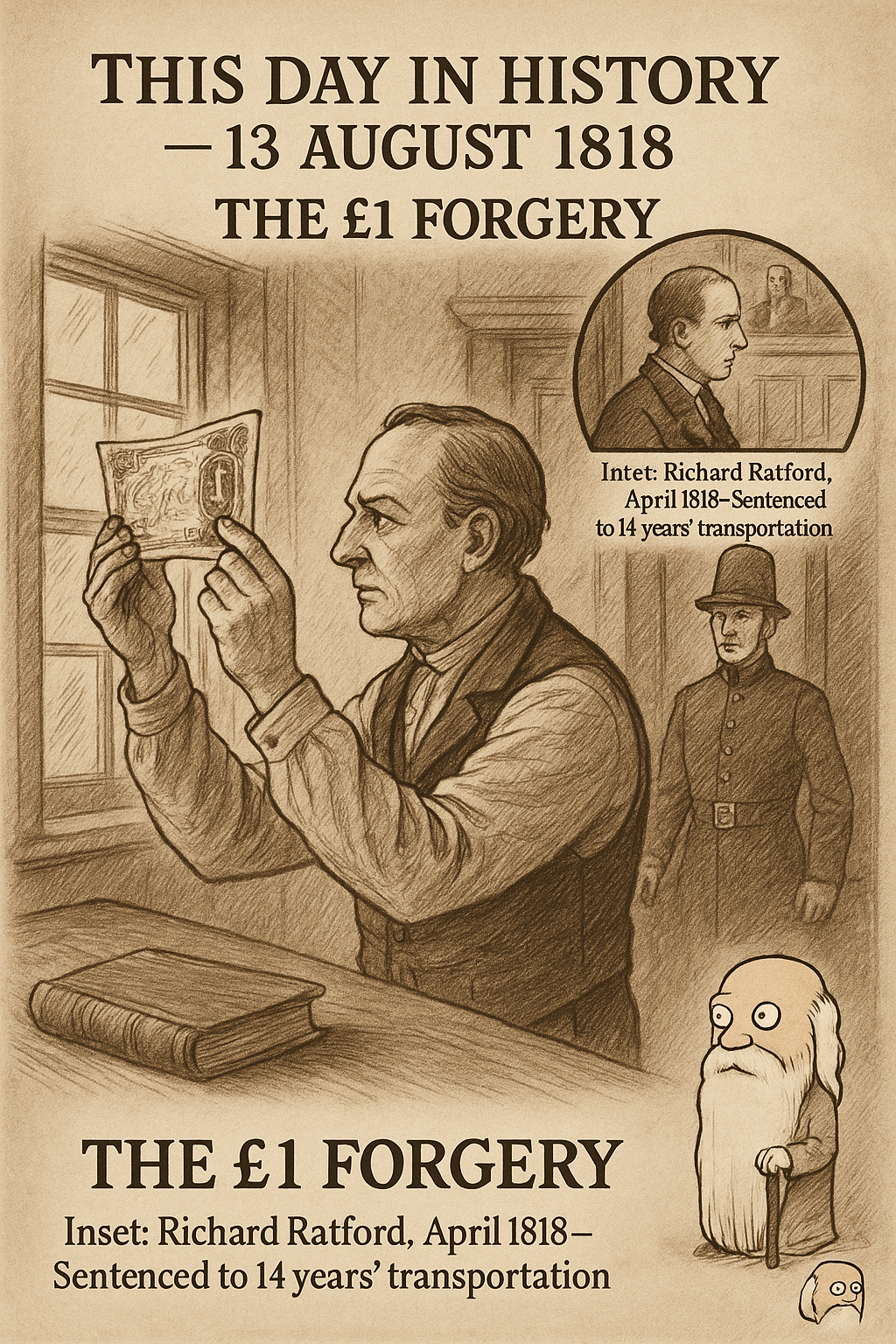
This Day in History – 13 August 1818

The One-Pound Forgery

A small note, a sharp eye, and a charge that could cost a life.

On 13 August 1818, a £1 Bank of England note (serial No. 75,121) dated that day was passed in payment. To the casual observer, it was simply currency. But to the trained eye of a London tradesman, it was suspicious—and later confirmed as forged. That single banknote became the centrepiece of a prosecution for uttering a forged banknote (passing a note knowing it to be false).

By the time the case reached the Old Bailey on 28 October 1818, the accused faced the full force of the law. In early 19th-century England, uttering forged notes was a capital offence. While juries were sometimes reluctant to convict when the gallows loomed, the courts treated such crimes as a threat to the very stability of the nation’s currency.

The name of the August 13 passer is lost to the shorthand Proceedings, but the crime itself is a textbook example of how a trivial purchase could spiral into a felony trial. In this era, even a single forged £1 note could lead to execution—though many sentences were commuted to transportation (forced exile, often for life) or long terms of imprisonment.


The Law in 1818

  • Forgery and uttering banknotes were punishable by death until reforms in the 1830s.
  • The Abolition of Punishment of Death Act 1832 first removed the death penalty for many forgery offences, but not all.
  • The Forgery Act 1837 finally abolished the death penalty for all forgery crimes, replacing it with transportation or imprisonment.

An Exemplary Case – Richard Ratford

While the August 13 case leaves the accused unnamed, another 1818 trial shows exactly how these prosecutions played out.

On 1 April 1818, Richard Ratford stood in the dock at the Old Bailey, charged with possessing and uttering forged Bank of England notes—then known as “coining” in the paper-money sense. The evidence was clear, and Ratford pleaded guilty.

The verdict was swift: guilty. The sentence: 14 years’ transportation to New South Wales. While harsh, this spared him the gallows—a fate many in his position faced. Ratford’s life from that moment was effectively erased from England’s story; he became another name in the long ledger of those shipped to the penal colonies.


Why These Cases Matter

  • Currency stability: In an economy built on paper money, trust in the note was paramount.
  • Severe deterrence: The law punished financial crime more harshly than some violent offences, reflecting deep anxiety about counterfeiting.
  • Human stories: Behind each case lay lives uprooted—by execution, by exile, or by the slow erasure of imprisonment.

Thank you for reading my writings. If you’d like to, you can buy me a coffee for just £1 and I will think of you while writing my next post! Just hit the link below…. (thanks in advance)

Quote of the Day: Lost and Found

“If you can’t find yourself, try looking under the sofa cushions. That’s where most things turn up.”
— Eric Shinn


About the Quote & Eric Shinn

Eric Shinn, noted for his ability to turn everyday objects into life lessons, has once again bridged the gap between the profound and the profoundly ridiculous. Known to spend entire afternoons searching for a missing pen before discovering it behind his ear, Shinn’s wisdom is rooted in the relatable absurdities of daily life.

In this latest musing, he invites us to consider that the answers we seek may not be in distant, exotic locations or buried in ancient tomes, but in the mundane spaces we ignore — like under the sofa cushions. It’s a reminder that sometimes the treasure we’re after is just a biscuit crumb and a forgotten remote control away.

For The Sage Page reader, the message is twofold: don’t take yourself too seriously, and never underestimate the dustier corners of your existence. Whether you’re searching for keys, your sense of direction, or the meaning of life, a quick peek under the cushions might surprise you — though it may also cost you in loose change.


Thank you for reading my writings. If you’d like to, you can buy me a coffee for just £1 and I will think of you while writing my next post! Just hit the link below…. (thanks in advance)

This Day in History – 12 August 1839

A Clerk’s Fall: Embezzlement and Transportation

On this day in 1839, the Central Criminal Court (Old Bailey) heard a run of theft and fraud cases. Among them was Henry Jarman, charged with embezzlement. Jarman pleaded guilty and was sentenced to transportation—banishment overseas, the standard Victorian remedy for non-violent but serious dishonesty. oldbaileyonline.org

Transportation didn’t just mean a long voyage; it meant years of compulsory labor in a penal colony, separation from family, and a permanent mark against one’s name. For a clerk, it was social extinction as well as legal punishment.

Accusation:
Henry Jarman was indicted for embezzling 7 shillings and 3 pence, received on behalf of Octavius Cox, for whom he was acting as a clerk or agent. The funds were entrusted to him in his official capacity—making the offence one of breach of trust / clerical fraud.

Charge Type & Context:
This wasn’t simple theft—it involved violating the trust of an employer, a serious crime in Victorian England. Clerks manipulated ledgers and funds daily; fraud from that office could disrupt livelihoods and betray confidence.

Sentence:
Jarman pleaded guilty. Although the precise sentence wasn’t spelled out in the snippet, individuals in his position often received transportation—up to 14 years—to colonies like Australia, especially after admitting guilt. Considering the mercy often granted to first-time offenders, this was a severe but not unusual outcome.


Why This Case Matters

  • Clerical betrayal: In a world increasingly dependent on paper accounting, a clerk’s dishonesty was both damaging and symbolically potent.
  • Embezzlement vs. theft: Unlike smash-and-grab thieves, Jarman exploited his position—raising deeper concerns about institutional trust and reliability.
  • Mercy and displacement: The plea of guilty likely spared him the death penalty. Yet, transportation would banish him from Britain permanently—a fate of social exile.

Also on the 12 August 1839 docket

  • William Boyce & William White – tried that day (case record t18390812-2151).
  • William Garland – simple larceny.
  • Harriet Lewis – simple larceny.
  • Thomas Digger – pocket-picking.

(The 12 August 1839 session page itself is here.) oldbaileyonline.org


Thank you for reading my writings. If you’d like to, you can buy me a coffee for just £1 and I will think of you while writing my next post! Just hit the link below…. (thanks in advance)


Advice of the Day: Mirror ID

Advice: “When asked for ID, show them a mirror and say, ‘This is me.’”

There’s something undeniably efficient about bypassing paperwork in favour of a visual demonstration. The Sage recommends the mirror method for its sheer simplicity: no plastic cards to lose, no signatures to forge — just you, your face, and a portable reflective truth machine.

While traditional authorities may frown upon this approach, it offers a philosophical statement as well as a practical one. “What better proof of existence than one’s own reflection?” asks The Sage, moments before being politely escorted from the premises. It’s ID that never expires, never needs renewal, and works equally well for humans and particularly vain cats.

However, this advice does come with a caution: be prepared for follow-up questions such as “Do you have anything with your address on it?” Mirrors, sadly, are less helpful there — unless you’ve written your postcode across your forehead in marker pen.


Thank you for reading my writings. If you’d like to, you can buy me a coffee for just £1 and I will think of you while writing my next post! Just hit the link below…. (thanks in advance)

Thought of the Day: The Pyjama Profession

Thought: “They say dress for the job you want. I want a job where pyjamas are the uniform.”


Explaining the Thought

Some people dream of corner offices, flashy suits, and power lunches. Others, like The Sage, dream of elastic waistbands, flannel comfort, and the gentle rustle of fleece in the midday breeze. The pyjama profession is not for everyone, but for those who’ve tasted its soft embrace, there’s no going back.

The Sage knows that the modern working world can be a little too focused on appearance — and not enough on comfort. Remote work has given many a tantalising glimpse of the utopia where your top half might be business, but your lower half is strictly bedtime attire. Why fight the urge to be cosy when the Wi-Fi signal reaches the sofa?

In truth, dressing for the job you want is less about clothes and more about designing a life that suits you. For The Sage, that life just happens to include a mug of cocoa, an old dressing gown, and the occasional Zoom call that ends with someone asking, “Are those slippers?”


Thank you for reading my writings. If you’d like to, you can buy me a coffee for just £1 and I will think of you while writing my next post! Just hit the link below…. (thanks in advance)

Quote of the Day: Humility’s Horizon

“True humility is not in shrinking from greatness—it’s in recognizing how much there still is to rise to.”
— Eric Shinn


About the Quote & Eric Shinn

Eric Shinn writes with quiet insight into the human condition. Raised in thoughtful surroundings that prized curiosity over accolades, Shinn pursued philosophical studies with an emphasis on self-awareness and inner expansion. His writing—delivered in lectures, essays, and conversations—is marked by clarity and a refreshing resistance to grandiosity.

In this quote, Shinn reframes humility not as modesty or retreat, but as a recognition of the unending journey. Rather than diminishing our achievements, humility becomes the lens through which we perceive what lies ahead—the uncharted territory of growth, wisdom, and empathy that still awaits.

For readers of The Sage Page, these words encourage us to view each milestone as a vantage point, not a finish line. Embracing humility in this way keeps our spirit open, vibrant, and ever ready for what’s next.

Thank you for reading my writings. If you’d like to, you can buy me a coffee for just £1 and I will think of you while writing my next post! Just hit the link below…. (thanks in advance)

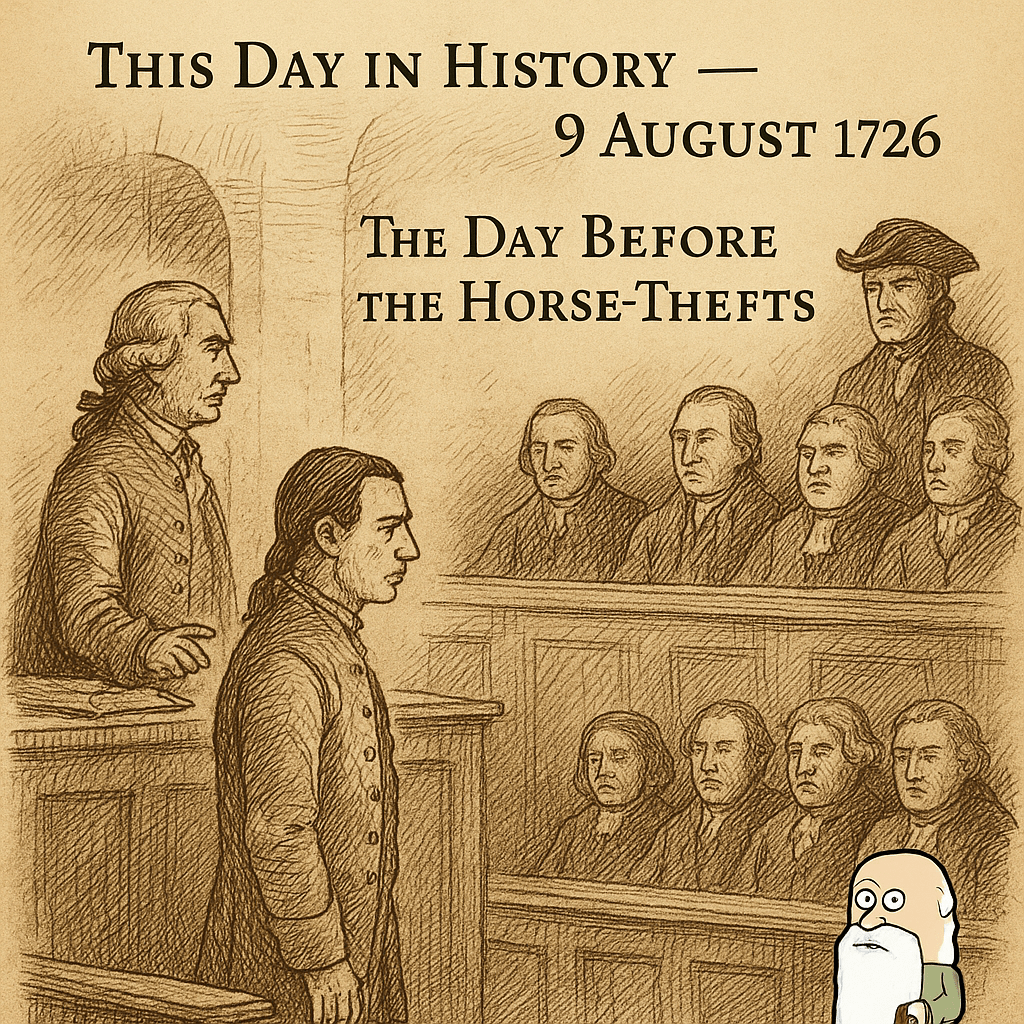
This Day in History — 9 August 1726

The Day Before the Horse-Thefts

An alias in the alehouse. A bay gelding in his eye. Tomorrow, trouble.

London, 9 August 1726.
In a smoky alehouse off Smithfield, a man who calls himself George Prentice — or Johnson, depending who asks — studies the comings and goings of horse-dealers and hostlers. He drinks little, listens much. Tomorrow will be market day of a different sort.

On 10 August, according to the later indictment, a bay gelding belonging to John Street will be taken; and in a second count, a grey gelding belonging to Robert Hanson will change hands for a hasty £15. Those are the facts the Old Bailey will print at month’s end; tonight is the quiet before the paper trail begins.

When the court eventually sits, the clerk will read:

“George Prentice, alias Johnson, indicted for stealing a bay gelding, value 10 l., the goods of John Street… and again indicted for a grey gelding, value 10 l., the goods of Robert Hanson; 10th of August.”

Witnesses swear to ownership and to dealings “on the 10th of August… the price was £15”; the alias is noted; the pattern is clear.


⚖️ The Trial at the Old Bailey

Date: Late August 1726
Location: Court of the Old Bailey, London

The prosecution’s case is straightforward.

  • John Street testifies that his bay gelding was secure until the night of the 9th–10th. By dawn, the horse and Prentice were both gone.
  • Robert Hanson recounts how, on the 10th, Prentice approached him with the grey gelding, pressing for a quick sale. The price — £15 — was tempting, but the circumstances were odd.
  • Both men identify Prentice in court, and their certainty is unshaken.

Prentice’s defence is weak: he claims confusion over ownership, offering no receipts or credible witnesses to support his story. The jury is unimpressed.

The foreman’s verdict comes quickly:

Guilty on both counts.


⛓️ The Sentence

Horse theft in 1726 is a capital offence — the gallows at Tyburn are the usual end for such convictions. The court sentences George Prentice, alias Johnson, to death by hanging.

Whether he was eventually executed or had his sentence commuted is not recorded in the surviving proceedings, but the public nature of such cases meant his conviction would have been widely known — a warning to other would-be horse thieves.


📜 Why It Matters

Public Example: Such trials were printed in the Old Bailey Proceedings and read aloud in alehouses, ensuring the lesson spread far beyond the dock.

Harsh Deterrents: The Prentice case shows the severity of Georgian justice — horses were vital for transport, farming, and trade, so their theft was treated on par with murder in some instances.

Market Vulnerabilities: Smithfield and other horse markets were bustling, poorly policed spaces, ideal for sharp operators.

Alias Culture: The use of “alias” in indictments reflects how criminals often adopted multiple identities to confuse victims and authorities.


Thank you for reading my writings. If you’d like to, you can buy me a coffee for just £1 and I will think of you while writing my next post! Just hit the link below…. (thanks in advance)
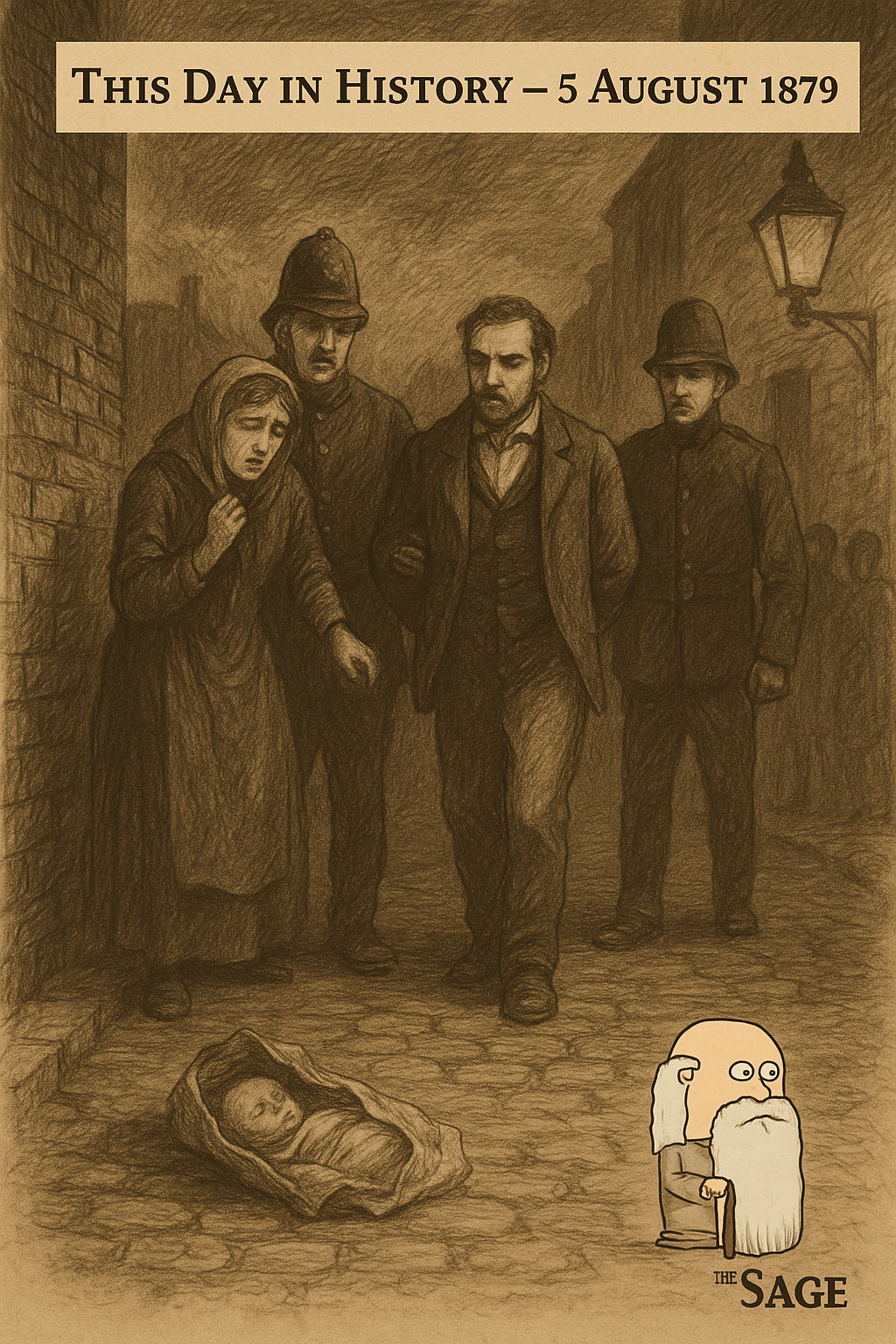
This Day in History – 5 August 1879

James Dilley & Mary Rainbow: A Mother’s Secret and a Child’s Fate

An infant killed. A hidden birth. A hush in the streets.


👶 The Case Unfolds

On 5 August 1879, both James Dilley, a 41-year-old labourer, and Mary Rainbow, 28, were tried together at the Old Bailey for the wilful murder of Mary’s own newborn daughter—a child unborn, unnamed, and dead before it could be named. The baby was discovered in a parcel inside Clapton, its life extinguished almost before it began.

A routine walk by a labourer revealed the body, wrapped in brown paper, beside a wall. Suspicion quickly fell on Rainbow, whose evidence revealed a concealed birth and deep secrecy.

Both were indicted for infanticide, a crime carrying the same punishment as murder in Victorian England.


⚖️ In Court

  • Mary Rainbow: The child’s mother, who claimed the baby’s sudden death during transit home and concealed the body out of desperation.
  • James Dilley: Identified as the father—married to another woman and aware, according to witness accounts, of the pregnancy.

The Old Bailey records note a brutal outcome: despite Rainbow’s plea for forgiveness and Dilley’s denials of involvement, the jury returned “Guilty” verdicts for both.


🪓 Sentence

The sentence was carried out with chilling clarity:

Condemned to death.

Both Rainbow and Dilley were sentenced to hang—though the final outcome for Rainbow remains unclear in the archives, Dilley’s records confirm the sentence sought to be carried out.


🔎 Why This Case Matters

  • Infanticide trials were rare but deeply charged—with strong public emotion surrounding motherhood, sexual morality, and social neglect.
  • Mary Rainbow’s baby was never named, and the child’s concealment reflected the pressure and stigma faced by unmarried mothers.
  • The joint trial emphasized both how Victorian society handled illegitimacy and its harsh legal penalties—even in cases of extreme secrecy and social shame.

Thank you for reading my writings. If you’d like to, you can buy me a coffee for just £1 and I will think of you while writing my next post! Just hit the link below…. (thanks in advance)

Quote of the Day: Lost at sea?

“I’m never lost at sea. It’s the shore that doesn’t know where to find me.”
— Noah Clooney


About the Quote & Noah Clooney

Born on August 7, 1955, in a coastal town in Maine, Noah Clooney is a distinguished maritime philosopher and former U.S. Navy navigator. He studied at the United States Naval Academy, where he blended navigation with philosophical inquiry. After years at sea, he authored works such as Sailing the Soul: Navigating Life’s Seas, exploring the parallels between ocean voyages and life’s journey.

Today’s quote reflects his unique perspective: Noah insists he’s not lost at sea—rather, it’s the shore that loses track of him. This subtle reversal highlights his belief that feeling “lost” is often about how we frame our experience. For a man who spent his life steering through real and metaphorical waters, it’s a reminder that our sense of direction is sometimes more about mindset than geography.


Thank you for reading my writings. If you’d like to, you can buy me a coffee for just £1 and I will think of you while writing my next post! Just hit the link below…. (thanks in advance)
Thought of the Day: Sofa with a Passport

“In a world where your sofa needs a passport, I can’t wait to see its holiday photos.”

The EU is rolling out digital product passports (DPPs) to provide detailed, transparent data about a product’s materials, repairs and lifecycle intereconomics.eu. They’re designed to help consumers and businesses make greener choices—but they also invite some amusing mental images.

Today The Sage muses: if every kettle, chair and toaster needs its own passport, will our sofas start collecting more stamps than we do? In his mind’s eye, he sees a sofa in sunglasses, queuing at customs while a stern official stamps its travel document. It’s a gentle poke at the growing bureaucracy around everyday objects and a reminder that there’s always humour in the fine print.

Behind the joke is a real trend: digital product passports are meant to support the circular economy by tracking and sharing product data across a product’s life. So next time you read about DPPs, spare a thought for your armchair’s holiday photos.

Thank you for reading my writings. If you’d like to, you can buy me a coffee for just £1 and I will think of you while writing my next post! Just hit the link below…. (thanks in advance)