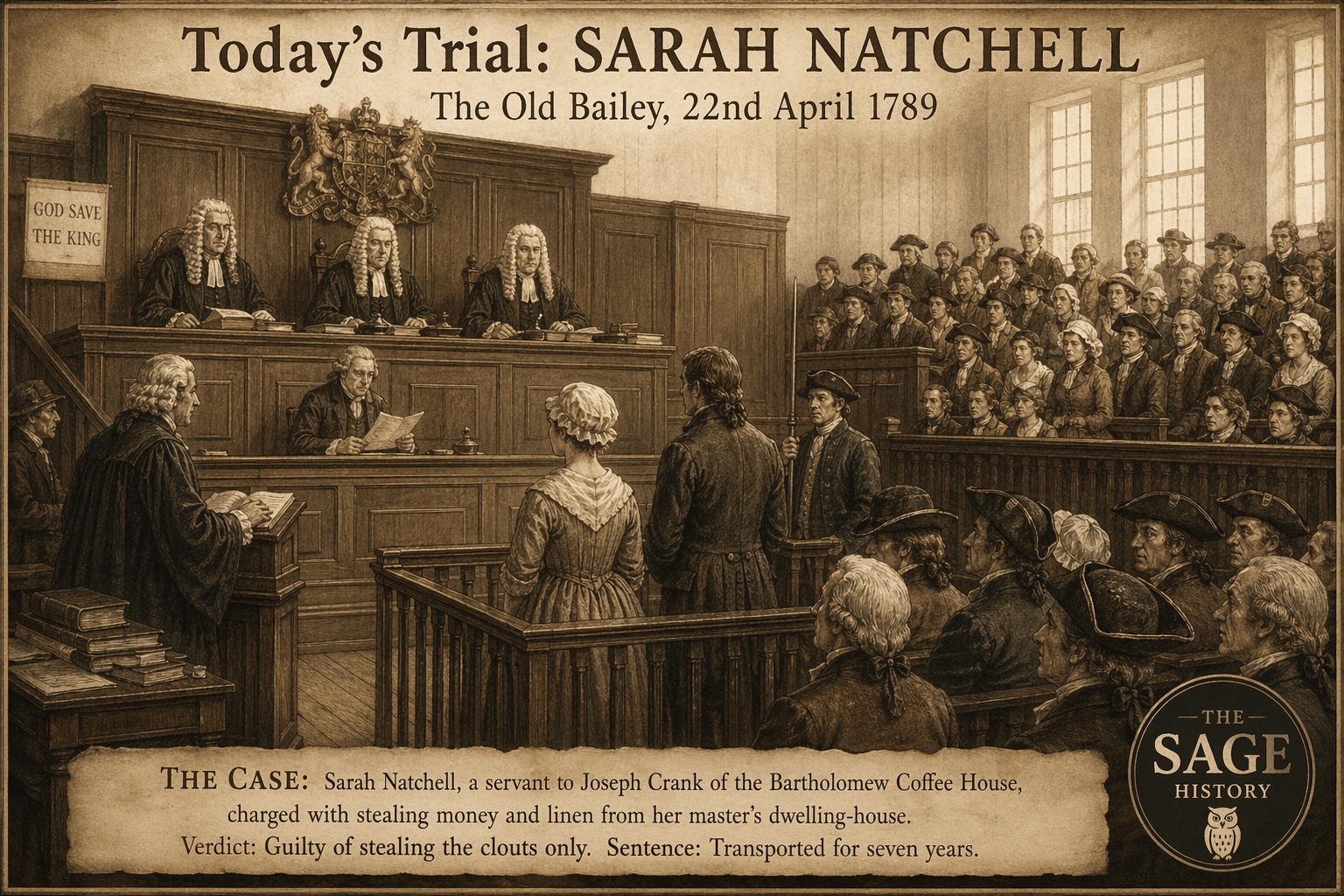
Sarah Natchell and the Missing Fortune at Bartholomew Coffee House
In April 1789, the Old Bailey heard the case of Sarah Natchell, a young servant accused of stealing money and household goods from her employer, Joseph Crank, proprietor of the Bartholomew Coffee House in West Smithfield. What began as a suspicious “break-in” soon unravelled into a tale of deception, hidden gold, midnight coach rides, and a servant whose sudden illness raised more suspicion than sympathy.
Though the prosecution alleged she had stolen over £45 in cash, gold coins, silver, and household linen, the jury ultimately convicted her only of stealing several marked tea-cloths—known in the trial as “clouts.” Even so, because she had stolen from her master’s household while in service, the punishment was severe: seven years’ transportation beyond the seas, eventually to New South Wales aboard the Lady Juliana.
The Coffee House Theft
Joseph Crank ran the busy Bartholomew Coffee House in West Smithfield, a respectable establishment where money regularly passed through the bar and till. Sarah Natchell had been employed there as a servant for only about a month.
On the night of 13 March 1789, she went to bed before her employers. Mr. Crank, preparing to retire shortly after midnight, noticed something odd: light still showed through the dining-room window. His wife, Jane, went downstairs and found one of the windows open. She shut and fastened it, and the couple went to bed.
At around half past six the next morning, Sarah came hammering violently at the door, announcing that the house had been broken into.
She claimed:
“The house was broke open… the dining-room window was open, and there were thieves in the house.”
Mr. Crank rushed downstairs and found the bar disturbed. The till lay on the floor. A bowl used for silver and gold coins had been overturned. Bills and papers were scattered everywhere. Yet strangely, some large sums of money remained untouched—£70 stored elsewhere in the bar and another substantial quantity left on a shelf.
What was missing, however, was significant: 22½ guineas in gold, £20 14s 6d in silver, £1 5s in halfpence, and several household cloths and linens.
It did not look like the work of ordinary thieves.
Suspicion Falls on Sally
At first, Crank hesitated to accuse Sarah. But her behaviour over the following days made him uneasy.
She asked to go out unusually often, stayed out late, and on one occasion returned near eleven at night after the city’s illumination celebrations. Soon afterward, she complained she was ill and took to her bed, saying:
“The town did not agree with her.”
Then, quite suddenly, she announced she would leave and “go into the country.”
She called a coach herself, loaded up a trunk and hat-box, and departed.
Crank followed the coach.
It first stopped in James Street, Bedford Row, where a footman came to the coach several times. Then she was driven to the Dolphin public house in Red Lion Street, Holborn.
This was enough. Crank now believed the “burglary” had never happened at all.
Drunk in Bed at the Dolphin
The landlady of the Dolphin, Helen Parry, gave evidence that Sarah had first visited days earlier, ordering repeated servings of brandy and water, cakes, and oranges, and asking for needle, thread, and twine while secretly making up parcels.
Later she returned in a hackney coach carrying boxes.
She asked to leave them there and summoned a gentleman’s servant to meet her privately. Afterward, a porter arrived and moved the luggage elsewhere.
By now the police were involved.
On 21 March, officer Charles Jealous arrested Sarah at a house in Little James Street, Oxford Road, where she was dining comfortably with another woman and two soldiers.
In her pocket, tied inside a silk handkerchief, he found:
- 17 guineas
- 8 half-guineas
- £2 9s 6d in silver
Further searches uncovered more money, new silver teaspoons, stockings, an umbrella, and—most importantly—ten tea-cloths belonging to Mrs. Crank, identifiable by a special iron mark she herself had made.
The supposed robbery had not gone very far.
Her Defence
Sarah did not deny possessing the goods, but she offered a dramatic explanation.
She claimed the money had not been stolen at all. Instead, she said it had been given to her by her “young master,” Lieutenant Richard Morgan, who had supposedly fathered her child before leaving for Bengal with his regiment. According to Sarah, the money was intended to maintain the child.
As for the cloths, she insisted they were hers and that she had even promised some to a friend, Sarah Brown, who testified she had indeed seen bits of cloth in Sarah’s box.
Several character witnesses described her as previously respectable and hardworking.
But the court was unconvinced.
Even if the greater theft could not be fully proved, the marked tea-cloths were enough.
The Verdict
The jury delivered a compromise verdict:
Guilty — of stealing the clouts only.
She escaped the gallows, but the Recorder made clear that servants who betrayed household trust were considered especially dangerous.
He told her:
“The offence of a servant breaking that trust reposed in them, is so dangerous to the peace and security of individuals, that it is the rule of the Court to treat it with the utmost rigour of the law.”
Sentence followed:
Transported for Seven Years
Sarah Natchell was sentenced to be:
“Transported beyond the seas for the term of seven years.”
Records later show her destination as:
Colony: New South Wales
Ship: Lady Juliana
The Lady Juliana would become famous as one of the first convict transport ships carrying women to Australia.
For a servant who claimed she merely wanted to leave London because “the town did not agree with her,” she ended up going rather farther than expected.
Why This Case Matters
The case of Sarah Natchell shows how Georgian courts treated servant theft with particular seriousness. A burglary by a stranger was one thing; betrayal from inside the household was another entirely.
It also reveals how suspicious behaviour—late nights, secret meetings, sudden illness, and hurried departures—could prove as damaging as direct evidence.
Though the jury spared her from conviction on the full theft of over £45, the marked tea-cloths were enough to change her life forever.
In eighteenth-century London, stealing your master’s linens could send you to the other side of the world.
Thank you for reading my writings. If you’d like to, you can buy me a coffee for just £1 and I will think of you while writing my next post! Just hit the link below…. (thanks in advance)

 The Sage Page