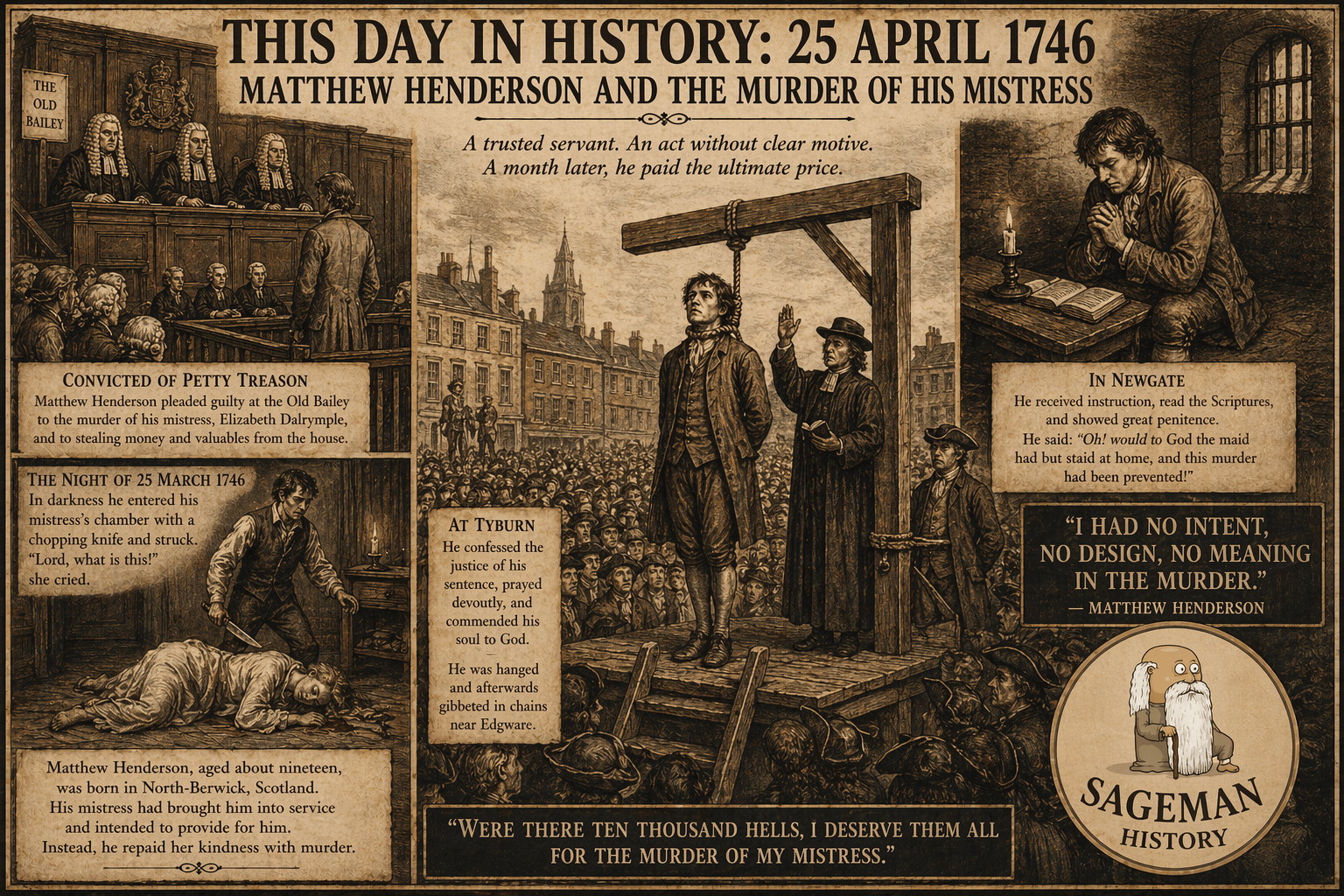
Matthew Henderson and the Murder of His Mistress
On 25 April 1746, nineteen-year-old Matthew Henderson was hanged for one of the most baffling domestic murders of the eighteenth century.
He had not killed an enemy, nor a cruel employer, nor a stranger in a drunken quarrel. He murdered the very woman who had helped his poor Scottish family, brought him into her household, and intended to provide for his future.
Even Henderson himself struggled to explain why he had done it.
His repeated answer was simple and chilling:
“I had no intent, no design, no meaning in the murder.”
A Servant Raised by Kindness
Matthew Henderson was born in North Berwick, East Lothian, in Scotland, around 1727.
His father was poor and had several children to support, while his mother took in nurse-children to help the family survive. One of those children happened to be the niece of Elizabeth Dalrymple.
Through visiting her niece, Mrs Dalrymple came to know the Henderson family and took a liking to young Matthew, who appeared well-behaved and respectable. She resolved that when he was old enough, she would bring him into service and, if he proved trustworthy, help establish him in life.
For five years he served the Dalrymple household.
By all accounts, he was quiet, capable, and not known for vice. He insisted he was not a drunkard, not a gambler, and not given to bad company.
Which made what happened next almost impossible to understand.
The Night of the Murder
On 25 March 1746, the household maid was absent from the house.
Henderson later said this absence mattered greatly.
That night, while preparing for bed, he suddenly remembered there was a chopping knife downstairs in the kitchen.
He went down and picked it up.
At first, he claimed, he did not know what he meant to do with it. But standing there with the knife in his hand, he began thinking of his mistress.
He walked upstairs to her bedchamber.
He admitted he hesitated. He felt fear. He stood still for a moment.
Then, as he later described it, “the temptation growing upon him” overcame him.
Entering in darkness, he struck.
His first blow missed.
The next reached her.
Elizabeth Dalrymple cried out:
“Lord, what is this!”
He struck again and left her bleeding to death on the floor.
After the Killing
After leaving his mistress dying, Henderson returned to his own bed and threw himself upon it, horrified by what he had done.
He said he kept repeating to himself:
“Lord, I must now be hanged.”
He then took the bloody knife and threw it into the privy.
Only after the murder did he decide to rob the house.
He stole money and valuables, later claiming the theft had not been the original motive at all, but something he thought of afterwards in panic and confusion.
The following morning, when the maid returned and discovered blood on the stairs and Mrs Dalrymple’s body upstairs, Henderson helped raise the alarm.
He even offered to be the messenger sent to inform his master, William Dalrymple, who was away at Richmond.
At first suspicion fell elsewhere.
But Henderson’s own behaviour soon betrayed him.
The Confession
When brought before a magistrate, he denied everything.
But under questioning, contradictions appeared, and suspicion quickly hardened into certainty.
Eventually he made a full confession.
He pleaded guilty both to the murder and to stealing from the house.
He was charged not simply with murder, but with petty treason—the killing of a mistress by her servant, considered a particularly grave betrayal of social and moral order.
This was seen as more than homicide.
It was treachery.
Why Did He Do It?
This was the question that obsessed everyone.
Even the Ordinary of Newgate seemed unable to believe there was no clear motive.
Had Mrs Dalrymple mistreated him?
No.
Had she denied him wages?
Not exactly.
Had he planned robbery first?
He insisted no.
Eventually Henderson revealed one incident.
A week before the murder, while curling his master’s hair, he accidentally stepped on Mrs Dalrymple’s toes. She later rebuked him sharply, struck him on the head, and threatened to dismiss him.
He replied angrily:
“You shall not turn me away, for I will go of my own accord.”
Yet he repeatedly swore this was not revenge.
Only when he stood with the knife in his hand did the memory suddenly return to him, and, he said, it strengthened the terrible temptation.
He also spoke of violent mood swings—periods of excessive excitement followed by deep gloom and withdrawal. He wondered if he had inherited some form of madness from an aunt known to lose her senses.
Many believed the crime was the result of a sudden frenzy rather than cold calculation.
But the law made little distinction.
Sentence of Death
Henderson was convicted and sentenced to die.
He showed no attempt to escape responsibility.
When someone suggested he should not plead guilty, he refused:
“What, have I not committed a crime great enough already, without adding to it a lie?”
He spent his final weeks in Newgate in prayer, attended by Anglican clergy and dissenting ministers alike.
Though still very young—and already married—he showed what witnesses described as sincere penitence.
His wife visited him daily.
He repeatedly returned to one thought:
that if the maid had only stayed home that night, the murder might never have happened.
She would have locked herself into the kitchen.
He would never have reached the knife.
Again and again he said:
“Oh! would to God she had but stayed at home.”
Execution Day
On 25 April 1746, exactly one month after the murder, Matthew Henderson was taken to execution.
Crowds gathered in enormous numbers.
As the cart approached Tyburn, it was deliberately routed past his master’s house near Cavendish Square—a final grim reminder of the life he had destroyed.
He refused wine before death, saying:
“It is no time for me to drink.”
At the gallows he prayed devoutly, received the sacrament, confessed the justice of his sentence, and mounted the ladder calmly.
When he was turned off, being light in body, he struggled for some time. His legs were pulled and blows were struck to his chest to hasten death.
Afterwards, his body was carried near Edgware and hung in chains—a gibbeted warning to others.
The Ordinary noted grimly that Henderson had survived his mistress by exactly one month.
Why This Case Still Matters
Matthew Henderson’s crime disturbed people because it seemed to have no satisfying explanation.
He was not a hardened criminal.
He was not abused.
He had been trusted, helped, and treated kindly.
Yet he walked upstairs one night with a kitchen knife and destroyed everything.
The case terrified eighteenth-century readers because it suggested that violence did not always come from greed or hatred.
Sometimes it came from something far less understandable.
A moment.
A temptation.
A thought allowed to grow too long.
And for that, both mistress and servant were dead within a month.
Thank you for reading my writings. If you’d like to, you can buy me a coffee for just £1 and I will think of you while writing my next post! Just hit the link below…. (thanks in advance)


