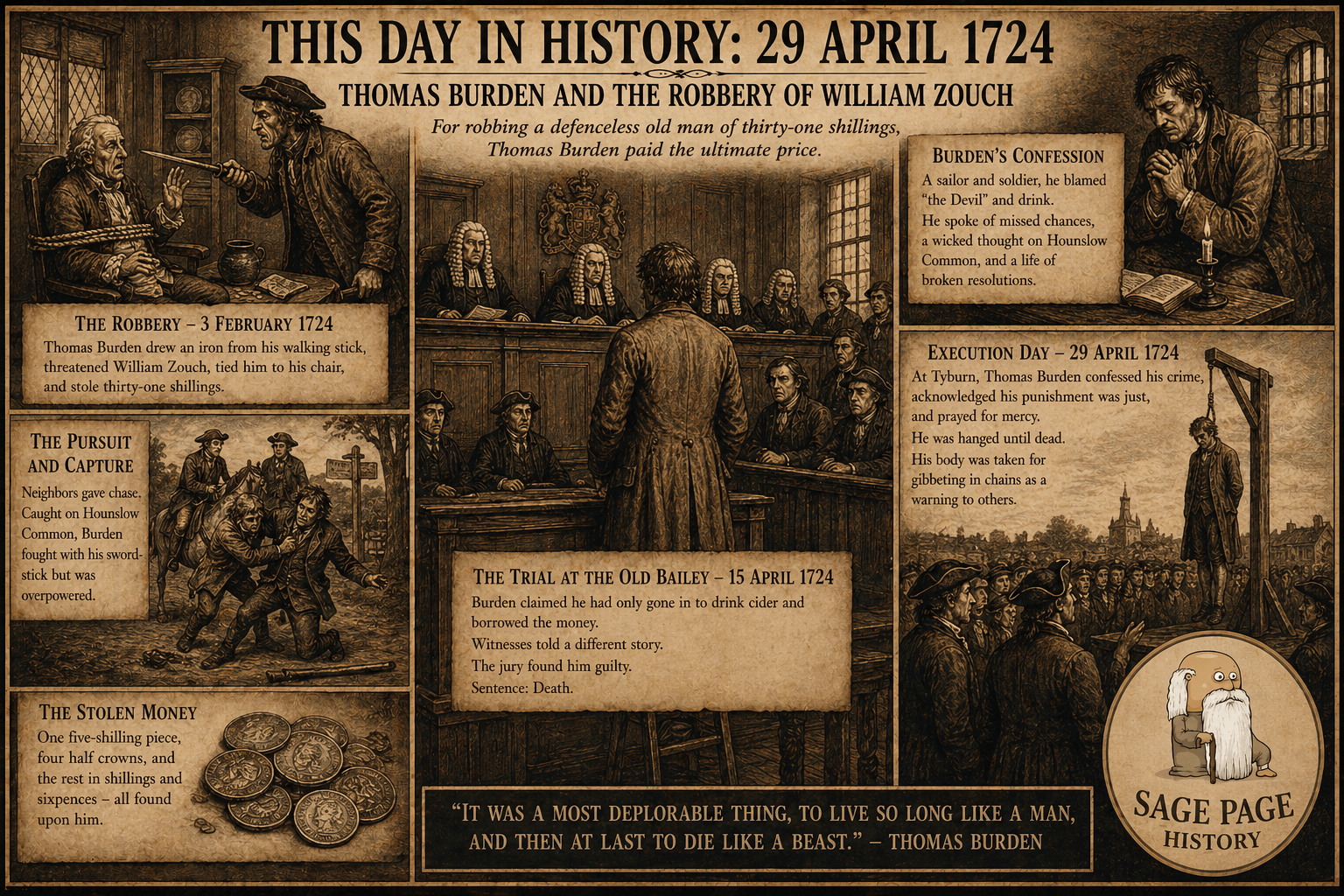
Thomas Burden and the Robbery on Hounslow Common
On 29 April 1724, Thomas Burden faced the final consequence of a crime he himself called the work of “the Devil.” Convicted of violently robbing an elderly man named William Zouch, Burden was executed after a case that mixed highway robbery, failed excuses, and a long, bitter reflection on a wasted life.
Unlike many hardened criminals who appeared before the Old Bailey, Burden was not a young rogue or a repeat offender. He was around fifty years old, a former sailor and soldier who had travelled widely, survived war, and escaped slavery abroad—only to end his life on the gallows for robbing a vulnerable old man in Twickenham.
The Victim: William Zouch
William Zouch was elderly, frail, and lived largely alone in the parish of Twittenham (Twickenham). On 3 February 1724, Thomas Burden entered his home around noon and began forcing conversation upon him, asking whether neighbours often visited.
It soon became clear that Burden had not come for company.
Drawing a concealed iron blade—a “tuck” hidden inside his walking stick—he pressed it against the old man’s chest and demanded money.
Zouch later told the court:
“He presently drew a Tuck out of it, and presented it to my Breast… and threatned me, if I did not immediately tell him where my Money was, he would run me through.”
Terrified, Zouch explained that he was poor, and that the 31 shillings he possessed were all he had—mostly charity given to him in old age.
Burden did not care.
He forced the old man into a chair, cut down a line hanging nearby, and tied him tightly in place before taking the money and leaving him helpless in his own home.
Escape, Pursuit, and Capture
Burden’s criminal career as a robber was not a polished one.
Though he tied Zouch up, he did it badly. The victim managed to free one arm, reach into his pocket for a knife, cut the cord, and escape.
He immediately alerted neighbours.
A local carpenter named Greenbury had seen Burden behaving suspiciously near the house and watched him leave “in a great Hurry.” When Zouch cried that he had been robbed, Greenbury borrowed a passing gentleman’s horse and set off in pursuit.
He soon caught up with Burden.
Fearing the man might be armed with pistols, Greenbury kept some distance until another man, Whittington, joined him. When Greenbury finally grabbed Burden by the collar, Burden again pulled the concealed sword from his walking stick and made several lunges at him.
Greenbury defended himself only with a horse whip, managing to slash Burden across the face.
Eventually Burden realised escape was impossible. He threw down the weapon and surrendered.
Even then, he tried to buy freedom by offering back the stolen 31 shillings.
It did not work.
The Trial at the Old Bailey
At the Old Bailey on 15 April 1724, the evidence was overwhelming.
William Zouch identified him.
Greenbury described the chase and arrest.
Whittington confirmed the capture.
The stolen money was found on Burden in the exact denominations Zouch described: one five-shilling piece, four half-crowns, and the rest in shillings and sixpences.
Burden’s defence was weak and almost absurd.
He claimed he had merely gone inside to light his pipe and drink “2 or 3 Pints of Cyder,” and that the old man had somehow lent him the money voluntarily.
He even remarked that although Zouch was “an old Man he was but a young Thief.”
The jury was not impressed.
They found him guilty.
Sentence: Death.
A Life of Missed Chances
What makes Burden’s case especially striking is the long account he gave while awaiting execution.
He said he had been born in Dorsetshire and sent to sea while still young. He sailed repeatedly “up the Streights” and into dangerous waters, surviving conflicts with Turks, Africans, and the French.
He claimed that before every battle he prayed sincerely, weeping for his sins and promising God he would change his ways.
But afterward, he said:
“The Devil was so powerful that he tempted me to deviate from my Resolutions.”
He blamed Satan, fate, bad company, and drink—but also himself.
He described being offered a respectable and profitable life in Aleppo, where a gentleman had offered him money and a permanent position if he would stay in Asia.
Instead, he chose the rough life at sea and the company of swearing companions.
Later, after military service in Flanders, he returned to England and worked successfully at his original trade in St Giles.
By his own account, life had been improving.
Then came one unlucky day at Hounslow.
“The Devil Put the Thought in My Mind”
Burden explained that after spending a night drinking with an old military acquaintance—a corporal stationed near Hounslow—he walked across the common the next day and began speaking about old William Zouch, who lived mostly alone.
After drinking heavily, he said:
“The Devil put the wicked Thought in my Mind.”
He decided to rob the old man.
Even in confession, he admitted how clumsy he had been.
He tied the victim badly.
He fled across open common “visible for many Miles together.”
He failed to hide in woods or take safer roads.
He described himself as a man entirely unskilled in villainy.
Yet clumsy or not, the crime was enough to send him to the gallows.
Facing Death
At first, Burden clung desperately to hope for mercy.
Even as an older man with no children and little to lose, he could not let go of life.
Eventually, though, he accepted his fate.
He said:
“It was a most deplorable Thing, to live so long like a Man, and then at last to die like a Beast.”
Before execution, he declared that by suffering in this life he hoped to avoid punishment in the next:
“Having satisfied Justice, and expiated my Crimes with my Blood.”
On 29 April 1724, Thomas Burden was hanged.
After years surviving wars and foreign dangers, he died not by cannon, sword, or slavery—but for robbing thirty-one shillings from an old man in his own kitchen.
Why This Case Matters
Thomas Burden’s story is not simply a robbery case.
It is a study in late regret.
He was not a desperate youth but a man who had survived half a lifetime of hardship, only to ruin himself with one brutal and foolish crime.
The hidden sword-stick, the tied chair, the desperate attempt to bribe his captors, and the long self-justifying confessions all make this a vivid portrait of a man who understood—far too late—that the smallest evil choice can outweigh an entire life.
Sometimes history’s tragedies are not grand conspiracies.
Sometimes they begin with a drink, a bad idea, and an old man sitting alone at home.
Thank you for reading my writings. If you’d like to, you can buy me a coffee for just £1 and I will think of you while writing my next post! Just hit the link below…. (thanks in advance)


