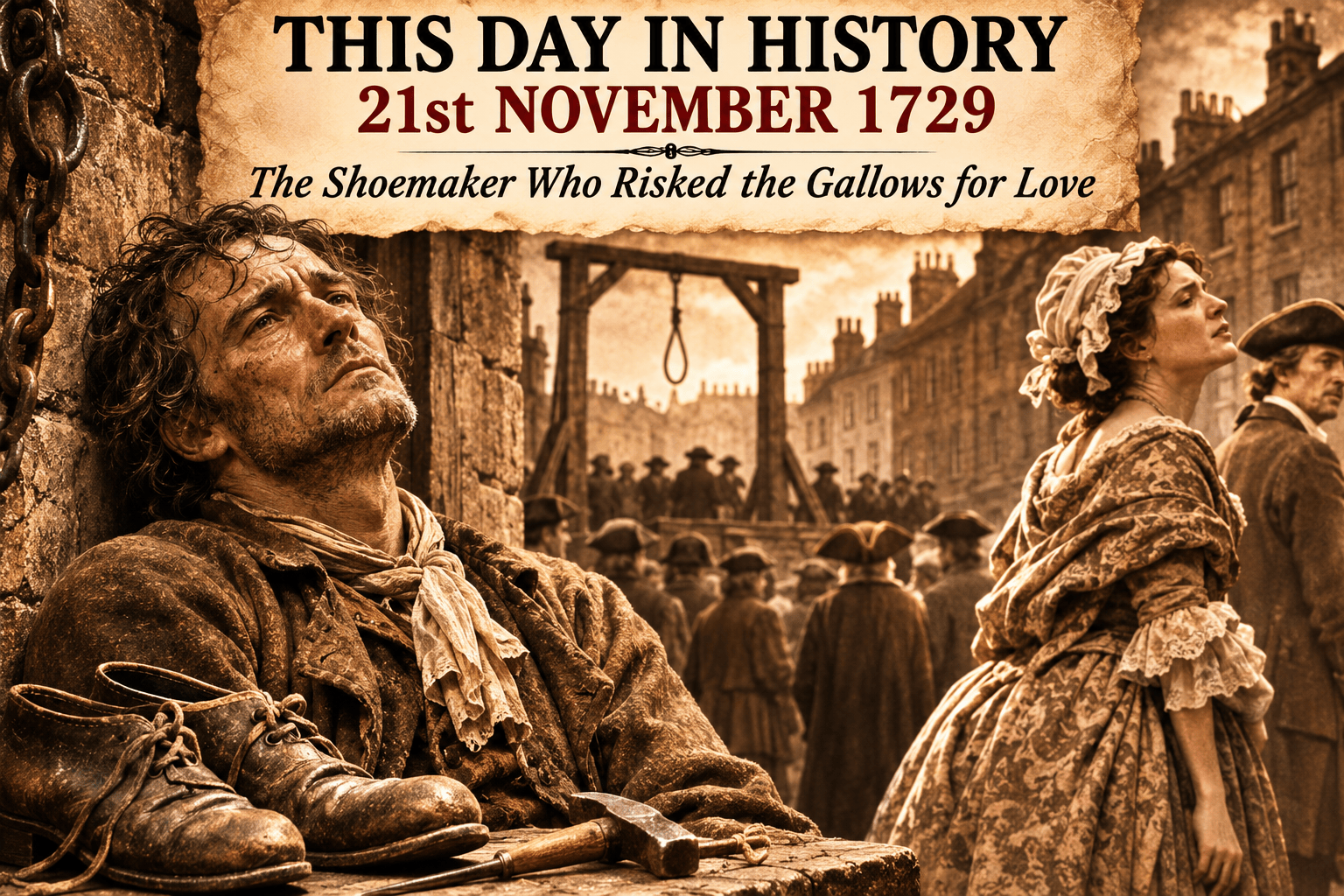
The Shoemaker Who Risked the Gallows for Love
In November 1729, a forty-year-old shoemaker named William Rogers sat under sentence of death in London’s Newgate Prison.
He was not accused of murder. He had not committed a violent robbery, nor had he threatened anyone with a weapon.
His crime was returning to England.
Three years earlier, Rogers had been convicted of stealing shoes from a London shop and sentenced to transportation to America. He had subsequently escaped from his master in Maryland, travelled to Virginia and found employment in his own trade.
By his own account, he was doing rather well.
But there was one thing he could not leave behind.
His wife.
And his determination to see her again would ultimately cost him his life.
Six Shoes and a Journey to America
The story began on 20th December 1725, in a shoemaker’s shop in Wych Street, London.
The shop belonged to William Holmes.
Holmes’s wife was sitting in the kitchen when she noticed a man examining the shoes displayed in the shop.
Suspicious, she got up to investigate.
By the time she reached the shop, the stranger had disappeared.
So had several shoes.
She immediately questioned Rob Swinny, a neighbour’s employee who had been standing outside his master’s premises.
Had he seen anyone passing with shoes?
He had.
A pursuit followed, taking the searchers through the Five Bell Tavern and into the Strand.
There they caught the culprit.
It was William Rogers.
He had one shoe tucked beneath his arm and another five concealed in his lap or clothing.
Six shoes in total — three pairs.
Rogers was brought before the Old Bailey on 14th January 1726, charged with stealing three pairs of shoes from Holmes’s shop.
The jury found him guilty, assessing the value of the stolen property at just ten pence.
The recorded verdict was comparatively straightforward.
The consequences would prove anything but.
From London to Maryland
Rogers was sentenced to transportation for seven years.
Transportation was an increasingly important punishment in eighteenth-century Britain. Rather than keeping offenders in prison for extended periods, the authorities could send them across the Atlantic, where their labour was placed at the disposal of colonial masters.
For Rogers, this meant leaving England, his trade and his wife.
He was sent to Maryland.
According to the account later given to the Ordinary of Newgate, Rogers served his master for a time before running away.
He made his way south to Virginia.
At Williamsburg, he found another master who employed him as a shoemaker.
It was a promising development.
Rogers had served a proper apprenticeship in England and knew his trade. In Virginia, he apparently found himself valued for his skills.
The Ordinary recorded that he received very good encouragement and might have prospered had he remained there.
After years of poor decisions, he appeared to have found a chance to rebuild his life.
But his thoughts remained fixed on England.
The Wife He Could Not Forget
Before his criminal activities began, Rogers had married.
He told the Ordinary that he and his wife had lived together in love and friendship until his transportation separated them.
He had not always been a criminal.
Born to parents of modest means, he had received a basic education and been taught to read, write and understand the Christian faith.
He had completed an apprenticeship as a shoemaker and subsequently supported himself through honest work.
But somewhere along the way, his behaviour had changed.
He began neglecting his business, associating with idle companions and spending time with women whom the Ordinary described as disreputable.
His earnings could no longer support his lifestyle.
Petty theft followed.
Then came the shoes, the conviction and transportation.
Yet despite everything, Rogers insisted that he still loved his wife.
And so, while working in Williamsburg, he made a decision that would destroy the future he had begun to build.
He would return to England.
A Homecoming Punishable by Death
Rogers knew the danger.
Under the law governing transportation, returning to Britain before completing the prescribed period, without lawful permission, was itself a capital offence.
He did not need to steal anything else.
He did not need to commit another robbery.
Simply setting foot in England before the expiry of his seven-year term could place him in jeopardy of execution.
Nevertheless, he made the journey.
The Ordinary later attributed his decision to a longing to be reunited with his wife.
It was an extraordinary gamble.
Rogers had escaped from servitude, found employment and apparently established a reasonable life in Virginia.
But he was willing to risk all of it for the possibility of returning to the woman he had left behind.
Unfortunately, his homecoming was not the reunion he imagined.
The Wife Who Had Moved On
When Rogers returned to England, he discovered that his wife was living with another man.
Worse still, according to Rogers, she refused to see him.
The Ordinary described her as an undutiful and disobedient wife, reflecting both Rogers’s account and the moral expectations of the period.
She would not visit her husband, even when he was facing death.
For Rogers, this was a devastating rejection.
He had abandoned a promising situation in America, crossed the Atlantic and knowingly risked the gallows to see her again.
Now she would not even come near him.
The Ordinary recorded that Rogers blamed his wife for his approaching death.
There is, of course, another side to this story that we cannot recover.
We know nothing of his wife’s circumstances during his absence, what she had been told about his fate, or why she chose to live with another man.
We hear only Rogers’s version, filtered through the prison chaplain.
But whatever the truth of their marriage, Rogers’s return had placed him in mortal danger.
And the authorities had not forgotten him.
Recognised, Convicted and Condemned
On 27th August 1729, William Rogers appeared before the Old Bailey.
The charge was not that he had committed another theft.
It was that, having previously been convicted of a felony and sentenced to transportation, he had returned before completing seven years.
The prosecution needed to establish that he was the same William Rogers who had received the earlier sentence.
That identity was proved.
The jury found him guilty.
The court’s recorded decision was devastatingly brief:
“The Jury found him guilty. Death.”
There was no need to establish that he had committed any new offence against another person.
His unlawful return was sufficient.
The shoemaker who had crossed the Atlantic in the hope of recovering his marriage was now condemned to hang.
The Final Days of William Rogers
By November 1729, Rogers was approximately forty years old.
The Ordinary of Newgate, whose duty included preparing condemned prisoners for death, described him in relatively sympathetic terms.
He was not, the chaplain observed, as desperately wicked as many of the prisoners who passed through Newgate.
Rogers behaved decently while under sentence.
He acknowledged that the law had been broken and accepted that his punishment was lawful, even though the circumstances had brought him considerable personal misery.
He expressed repentance for his offences and declared his Christian faith.
The Ordinary recorded that Rogers believed himself to be at peace with the world.
But one sorrow remained.
The wife for whom he had risked everything had refused to see him while he was alive.
His account ends not with a dramatic confrontation or a last-minute reconciliation, but with a man preparing to die, apparently still convinced that love had led him to destruction.
The Sage’s Reflection
There is something deeply tragic, and almost absurd, about William Rogers’s story.
He began by stealing six shoes.
For that offence, he was transported thousands of miles from home.
Once in America, he escaped from his master and managed to find respectable employment in the very trade he had learned as a young man.
He could have stayed.
He could have worked, earned money and perhaps eventually built a new life.
Instead, he returned to England because he missed his wife.
She had moved on.
And the law condemned him to death for coming back.
We should not overlook Rogers’s own responsibility. He had stolen, absconded from his master and knowingly violated the conditions of his transportation.
Nor can we assume that his wife’s decision to avoid him was necessarily cruel. Her side of the story is missing.
But the punishment remains extraordinary to modern eyes.
A man could survive the Atlantic crossing, escape servitude, rebuild his livelihood and then face the gallows simply because he wanted to go home.
And perhaps the saddest irony is that the woman he returned to see was the one person who would not see him.
Historical Footnote – Returning from Transportation
The Transportation Act of 1718 established a system under which many convicted offenders were sent to Britain’s American colonies for fixed terms, commonly seven or fourteen years.
Returning before the expiry of the sentence, without lawful permission, was a felony punishable by death.
William Rogers’s case illustrates the severity of this legislation. His original conviction concerned the theft of three pairs of shoes, valued by the jury at ten pence. His subsequent capital conviction arose from his unlawful return from transportation, not from a new theft.
Thank you for reading my writings. If you’d like to, you can buy me a coffee for just £1 and I will think of you while writing my next post! Just hit the link below…. (thanks in advance)


