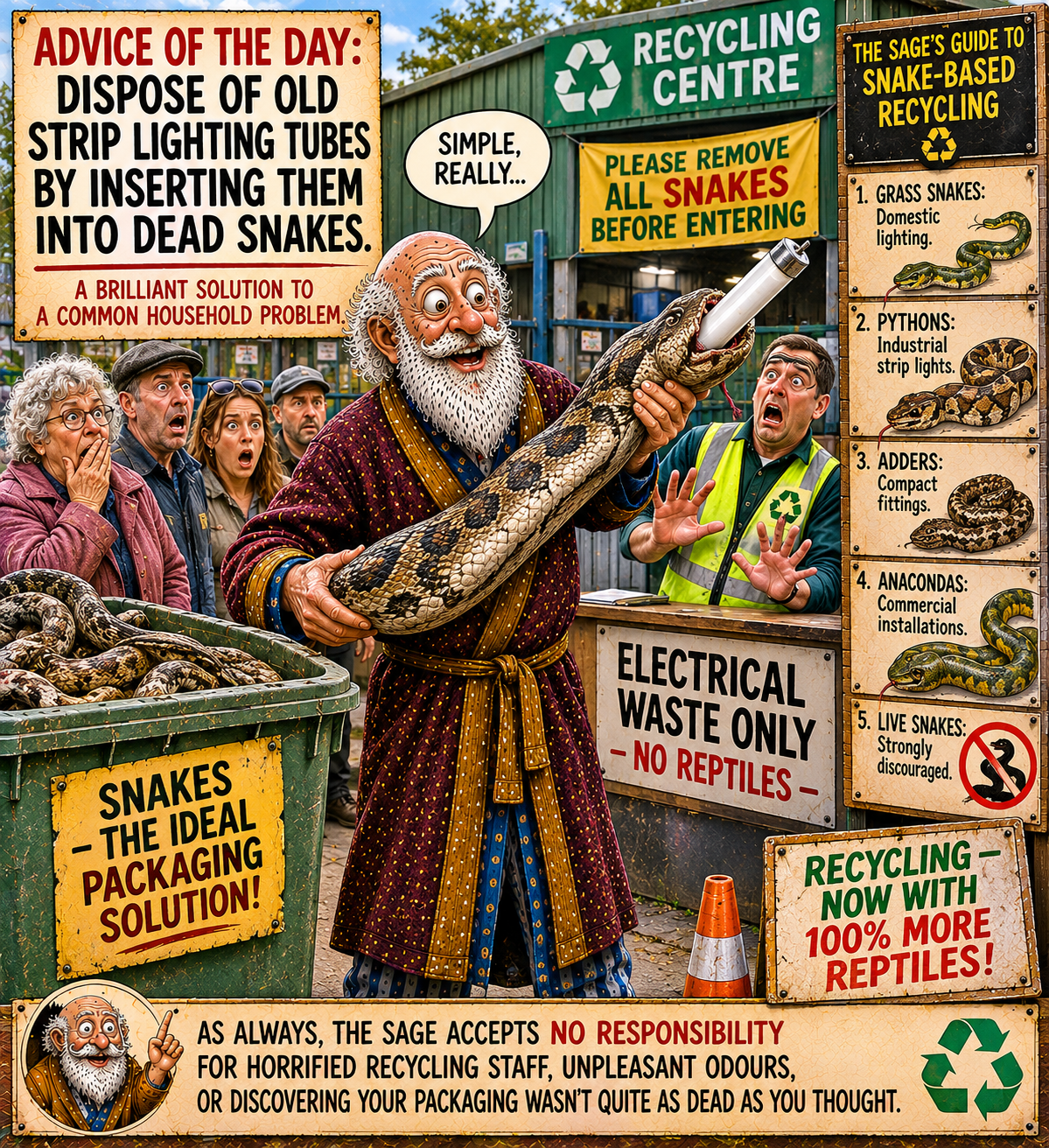
Dispose of old strip lighting tubes by inserting them into dead snakes.
the sage
Disposing of old fluorescent strip lights can be a tiresome business. They’re long, fragile, awkward to carry and generally require a special trip to the recycling centre. Fortunately, The Wise Sage has devised a revolutionary disposal system involving one of nature’s most conveniently shaped creatures: the snake.
The principle is beautifully simple. Instead of struggling with cardboard tubes, bubble wrap and complicated waste disposal regulations, simply locate a deceased snake of approximately the same length as your unwanted light fitting. The snake’s naturally elongated design makes it appear ideally suited to accommodating awkward household objects. Once again, nature has provided a solution to a problem nobody realised it was supposed to solve.
Of course, selecting the correct snake is essential. A grass snake may be suitable for a modest kitchen fitting, while larger fluorescent tubes could require something approaching python dimensions. Attempting to accommodate a six-foot strip light in a deceased adder is likely to prove disappointing for everyone involved, particularly the adder.
The Sage recommends keeping a small selection of snakes in the shed, organised by length and clearly labelled for future reference. This eliminates the frustration of discovering that you’ve finally found a suitable reptile but have already disposed of the light fitting. As with most household maintenance tasks, preparation is everything.
There are additional benefits. Unlike cardboard packaging, a snake provides a distinctive appearance that will certainly attract attention at your local recycling centre. Simply arrive carrying your reptile-encased light tube and announce, “Electrical waste, please.” The resulting silence should give staff ample opportunity to consider their career choices.
Should the recycling attendant object, explain that you’re pioneering a new form of biodegradable electrical packaging. Use phrases such as “sustainable reptilian containment” and “nature-inspired waste management”. These sound sufficiently technical to suggest that somebody, somewhere, has approved the idea.
For advanced practitioners, different species could theoretically be used to identify different types of lighting. Grass snakes for fluorescent tubes, pythons for industrial fittings and slow worms for smaller bulbs, although the latter are technically legless lizards and may object to being included in the scheme.
There are, admittedly, a few practical difficulties. Suitable dead snakes are rarely available in convenient sizes, the resulting package may be considerably less pleasant to handle than anticipated, and your local council is unlikely to recognise reptiles as an approved form of electrical waste packaging.
In reality, fluorescent tubes should be taken intact to an appropriate recycling facility, as they may contain mercury and require specialist handling. Dead wildlife is also best left undisturbed. The Sage acknowledges these minor technicalities but maintains that the idea looks absolutely splendid on paper.
Ultimately, the true genius of this system lies in its simplicity. Why manufacture expensive protective packaging when evolution has spent millions of years producing something almost exactly the right shape?
As always, The Sage accepts no responsibility for horrified recycling attendants, suspicious smells in the garden shed, or being permanently banned from the local reptile society.
Thank you for reading my writings. If you’d like to, you can buy me a coffee for just £1 and I will think of you while writing my next post! Just hit the link below…. (thanks in advance)


