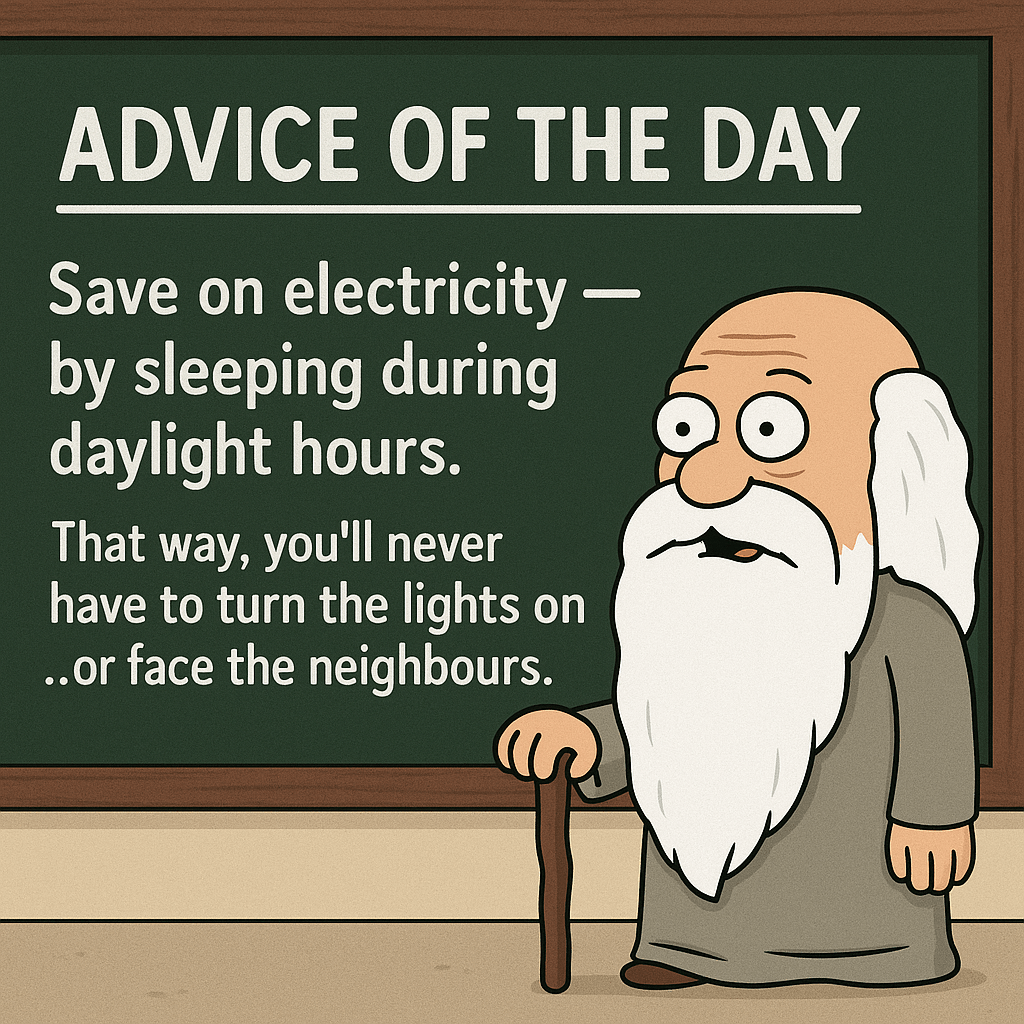
ADVICE OF THE DAY Save on electricity — by sleeping during daylight hours! That way, you’ll never have to turn the lights on… or face the neighbours.
Ever the master of practical nonsense, The Sage today turns his attention to the rising cost of energy. While lesser mortals switch tariffs, install smart meters, or argue with customer service bots, The Sage has discovered a truly revolutionary method: simply rearrange your existence. Sleep through the day like a particularly thrifty owl, and rise at dusk to do your living under the generous glow of street lamps and moonlight — both entirely free!
Of course, there are minor inconveniences. The post office will be shut, the shops will be closed, and your friends may grow suspicious of your new “night-based lifestyle.” But The Sage insists these are small sacrifices on the path to enlightenment (and a smaller electric bill). The real benefit, he notes, is spiritual: “You can’t be distracted by daylight when there isn’t any.”
In the grand tradition of The Sage’s wisdom, today’s advice blends a curious mixture of logic and lunacy — a perfect reminder that the pursuit of thrift often leads one down the dimly lit alleyways of absurdity. Still, as The Sage would say: “A penny saved is a sunrise avoided.”
Thank you for reading my writings. If you’d like to, you can buy me a coffee for just £1 and I will think of you while writing my next post! Just hit the link below…. (thanks in advance)
“Wisdom isn’t knowing the answer — it’s remembering the question long enough to laugh at it.” — The Sage
💬 Explanation
The Sage has never trusted tidy answers. He suspects that most of life’s great truths get ruined the moment someone tries to explain them. Instead, he suggests that true wisdom lies in lingering — in sitting with the question, poking at it, even sharing a chuckle with it. To laugh at the question is to accept that we are, all of us, fumbling our way through mysteries far older and larger than ourselves.
In his view, laughter isn’t a sign of mockery, but of liberation. When we can laugh at our own confusion, we release the grip of pride and expectation. It’s in that relaxed, good-humoured state that understanding often sneaks up on us — not as revelation, but as quiet recognition. The Sage knows that the mind opens best when the heart is light.
So when he tells us to “remember the question long enough to laugh at it,” he’s inviting us to stay curious, patient, and humble. The world’s riddles aren’t puzzles to be solved but companions to be appreciated. Somewhere between a smile and a sigh, The Sage reminds us that wisdom grows not from answers, but from the gentle art of wondering well.
Thank you for reading my writings. If you’d like to, you can buy me a coffee for just £1 and I will think of you while writing my next post! Just hit the link below…. (thanks in advance)
On the cold night of 22 October 1781, London’s taverns were alive with laughter, pipe smoke, and deceit. At the Nag’s Head alehouse, John Tucker drank alongside strangers who, by dawn, would stand as witnesses to his downfall.
By morning, Tucker was under arrest for stealing a silver watch — a theft so ordinary it might have vanished into history, were it not for the sharp memory of a barmaid and the patient handwriting of an Old Bailey clerk.
The theft
According to testimony, Tucker had joined a group of men playing at cards in the back room. One of them, Thomas Reed, took off his coat, laying it across the bench behind him.
Reed: “My watch was in the pocket, sir — safe, as I thought, until the gentleman beside me rose and left the room.”
The “gentleman” was Tucker. Within an hour, Reed’s watch had vanished, and so had Tucker. The landlord sent a boy to follow him down Holborn. When constables finally caught him, he was attempting to sell the watch at a pawnbroker’s, still with Reed’s initials engraved inside.
The trial
At the Old Bailey later that week, Tucker cut a nervous figure — not from remorse, but from drink and defiance.
Clerk: “You are charged with stealing a silver watch from the person of Thomas Reed, in an alehouse, on the 22nd day of October. How say you — guilty or not guilty?” Tucker: “Not guilty. I found the watch lying upon the floor.”
The barmaid’s evidence settled the matter.
Barmaid: “He left the house the very moment Mr Reed cried out that his watch was gone. He’d been eyeing it all evening.”
The jury took little time.
Foreman: “Guilty.”
Tucker was sentenced to transportation for seven years — a reprieve from the gallows, but a lifetime away from London alehouses.
Why this mattered
Cases like Tucker’s were the lifeblood of the Old Bailey’s daily business: petty thefts, drunken misjudgements, and bad luck turned to crime. His sentence reminds us that the cost of a single watch in Georgian London could be seven years in exile — a brutal exchange rate between fortune and folly.
Source
R v. John Tucker (t17811024-54), trial of John Tucker at the Old Bailey on 24 October 1781 for a theft committed the night before, 22 October 1781. Verdict: Guilty. Sentence: Transportation for seven years. Old Bailey Proceedings Online
Thank you for reading my writings. If you’d like to, you can buy me a coffee for just £1 and I will think of you while writing my next post! Just hit the link below…. (thanks in advance)
The year was 1772, and the roads around London still whispered with the threat of pistols and masked men. One October night, one such figure — Henry Duffill — stepped into infamy when he stopped a stagecoach on the open road, declared himself master of the purse, and demanded the travellers’ valuables “in the King’s name.”
The robbery
According to the indictment, Duffill and an accomplice halted a carriage carrying two gentlemen and a lady returning from an evening engagement. The driver later told the court:
Coachman: “One of them called out, ‘Stand and deliver!’ and the other seized my reins. I saw the shine of a pistol under the moon.”
Passenger: “He was no common footpad, but dressed like a tradesman — bold in manner, polite in speech. He said, ‘I rob no poor man, sir. Only those who can afford to be lighter of pocket.’”
The thieves took a silver watch, a handful of guineas, and a lady’s ring before galloping off into the night.
But fortune was against Duffill. The watch bore the owner’s initials, and by dawn he was traced to a lodging house in St Giles’s. Constables burst in as he tried to burn the ribbon attached to the stolen watch.
The trial at the Old Bailey
The court met on 21 October 1772, the very day noted in the indictment. Duffill stood accused of feloniously assaulting John Drew, putting him in fear, and taking from his person one silver watch and other goods.
Clerk of Arraigns: “Henry Duffill, you stand indicted for making an assault upon the King’s highway, and stealing goods of the value of twenty shillings. How say you — guilty or not guilty?” Duffill: “Not guilty, my lord. I was at a public house that night, as three men there can swear.”
His supposed alibi quickly collapsed. One of the publicans identified him as having left the tavern shortly before the robbery and returning later with mud upon his boots.
Publican: “He said he had been to fetch his horse. Yet he had none stabled with us.”
The stolen watch was produced in court, still bearing the engraved initials.
Judge: “This alone would hang you, Mr Duffill, if the jury credit the evidence.”
The jury did not take long.
Foreman: “Guilty.”
Sentence and aftermath
Highway robbery was a capital offence, and Duffill’s plea for mercy was futile. The judge pronounced:
Judge: “You have chosen the life of a robber, and must meet the death appointed by law. You shall be hanged by the neck until you are dead. God receive your soul.”
Duffill was executed at Tyburn within weeks, his name added to the long roll of the gentlemen of the road whose gallantry could not disguise their crimes.
Why this mattered
The case of Henry Duffill stands at the midpoint between legend and reality. By 1772, the romantic notion of the highwayman was fading; yet in the candlelit courtroom of the Old Bailey, juries still half-believed in the swaggering outlaw who robbed “politely.”
His death marked another step toward the end of the open road’s tyranny. Within a generation, tollgates, mounted patrols, and the growing police presence would make such adventures impossible.
Source
R v. Henry Duffill (t17721021-51), tried at the Old Bailey on 21 October 1772 for violent theft, highway robbery. Verdict: Guilty. Sentence: Death (execution at Tyburn). Old Bailey Proceedings Online
Thank you for reading my writings. If you’d like to, you can buy me a coffee for just £1 and I will think of you while writing my next post! Just hit the link below…. (thanks in advance)
Advice:Save money on holidays by closing your eyes and pretending you’re abroad.
The Sage’s latest travel tip comes from years of avoiding airports, luggage fees, and sunscreen. Why bother with long queues, lost passports, or aggressive seagulls when paradise is just an eyelid away?
He recommends beginning your “trip” by closing your eyes, turning on a fan for that authentic sea breeze, and asking a friend to overcharge you for an ice cream. For the full experience, misplace your luggage somewhere in the house and shout at yourself in another language.
As The Sage wisely notes, “It’s not where you go that matters — it’s how little it costs to stay there.”
Thank you for reading my writings. If you’d like to, you can buy me a coffee for just £1 and I will think of you while writing my next post! Just hit the link below…. (thanks in advance)
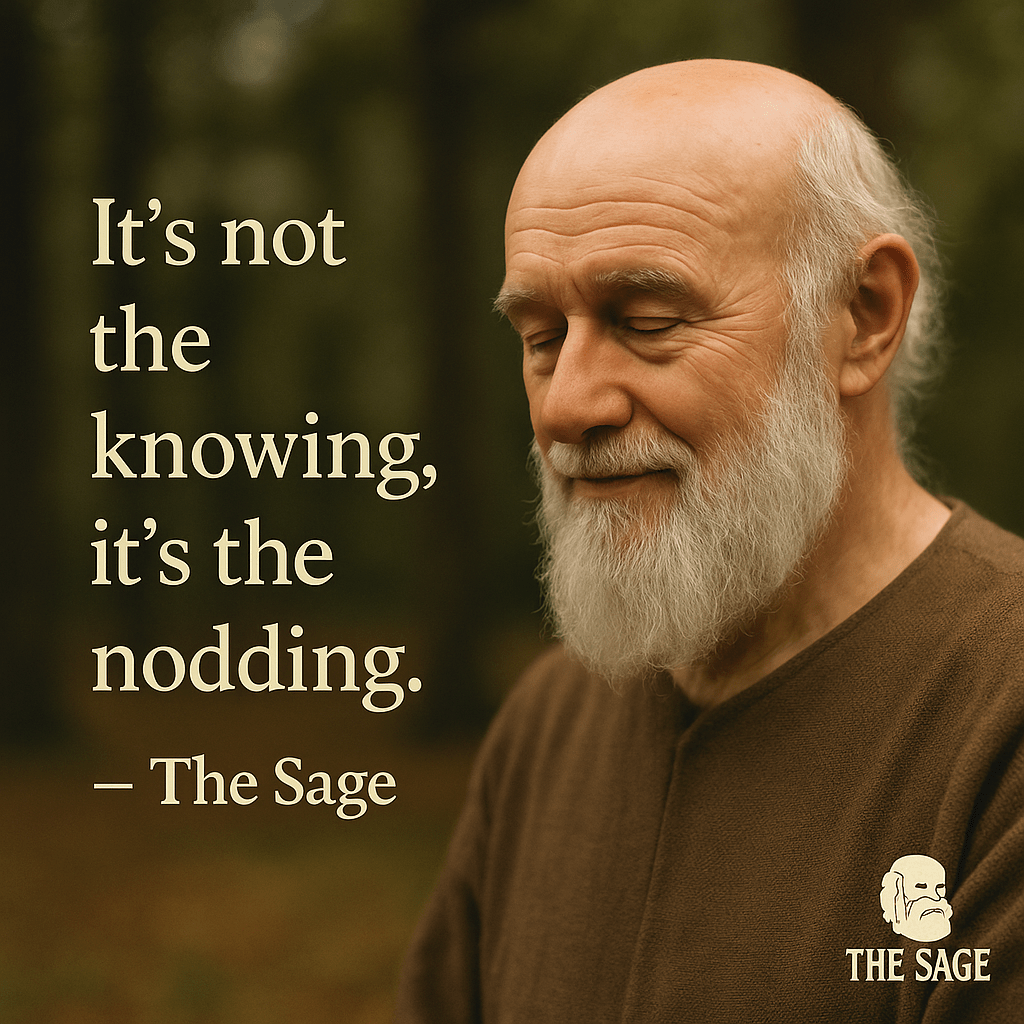
Quote:It’s not the knowing, it’s the nodding. — The Sage
The Sage has always valued the appearance of wisdom almost as much as the thing itself — perhaps more. In his view, genuine understanding is optional, but a well-timed nod can move mountains (or at least end conversations).
This philosophy was reportedly born during a particularly long town council meeting, when The Sage realised that nodding thoughtfully at regular intervals earned him unanimous agreement, three biscuits, and an invitation to chair the next session.
For The Sage, the nod is more than gesture — it’s performance art, a silent symphony of “Yes, yes, I see,” even when he most certainly doesn’t. As he likes to remind us: comprehension is fleeting, but confidence, feigned correctly, can last forever.
Thank you for reading my writings. If you’d like to, you can buy me a coffee for just £1 and I will think of you while writing my next post! Just hit the link below…. (thanks in advance)
“It’s not the knowing, it’s the nodding.” — The Sage
The Sage
Few figures in modern philosophy have contributed less yet meant more than The Sage of Dorchester. Revered for his beard, feared for his logic, and occasionally spotted near a teapot, The Sage has become an unlikely cornerstone of British humour and quiet absurdity. His teachings — part wisdom, part bewilderment — have inspired countless readers to pause, think deeply, and then make another cup of tea. What follows is a detailed chronicle of a man who has successfully combined enlightenment with mild confusion.
Born
4 February (year uncertain)
Birthplace
Dorchester, Dorset, England
Nationality
British
Occupation
Philosopher, humourist, reluctant guru
Notable works
Thought of the Day, Advice of the Day, The Cup of Knowing
Little is known of The Sage’s early years, though local legend claims he was born in Dorchester during an unusually contemplative drizzle. His mother allegedly described him as “a quiet child, except when asked to tidy up.”
He is said to have achieved enlightenment at the age of eight after staring into a biscuit tin and realising that “emptiness has a certain flavour.” Early school reports described him as “philosophically gifted but academically bewildered.”
Education
The Sage claims to have studied “everything that could possibly be misunderstood” at the University of Life (Dorchester Campus). He later pursued an unaccredited PhD in Applied Common Sense, though he reportedly failed his viva after pointing out that “sense is subjective.”
He also briefly taught at the Dorset School of Philosophy and Plumbing, where he lectured on the metaphysical implications of leaking taps. His most popular module, Metaphysics and the Stopcock, was discontinued after a practical session ended in mild flooding and enlightenment.
Philosophy
The Sage’s philosophy blends gentle absurdity with unexpected insight. Central to his teachings is the notion of Everyday Enlightenment — the belief that truth is best discovered during tea breaks, minor inconveniences, and moments of sheer confusion.
His guiding principles include:
“If you can’t find yourself, try the kitchen.”
“Nothing is impossible — just unlikely and poorly timed.”
“Wisdom is what’s left when you’ve lost the instructions.”
Critics have described his outlook as “existentialism with biscuits.”
Career and publications
The Sage gained fame through his chalkboard writings, Thought of the Day and Advice of the Day, a series of daily reflections mixing pseudo-wisdom with deliberate impracticality. Popular examples include:
“Never oversleep by replacing your pillow with a cactus.”
“Save money on gym memberships by installing revolving doors at home.”
His published works include:
The Cup of Knowing: Reflections at Brew Time (2019)
The Slightly Bent Path to Wisdom (2021)
No, Really, I’m Listening (2023)
The Complete Guide to Partial Understanding (forthcoming)
He also co-authored the Dorchester Book of Mildly Startling Observations (out of print).
Public appearances
The Sage is rarely seen outside Dorchester, preferring to “broadcast from within.” However, witnesses claim he occasionally appears at local fêtes, cafés, and libraries, offering unsolicited advice to anyone within earshot.
His one documented public talk, “The Meaning of Life (and Other Things I Misplaced),” ended abruptly when he misplaced his notes.
Followers, known as The Sagely Order of Reasonable Doubt, hold occasional gatherings in Dorset tea rooms, during which they attempt to agree on the topic of discussion.
Personal life
The Sage lives in a modest thatched cottage on the outskirts of Dorchester. He claims to share the property with “several unfinished thoughts” and a kettle named Aristotle.
He is rumoured to have once been married to Lady Wisdom, who left him “to find someone more decisive.” His hobbies include beard maintenance, staring at the horizon, and shouting answers at quiz shows several seconds too late.
Legacy
The Sage has been credited with popularising the genre of philosophical absurdism with a Dorset accent. His sayings have been quoted in blogs, pub toilets, motivational calendars, and at least one wedding speech that went terribly wrong.
Academics have described him as “the Socrates of the South West,” though locals prefer “that bloke with the beard who talks to his kettle.”
His self-written epitaph reads simply: “Still thinking.”
References
Lurt, Bea. On the Limits of Knowing People Who Know Things. The Sage Journal, Vol. 3 (2022).
Shinn, Eric. Humility and Other Unverified Claims, Dorset Press, 2021.
Moses, Holly. Life’s Song: Notes from the Edge of Understanding, The Sage Page (2024).
Teak, Anne. The Wisdom of Splinters: Lessons from Furniture and Fate, 2023.
Cox, A. (ed.). Collected Teachings of The Sage, Dorchester Archives (unpublished).
Thank you for reading my writings. If you’d like to, you can buy me a coffee for just £1 and I will think of you while writing my next post! Just hit the link below…. (thanks in advance)
Article compiled from various sources, none of them reliable. Historical accuracy has been approximated for entertainment purposes and lightly steeped in tea.
Advice:Tired of losing socks? Sleep in the washing machine.
The Sage has long wrestled with one of life’s great mysteries: the vanishing sock. Philosophers have pondered the meaning of existence, but few have questioned where the left sock goes after a spin cycle. The Sage’s solution is simple — join the journey.
By spending the night in the washing machine, you not only keep your socks safe but also emerge refreshed, gently tumbled, and faintly lemon-scented. It’s a bold lifestyle choice that combines minimalism, mindfulness, and mild hypothermia.
While critics warn of the practical dangers, The Sage insists the true spin happens within.
Thank you for reading my writings. If you’d like to, you can buy me a coffee for just £1 and I will think of you while writing my next post! Just hit the link below…. (thanks in advance)
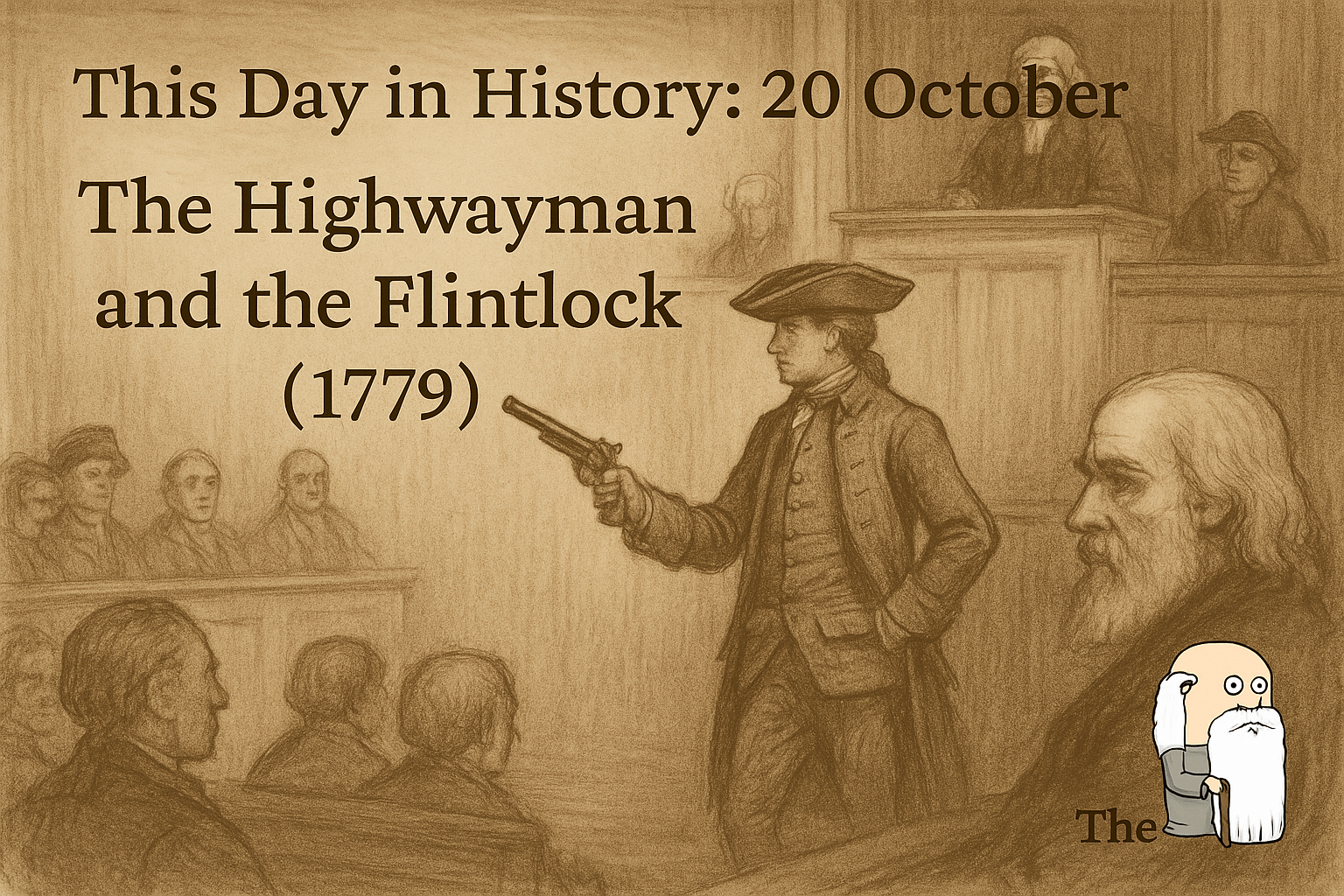
On the misty evening of 20 October 1779, a traveller named John Staples stopped a carriage on the London road, pistol in hand and bravado in voice. What followed was swift, absurd, and utterly Georgian: a highway robbery gone wrong.
The crime
Staples, a man of about twenty-five, had taken to the highway armed with a flintlock pistol and a hungry purse. His chosen victim was John Vass, a clerk carrying several shillings and a watch.
As the indictment read:
“John Staples was indicted for making an assault upon John Vass, upon the King’s highway, putting him in corporal fear and danger of his life, and feloniously taking from his person one watch and certain monies.”
Vass testified that the attack was almost theatrical.
Vass: “He cried out ‘Stand and deliver!’ and I, thinking him in jest, said, ‘You are a bold one, sir.’ But then he levelled the pistol.” Prosecutor: “Did you resist?” Vass: “I gave him the watch. He thanked me for it, and rode off at a gallop.”
The pursuit
Unfortunately for Staples, a patrol of constables was only a field away. They pursued him through the hedgerows, the sound of hoofbeats echoing down the turnpike. When they caught him, the watch was still in his pocket and the pistol primed.
Constable: “He begged that I not take him to the watch-house, saying he had only meant to frighten the gentleman.” Judge: “A strange jest with a loaded pistol.”
The trial and sentence
At the Old Bailey, Staples faced the full weight of 18th-century law. Robbery on the highway was a capital offence, and juries knew it. The prisoner pleaded for mercy, insisting he had been “drunk and desperate.”
The jury deliberated briefly and returned a guilty verdict.
Judge: “You have taken to a practice which strikes at the peace of all travellers. The sentence of the law is that you be hanged by the neck until you are dead. May God have mercy upon your soul.”
Execution followed at Tyburn within the month — one of the last years before the gallows would move permanently to Newgate.
Why this mattered
The case of John Staples shows how fear and fascination surrounded highway robbery at the end of the 18th century. Once romanticised, by 1779 it had become a dying trade — driven to extinction by better roads, armed patrols, and the certainty of the noose.
Staples’ brief adventure marks the twilight of the English highwayman, when pistols still glinted under lantern light and every coachman’s heart leapt at the cry of “Stand and deliver!”
Source
R v. John Staples (t17791020-13), tried at the Old Bailey on 20 October 1779 for violent theft, highway robbery. Verdict: Guilty. Sentence: Death (execution at Tyburn). Old Bailey Proceedings Online
Thank you for reading my writings. If you’d like to, you can buy me a coffee for just £1 and I will think of you while writing my next post! Just hit the link below…. (thanks in advance)
On 9 October 1912, Richard Courtney, a 50-year-old seaman, stood before the Old Bailey charged with attempting to break and enter the shop of Harry Manfield & Co., and another premises, with intent to steal.
The charge was read aloud in the formal, almost liturgical tone of the court:
Clerk of Arraigns: “Richard Courtney, you stand indicted for that you did, on or about the eighth day of October, feloniously attempt to break and enter certain shop premises with intent to steal therein. How say you — guilty or not guilty?” Courtney: “Guilty, sir.”
The admission silenced the public gallery. In 1912, a guilty plea was both rare and oddly respectable — a sign that the accused would not waste the court’s time. Yet the judge still sought to hear the facts.
Prosecutor: “The prisoner was found loitering near the door of the firm of Harry Manfield & Company, at an hour when the place was long closed. Marks were found upon the lock. When challenged by the constable, he made no attempt to flee.” Judge: “And the instrument used?” Prosecutor: “A small chisel, Your Lordship. Found in his pocket.” Judge: “Have you anything to say before I pass sentence?” Courtney: (quietly) “No, sir — only that I meant no harm by it.”
The judge’s voice softened slightly.
Judge: “Mr. Courtney, you are a man of fifty years, and one who has seen honest work upon the seas. It is most unfortunate that you should end a working life thus. You will be imprisoned for six months, second division.”
And with that, the briefest of trials was done.
Why this mattered
This small exchange captures a turning point in London’s criminal history. Gone were the days of pickpockets and highwaymen; by 1912, it was the urban tradesman’s shop — locked, insured, and gaslit — that bore the brunt of desperation.
Courtney’s sentence of six months, second division reflected the Edwardian belief that punishment could still be humane. Second-division prisoners avoided the treadwheel and the hard labour that earlier convicts endured, yet the stigma of the dock would follow them as surely as the sound of the judge’s gavel.
It was a short case, but a very human one — a weary sailor, an unlocked door, and the long shadow of temptation in a city of endless windows.
Source
R v. Richard Courtney (t19121008-15), trial at the Old Bailey, 8 October 1912, sentence 9 October 1912. Verdict: Guilty (plea). Sentence: Six months’ imprisonment (second division). Old Bailey Proceedings Online
Thank you for reading my writings. If you’d like to, you can buy me a coffee for just £1 and I will think of you while writing my next post! Just hit the link below…. (thanks in advance)