This Day in History: 13 November 1784 — The Copper Heist in the Night

On the night of 13 November 1784, around eleven o’clock, a man named James Thomas slipped into the London home of John Parleyman. It was no grand townhouse, but it had something worth stealing: a store of copper, heavy, valuable, and easy to sell by weight.

Under cover of darkness, Thomas broke and entered the dwelling house, made his way to the storage area, and carried off about eighty pounds of copper, bundled into a hemp sack. For Parleyman, this wasn’t an abstract loss; copper meant tools, fittings, and ready money.

Within weeks, suspicion and evidence converged. Whether it was a neighbour who saw him struggling with the suspiciously heavy sack, or a metal dealer who recognised marked copper, Thomas was arrested and committed for trial at the Old Bailey.


The trial at the Old Bailey — 8 December 1784

On 8 December 1784, the court heard the case recorded as R v. James Thomas — a burglary charge, explicitly tied back to “the 13th of November last, about the hour of eleven in the night.”

The indictment (summarised in later records) accused Thomas of:

“Burglariously and feloniously breaking and entering the dwelling house of John Parleyman, on the 13th of November last, about the hour of eleven in the night, and burglariously stealing therein, eighty pounds weight of copper, value forty shillings, and one hempen sack, value one shilling.”

The value mattered. Forty shillings put the offence into serious territory, and “burglariously” signalled a night-time housebreaking — a classic capital crime in 18th-century law.

We don’t have the full verbatim dialogue, but we can be confident about the basic shape of proceedings:

  • Parleyman (or his servant) testified that the house was secure on the night of the 13th, and that the copper and sack were present when they retired.
  • He then described finding door or window forced, copper missing, and traces of the theft.
  • One or more witnesses connected Thomas to the stolen copper — perhaps a constable who found him with the sack, or a dealer who purchased it and later identified him.

Thomas was found guilty, but crucially, the jury or court recorded the offence as “theft under 40 shillings” rather than full, value-heavy burglary — a common way of avoiding the automatic death sentence. He was instead sentenced to transportation, specifically seven years beyond the seas.

By January 1787, Thomas was on a convict transport ship bound for New South Wales — one of the many whose crimes dated in London and whose punishments were carried out on the other side of the world.


Why this 13 November matters

The case of James Thomas is a neat window into late-Georgian justice:

  • It shows how a single night’s burglary on 13 November could ripple outward into years of forced labour in a new colony.
  • It illustrates the way juries sometimes downgraded value (“under 40 shillings”) to spare a defendant from the gallows while still upholding the seriousness of the offence.
  • And it captures the material reality of the time: copper and a sack were enough to tempt a man into risk, and enough to send him halfway across the globe.

Thank you for reading my writings. If you’d like to, you can buy me a coffee for just £1 and I will think of you while writing my next post! Just hit the link below…. (thanks in advance)


Quote of the Day: Silent Wisdom

“Half of wisdom is learning when not to say ‘I told you so.’”
— The Sage


The Sage has always believed that wisdom is measured less by what we know and more by what we choose not to say. To him, restraint is one of the highest virtues, especially when the temptation to gloat comes wrapped in delicious accuracy. A true sage, he argues, can swallow the satisfaction of being right in favour of preserving peace.

He notes with a twinkle in his eye that most people don’t actually need to hear “I told you so” — they already know it, and usually regret it. Pointing it out rarely enlightens them; it only deepens the bruise. Wisdom, therefore, lies in resisting the urge to twist the knife of correctness.

This gentle humour underscores a deeper truth: kindness often grows where ego steps aside. The Sage reminds us that being right matters far less than being gracious. Sometimes the wisest words are the ones we leave unspoken — especially when they would feel so good to say.


Thank you for reading my writings. If you’d like to, you can buy me a coffee for just £1 and I will think of you while writing my next post! Just hit the link below…. (thanks in advance)

Advice of the Day: Portable Sunlight

“No torch on your phone? Take a photo of the sun, and use it in the dark.”

The Sage

Modern life is full of little inconveniences, and The Sage believes each one deserves an equally ridiculous solution. His latest gem: “No torch on your phone? Take a photo of the sun, and use it in the dark.” Simple, effective, and only slightly catastrophic if taken literally.

According to The Sage, light is just light — so why should we let physics get in the way of a good idea? By capturing the sun at its brightest, you’re essentially downloading daylight. Sure, scientists will argue about how “that’s not how light works,” but they said the same thing about rubbing onions on your feet to cure colds, and look how that turned out.

Of course, practical results may vary. Some users report minimal illumination, while others experience mild existential crises about the futility of technology. Still, The Sage insists it’s better than nothing — and far safer than trying to light your way with a flaming napkin again.


Thank you for reading my writings. If you’d like to, you can buy me a coffee for just £1 and I will think of you while writing my next post! Just hit the link below…. (thanks in advance)

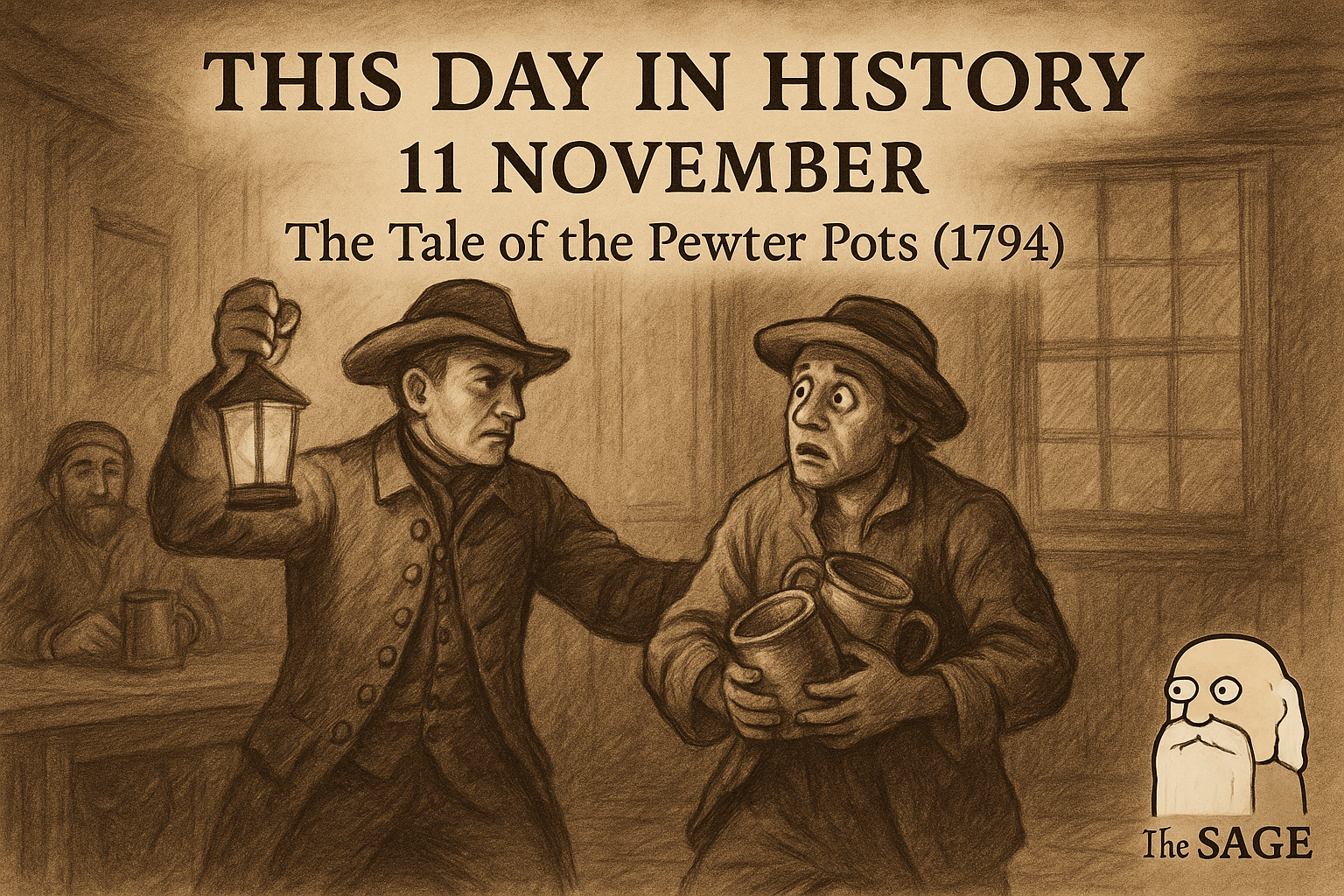
This Day in History: 11 November 1794 — The Tale of the Pewter Pots

On this day, 11 November 1794, the Old Bailey heard the curious case of John Webb, a London labourer accused of stealing three pewter quart pots from a tavern in the city. The theft itself had taken place some weeks earlier, but the echoes of that small crime reached the courtrooms of justice on this damp November morning.


The theft

The indictment read plainly enough:

“John Webb was indicted for stealing, on a certain day in October, three pewter quart pots, value three shillings, the goods of Thomas Brown.”

It was the sort of offence that kept constables busy — unglamorous, commonplace, yet vital to the rhythm of Georgian London.
Brown kept an inn near the Borough; Webb, a familiar customer, knew his way around the cellar and the shelves.
When three of the landlord’s pots disappeared, suspicion naturally followed the man who’d left the tavern a little too merry, with a bundle that clinked when he walked.

Landlord: “I missed three pots from the shelf, and sent the pot-boy to look among the benches. He came back with none. A neighbour said he’d seen Webb pass with something under his arm.”

The constable found him a few streets away, the bundle heavy with pewter and guilt.


The trial at the Old Bailey

In court, Webb played the fool, claiming coincidence and misfortune.

Clerk: “You stand indicted for stealing three pewter quart pots, the property of Thomas Brown. How say you — guilty or not guilty?”
Webb: “Not guilty, my lord. I found them in the street.”

The evidence was so straightforward that the jurors scarcely warmed their benches.

Foreman: “Guilty.”


Sentence and aftermath

Though pewter theft may sound trifling today, in Georgian London it was treated as a serious betrayal of trust and livelihood.
The judge delivered the standard sentence for repeat petty larceny:

Judge: “You will be transported beyond the seas for seven years.”

Within weeks, Webb was shackled aboard a prison hulk on the Thames, awaiting transport to Botany Bay — one more Londoner sent to the farthest corner of the empire for the price of three drinking pots.


Why this mattered

John Webb’s trial reminds us that the Old Bailey did not just punish grand villains and murderers.
It dealt daily in the ordinary sins of ordinary men — a few missing spoons, a stolen handkerchief, or a tavern pot gone astray.
Each verdict echoed through the alleys of London, proof that in 1794 even a pewter tankard could change a life forever.


Source

R v. John Webb (t17941111-25), tried at the Old Bailey on 11 November 1794 for theft of pewter pots from publican Thomas Brown. Verdict: Guilty. Sentence: Transportation for seven years.
Old Bailey Proceedings Online


Thank you for reading my writings. If you’d like to, you can buy me a coffee for just £1 and I will think of you while writing my next post! Just hit the link below…. (thanks in advance)

Quote of the Day: Silence

“The problem with silence is that most people only notice it when it’s gone.”
— The Sage


The Sage has always treated silence as an old friend — patient, calm, and endlessly revealing. To him, silence isn’t the absence of sound, but the presence of space. It’s where thoughts settle, ideas form, and the world remembers to breathe. Yet, like so many quiet things, it’s rarely appreciated until it disappears beneath the roar of daily life.

He believes that silence is one of life’s great teachers. It allows wisdom to surface and humility to grow. In stillness, we begin to hear not just the world, but ourselves — the deeper rhythm beneath the chatter. For The Sage, that’s where understanding lives: not in noise, but in the hush between words.

Of course, he can’t resist a smile as he says it. The Sage knows that our noisy world fears quiet because it leaves us alone with our own thoughts — and those can be louder than any crowd. His advice is simple: learn to listen to silence before it’s drowned out completely.


Thank you for reading my writings. If you’d like to, you can buy me a coffee for just £1 and I will think of you while writing my next post! Just hit the link below…. (thanks in advance)

Advice of the Day: Bath-Night Spaghetti

“Only eat spaghetti on bath nights.”

The Sage

The Sage has many rules for living, but few are as practical — or as messy — as this one: “Only eat spaghetti on bath nights.” It’s advice born of experience, tomato stains, and a lifelong battle with gravity. For The Sage, spaghetti isn’t food; it’s a lifestyle hazard that demands both caution and a nearby source of hot water.

Spaghetti, he explains, is a treacherous meal — a slithering ambush disguised as dinner. Every forkful carries the risk of airborne sauce, accidental lassoing, or what scholars now call The Marinara Incident. That’s why the truly enlightened schedule their pasta feasts for evenings when a thorough scrubdown is already on the agenda. It’s not laziness — it’s logistical genius.

So next time you fancy a plate of spaghetti, check your calendar first. Is it bath night? Excellent. Proceed with reckless abandon. If not, step away from the pasta, for there’s wisdom in restraint — and no detergent on Earth that truly removes tomato from beige robes.


Thank you for reading my writings. If you’d like to, you can buy me a coffee for just £1 and I will think of you while writing my next post! Just hit the link below…. (thanks in advance)

Advice of the Day: Trust Dogs

“Trust dogs. They always know who to stay away from.”

The Sage

The Sage believes that dogs possess an ancient, unspoken wisdom that far surpasses our own. As he puts it: “Trust dogs. They always know who to stay away from.” And he’s right. Dogs have an uncanny knack for sniffing out the truly dodgy — be it a deceitful salesman, a visiting in-law, or anyone who uses the word “synergy” unironically.

While humans waste time reading body language or analysing motives, dogs simply know. A low growl or a strategic retreat tells you everything you need to know about someone’s character. The Sage advises taking this behaviour seriously. If your dog avoids a person, you probably should too — or at least keep them on a shorter metaphorical leash.

Of course, this principle also works in reverse. If a dog bounds up to someone, wagging like an overexcited metronome, that’s usually a sign of good heart — or at least an owner who smells faintly of bacon. So next time you’re uncertain about a new acquaintance, don’t consult your instincts — consult your Labrador.


Thank you for reading my writings. If you’d like to, you can buy me a coffee for just £1 and I will think of you while writing my next post! Just hit the link below…. (thanks in advance)
Advice of the Day: The Art of Blame

If you do something bad, make sure there’s someone else around to blame.”

The Sage

Few people appreciate the delicate art of wrongdoing. Most amateurs commit their misdeeds alone, which is both foolish and inefficient. The Sage, however, understands that true wisdom lies not in avoiding trouble, but in ensuring there’s someone nearby to absorb the fallout. As he sagely puts it: “If you do something bad, make sure there’s someone else around to blame.”

It’s an ancient principle — as old as Eve and the serpent, or as modern as every office email chain ever sent. Why suffer the consequences yourself when you can diversify responsibility? From spilled tea to global catastrophes, history’s smartest wrongdoers have always known the power of a well-timed finger point. After all, chaos shared is chaos halved.

Of course, The Sage advises moderation. Blame should be spread with the care of a seasoned gardener, not the enthusiasm of a leaf blower. Choose your scapegoat wisely — ideally someone slow to realise what’s happened. And remember: the true master of mischief doesn’t deny wrongdoing — he simply makes it look like someone else’s idea.


Thank you for reading my writings. If you’d like to, you can buy me a coffee for just £1 and I will think of you while writing my next post! Just hit the link below…. (thanks in advance)

Quote of the Day: A Clear Conscience

“A clear conscience is usually the result of a bad memory.”
— The Sage


The Sage has always viewed the human conscience with affectionate suspicion. He knows that most people sleep soundly not because they’ve led blameless lives, but because they’ve conveniently forgotten the bits that might keep them awake. To him, peace of mind is less a moral triumph and more a lapse in recall.

In his characteristic way, The Sage exposes the gentle comedy of human self-delusion. We tell ourselves stories of virtue, edit out the embarrassing footnotes, and call it “a clear conscience.” It’s not hypocrisy, he insists — it’s simply survival. Memory, after all, can be a heavy burden, and the mind is clever at lightening its own load.

But beneath the chuckle lies a note of compassion. The Sage doesn’t mock our forgetfulness — he understands it. To forgive oneself often starts with a little selective amnesia. In the grand ledger of life, he suggests, it’s the smudged entries that make us human.


Thank you for reading my writings. If you’d like to, you can buy me a coffee for just £1 and I will think of you while writing my next post! Just hit the link below…. (thanks in advance)

This Day in History: 4 November 1734 — The Linen Thief in the Basement

On the night of 4 November 1734, London was wet, smoky and full of washing lines. In a house “below stairs”, Joan Wayte hung her freshly washed linen to dry in a basement room. She stepped out between eight and nine o’clock, shut the door behind her, and thought no more of it — until she came home to find her laundry gone and her door disturbed.

Within a month, the Old Bailey would record her words and the name of the man accused: Emanuel Pim, indicted for theft and burglary against her property.


The burglary

From the surviving snippet of Joan’s testimony we know the essentials:

“I hung up some Linnen to dry in my Room below Stairs. I went out between 8 and 9 at Night, and shut my Door after me; but when I returned…”

The unwritten part writes itself. When she came back in later that evening, the latch showed signs of tampering, the door no longer sat true in its frame, and the line where her shifts and aprons had hung was suspiciously bare. In an age when linen meant labour and money — spun, woven and stitched by hand — this was no minor nuisance but a real financial blow.

Neighbours would have been the first detectives. A servant, a watchman, or a curious neighbour likely noticed a man lingering near the tradesmen’s entrance, or carrying an oddly heavy bundle away from the house. One way or another, suspicion settled on Emanuel Pim, and before long he stood in the dock at the Old Bailey.


The trial at the Old Bailey — 4 December 1734

The case appears in the 4 December 1734 Sessions as “Emanuel Pim. Theft; burglary.” with Joan named as the complainant whose linen was stolen from the basement room.

The court would have followed a familiar pattern:

  • Joan describing how she left everything secure and came back to find it disturbed.
  • The value of the linen being carefully listed: shirts, aprons, shifts or sheets, each given a shilling value to show the crime was worth the court’s time.
  • One or more witnesses tying Pim to the stolen bundle — a pawnbroker, a neighbour, or a constable who stopped him with suspiciously damp laundry under his arm.

In our reconstructed dialogue, it might have sounded like this:

Clerk of Arraigns: “Emanuel Pim, you stand indicted for breaking and entering the lodgings of Joan Wayte, and stealing her linen. How say you — guilty or not guilty?”
Pim: “Not guilty.”
Joan: “’Twas my linen, my lord, the very pieces I had washed with my own hands.”

Unfortunately, the detailed verdict line for Pim’s case is behind a technical barrier for me, so I can’t see with certainty whether he was sentenced to death, transportation, or a lesser punishment. We do know from the way the case is catalogued (“theft; burglary” in the 1734 Proceedings) that the court treated it as a serious property crime, not a mere petty larceny.

In similar linen-burglary cases of the 1730s, first-time offenders often faced transportation for seven years, while repeaters or aggravated cases sometimes received death sentences, later commuted. That’s an informed comparison rather than a confirmed fact about Pim himself.


Why this mattered

The story of Joan Wayte’s missing linen speaks to everyday life in early-18th-century London:

  • Linen was wealth. A few shirts and aprons represented days of spinning, weaving, bleaching and sewing. Stealing laundry was effectively stealing someone’s wardrobe and work.
  • Basement rooms were vulnerable. Servants and poorer lodgers often lived “below stairs,” with doors that opened straight onto alleys or yards — perfect opportunities for quick, low-level burglary.
  • The Old Bailey recorded the invisible. Without Joan’s complaint, the theft would have disappeared into gossip. With it, one woman’s laundry day became a small part of London’s legal memory.

On the night of 4 November 1734, a thief found a line of tempting linen; a month later, the court found a name to attach to that act. The detailed sentence is lost behind our present technical curtain, but Joan’s brief line — “I hung up some Linnen to dry…” — is enough to hang a whole story on.


Source

  • Emanuel Pim, theft and burglary case in the 4 December 1734 Old Bailey Proceedings, with complainant Joan Wayte, linen stolen from a room “below stairs” after she went out between eight and nine at night. oldbaileyonline.org+1

Thank you for reading my writings. If you’d like to, you can buy me a coffee for just £1 and I will think of you while writing my next post! Just hit the link below…. (thanks in advance)