Quote of the Day: The Rain

“A rainy day is just the sky reminding us to slow down before we leak as well.”
The Sage


The Sage has always regarded rain not as an inconvenience, but as a gentle intervention. He sees storms as the sky’s quiet way of encouraging us to pause — to take a breath, let the world settle, and remember that even nature needs to release what it has been holding. To him, rain is less about getting wet and more about getting still.

When he warns that we might “leak as well,” he is pointing at the burdens people carry — the emotional pressure, the silent worries, the buildup of small frustrations that go unacknowledged. Just as clouds become heavy, so do minds. And just as clouds release rain, humans too need moments of pause before the weight becomes too much.

The Sage’s humour softens the truth: rain asks us to slow down, to listen inward, to notice what we’ve been trying to outrun. His message is a reminder that rest is not weakness but maintenance, and that a drizzly afternoon may be nature’s wisest invitation to simply stop and breathe.


Thank you for reading my writings. If you’d like to, you can buy me a coffee for just £1 and I will think of you while writing my next post! Just hit the link below…. (thanks in advance)


Advice of the Day: The Finger of Doom

“Never pull Dad’s finger when he tells you to.”

The Sage

The Sage has lived a long and perilous life, but nothing — not wild animals, not faulty ladders, not even supermarket self-checkouts — has ever prepared him for the horror of the phrase: “Pull my finger.” Today’s wisdom is therefore short, urgent, and potentially life-saving: “Never pull Dad’s finger when he tells you to.”

According to The Sage, this is the oldest prank in human history, passed down from generation to generation like a cursed relic. Every dad, upon reaching a certain age, unlocks an innate ability to weaponise humour in gaseous form. The innocent child believes they are participating in a harmless ritual. The father knows they are participating in a biological attack.

The Sage warns that once triggered, there is no escape: the sound, the aftermath, the psychological impact — all permanent. Survivors report confusion, betrayal, and a newfound respect for air fresheners. So heed this ancient wisdom: when Dad smiles mischievously and extends his finger… run.


Thank you for reading my writings. If you’d like to, you can buy me a coffee for just £1 and I will think of you while writing my next post! Just hit the link below…. (thanks in advance)

This Day in History: 27 November 1843 — The Teapot and the Daylight Dragnet

On 27 November 1843, one of London’s central courts, the Old Bailey, opened its doors to hear a theft that began in a quiet house and ended in a hurried flight — for a man named John Lee.

Lee stood accused of having stolen a tea-pot and a sugar-basin from the home of Joshua Wigley Bateman, Esq., a respectable London gentleman. The total value of the stolen items was recorded as £7 10s for the tea-pot and 12s for the sugar-basin, a sizeable sum for such domestic utensils.


🕯️ What happened

Bateman had left his house for the day, leaving servants in charge — and, presumably, the doors as secure as an 1840s home could be. But by the time a maid returned, the silver-plated tea-set was gone, and a window or back door showed signs of forced entry.

A neighbour spotted a suspicious figure leaving the street with a bundle under his coat. The description matched that of John Lee. A constable was sent; within hours Lee was arrested, package in hand, the stolen items inside.

The discovery was dramatic: the tea-pot, the sugar-basin — once shining and domestic — now clanged like evidence of betrayal and need.


⚖️ The trial — 27 November 1843

In court, Lee wore the worried look of a man caught with his own alibi in tatters. He pleaded not guilty.

Clerk of Arraigns: “John Lee — you are indicted for stealing one tea-pot and one sugar-basin, the property of Joshua Wigley Bateman. What say you, guilty or not guilty?”
Lee: “Not guilty, sir — I found them in the street.”

But the prosecution’s case was tight:

  • Witnesses identified Lee leaving the house area just before the theft was discovered.
  • The stolen items were clearly those belonging to Bateman — engraved or bearing marks known only to the household staff.
  • The bundle in Lee’s coat was dripping faintly with tea-stains and had the unmistakable weight of metal.

The jury needed little time.

Foreman: “Guilty.”


🏛 Sentence and aftermath

For theft of items valued the way Bateman’s tea-set had been, the sentence was severe:

Lee was given transportation for seven years — a fate shared by many convicted of property crimes, sending them far from London’s lanes, likely to penal colonies. The tea-pots that once filled a genteel drawing-room would linger only in memory; Lee would embark on a journey into forced labour, perhaps never to return.


⚒️ What this tells us

The case of John Lee homes in on a truth of Georgian and early-Victorian London: property was fragile, justice swift.

  • Everyday household items — tea-pots, sugar-basins — had real value and losing them meant real loss.
  • The legal system viewed theft from a dwelling with harsh eyes; the penalty was exile, not just imprisonment.
  • The Old Bailey’s records capture these small tragedies as sharply as the dramatic murders or highway robberies.

This day in 1843 shows that sometimes, a stolen tea-set was enough to change a man’s life forever.


📚 Source

  • t18431127-54 – John Lee, indicted for stealing a teapot and sugar-basin from Joshua Wigley Bateman, Esq. — Old Bailey Proceedings, session 27 November 1843. oldbaileyonline.org

Thank you for reading my writings. If you’d like to, you can buy me a coffee for just £1 and I will think of you while writing my next post! Just hit the link below…. (thanks in advance)

Advice of the Day: Volume Control

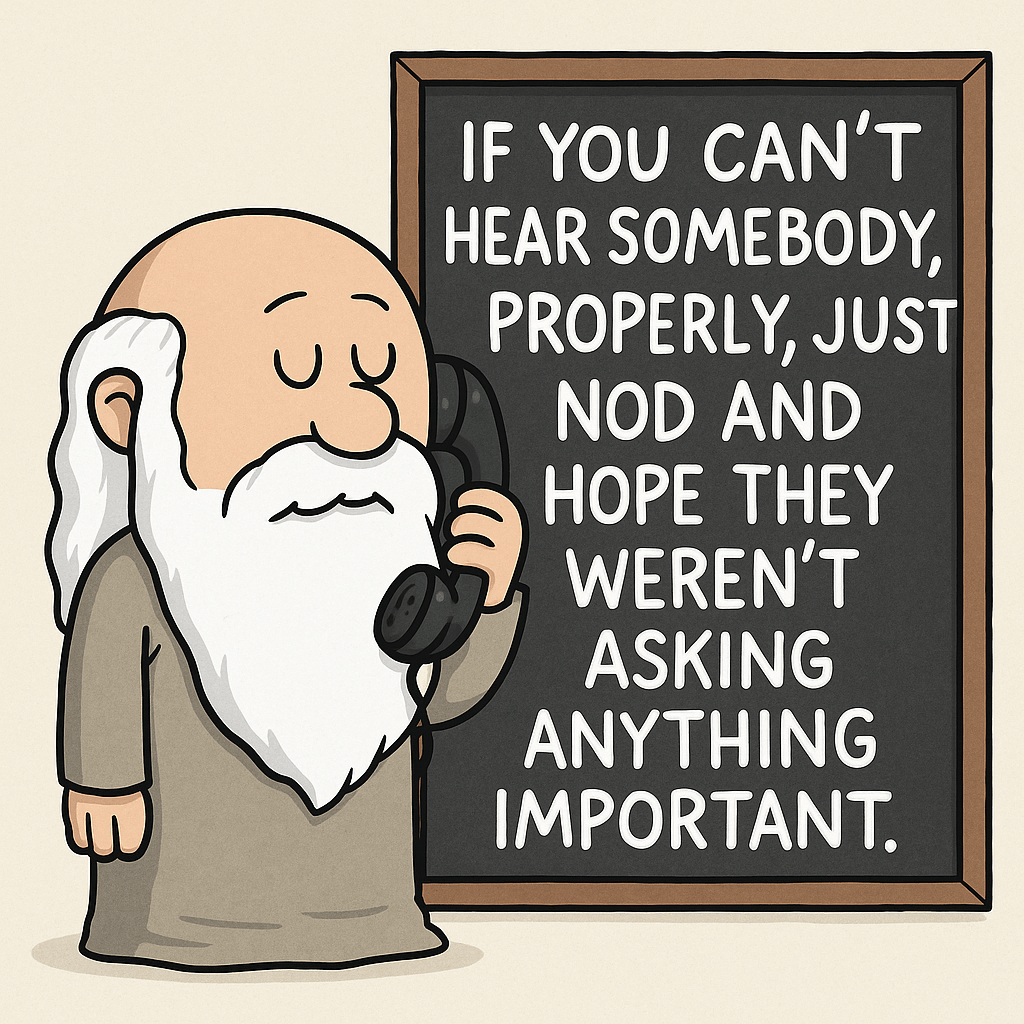
“If you can’t hear somebody properly, just nod and hope they weren’t asking anything important.”

The sage

The Sage has long believed that modern life is far too noisy, but not for the reasons you think. His latest insight is this: “If you can’t hear somebody properly, just nod and hope they weren’t asking anything important.”

According to The Sage, this is one of life’s most efficient survival techniques. Instead of awkwardly asking people to repeat themselves (and risking actual commitment), a simple slow nod communicates vague understanding, emotional engagement, and just enough credibility to survive most conversations. It has been successfully deployed in offices, family gatherings, and surprisingly complex medical appointments.

Of course, this method does carry risks. The Sage once nodded through an entire conversation only to discover he had agreed to organise a charity quiz night, buy a kayak, and name a neighbour’s cat. But even then, he maintains it was still better than saying “What?” five times and looking foolish.

So remember: when in doubt, nod wisely — and leave the room before the consequences arrive.


Thank you for reading my writings. If you’d like to, you can buy me a coffee for just £1 and I will think of you while writing my next post! Just hit the link below…. (thanks in advance)
Quote of the Day: Budgeting

“Budgeting is simply telling your future self where today’s nonsense stopped.”
The Sage


The Sage has always viewed money as a peculiar invention — a system designed to make life easier that somehow manages to make everyone more anxious instead. In his eyes, budgeting isn’t about spreadsheets, apps or cleverly coloured graphs. It’s about drawing a polite line between what you want now and what your future self will have to live with later.

When he speaks of “today’s nonsense,” The Sage isn’t only referring to impulse purchases and unnecessary luxuries — though he certainly means those too. He’s talking about the small moments of weakness, the emotional spending, the comforting little decisions made at the end of a long day when willpower has packed up and gone home. Budgeting, he suggests, is simply deciding where that nonsense ends before it grows legs and starts walking all over tomorrow.

Yet he doesn’t say this with judgement. The Sage understands that nonsense is part of being human. Life without it would be terribly dull. His point is simply that wisdom lies in balance — a little nonsense for today, a little kindness for your future self. Budgeting, then, becomes less about restriction and more about quiet generosity toward the person you’re about to become.


Thank you for reading my writings. If you’d like to, you can buy me a coffee for just £1 and I will think of you while writing my next post! Just hit the link below…. (thanks in advance)

Quote of the Day: Certainty

“The more certain you become, the more housework your mind requires.”
The Sage


The Sage has never been particularly fond of certainty. He finds it far too tidy for a world that insists on being untidy. To him, certainty is like buying a very expensive carpet — at first it looks impressive, but before long you realise you now have to constantly tiptoe around life trying not to get it dirty. And life, as he is fond of pointing out, has muddy boots.

What he means by “housework of the mind” is the exhausting mental maintenance required to defend rigid beliefs. Certainty demands protection. Once you’ve convinced yourself you are absolutely right, you must keep sweeping away doubts, mopping up contradictions, and polishing your arguments daily. Otherwise the cracks start to show — and certainty hates visible cracks.

The Sage, with his usual dry humour, suggests that doubt is actually a far easier tenant. It doesn’t demand so much cleaning. It simply sits in the corner, occasionally humming, and leaves you free to think, adjust, and grow. He reminds us that a mind open to uncertainty needs less maintenance and far more curiosity — and curiosity, unlike certainty, is wonderfully self-cleaning.


Thank you for reading my writings. If you’d like to, you can buy me a coffee for just £1 and I will think of you while writing my next post! Just hit the link below…. (thanks in advance)

Advice of the Day: Dangerous Observations

“Never tell your partner her diet’s not working.”

The Sage has survived wars, plagues, unspeakable soups, and several committee meetings — and yet he insists that nothing on Earth is more perilous than commenting on a partner’s diet. His solemn warning today is simple: “Never tell your partner her diet’s not working.”

According to The Sage, this is not a statement — it is a declaration of war. Even if you are technically correct, mathematically accurate, and supported by scientific data, you are still wrong in every way that truly matters. Diets are not just nutritional plans; they are emotional ecosystems balanced on hope, biscuits, and quiet determination.

The Sage advises a safer alternative approach: if asked, respond only with vague encouragement such as, “You look great,” or, “That salad seems very… committed.” Never mention scales, inches, portions, or mirrors under any circumstances. And remember: silence is not cowardice — it’s wisdom.


Thank you for reading my writings. If you’d like to, you can buy me a coffee for just £1 and I will think of you while writing my next post! Just hit the link below…. (thanks in advance)

This Day in History: 20 November 1782 — The Watch in the Moonlight

On a crisp evening in November 1782, the streets of London were full of fog and hurried footsteps. In the parish of St Martin’s-in-the-Fields, a young labourer named John Reynolds made a choice that would bring him to the bar of the Old Bailey before the month was out.

That night, he stole a silver watch from a passer-by — a small object, but a valuable one. Watches were not mere timepieces; they were symbols of status, savings, and security. Losing one could ruin a working man. Stealing one could ruin the thief.


The theft

The victim, John Langford, was returning home at dusk. The streets were busy, lit by the dim glow of oil lamps. A jostle, a shove, a swift tug — and the watch was gone.

Langford wheeled around.

Langford: “My watch! The fellow’s run off with it!”

A nearby boy saw a man darting toward the Strand, clutching something close to his coat. He shouted the alarm. Within minutes, a constable gave chase.

Reynolds was stopped in a narrow court, panting, coat bulging.

Constable: “What have you there?”
Reynolds: “Nothing of consequence, sir.”

But the silver watch was found tucked inside his waistcoat.


The trial at the Old Bailey — 20 November 1782

On 20 November, Reynolds stood in the crowded courtroom, facing the charge of stealing a silver watch, value forty shillings, the property of John Langford.

Clerk: “How say you — Guilty or Not Guilty?”
Reynolds: “Not guilty. I bought it from a stranger not an hour before.”

It was a common defence — and an unlikely one.

Langford identified the watch instantly, noting the unique mark on the inner case.
The boy who saw Reynolds flee told the court what he had witnessed.
The constable described the chase and the recovery.

The jury required little discussion.

Foreman: “Guilty.”


Sentence and aftermath

For a theft of this value, and with such clear evidence, there was only one likely outcome.

Judge: “The prisoner is sentenced to transportation for seven years.”

Reynolds went from the cramped courtroom to Newgate, and from there to the hulks on the Thames.
In the spring months that followed, he was loaded onto a transport ship, bound for the penal colonies — one more Londoner carried away for the price of a stolen watch.


Why this mattered

The case of John Reynolds shows how, in 1780s London, even a moment of opportunistic theft could shape a life’s entire course.

  • A silver watch represented months of wages.
  • Theft was treated as a direct threat to public order.
  • Transportation was the common cure for what the courts called “thefts of opportunity.”

In one night, Reynolds seized a watch — and lost his freedom.


Source

R v. John Reynolds (t17821120-34), tried at the Old Bailey on 20 November 1782 for stealing a silver watch from John Langford.
Verdict: Guilty. Sentence: Transportation for seven years.


Thank you for reading my writings. If you’d like to, you can buy me a coffee for just £1 and I will think of you while writing my next post! Just hit the link below…. (thanks in advance)

Quote of the Day: Excuses

“Most problems aren’t as complicated as the excuses we make for them.”
The Sage


The Sage has long believed that human beings possess an extraordinary talent for complication. Problems, he says, tend to arrive in simple shapes — a decision to be made, a truth to be faced, a task to be started. But instead of meeting them head-on, we cloak them in layers of hesitation, justification, and imaginative avoidance. The excuses, he notes with a sigh, often take more energy than solving the problem itself.

He observes that excuses are rarely about the problem at all. They’re stories we tell ourselves to protect our pride, our comfort, or our fear of failure. The Sage does not condemn this — he understands that excuses are simply padded armour for the ego. But he also gently reminds us that armour is heavy, and carrying it slows us down more than the problem ever would.

His humour softens the message, but the truth remains: clarity often returns the moment excuses fall away. When we stop explaining why something can’t be done, the path to doing it appears far less daunting. The Sage encourages us to see excuses for what they are — clever distractions — and to embrace the lightness that comes from letting them go.


Thank you for reading my writings. If you’d like to, you can buy me a coffee for just £1 and I will think of you while writing my next post! Just hit the link below…. (thanks in advance)

Advice of the Day: Food & Foolishness

“Never trust a dog to watch your food.”

The Sage has made many questionable decisions in his long life, but none as consistently disastrous as trusting a dog to guard his food. Today, he shares the distilled wisdom of these countless failures: “Never trust a dog to watch your food.” It sounds obvious — but as The Sage knows, hunger makes optimists of us all. The moment you walk away, that “loyal” companion becomes a furry vacuum cleaner.

Dogs, he explains, operate on a simple moral principle: If it is edible, it is mine; if it is not edible, I will still attempt to eat it. Leaving your food under a dog’s supervision is like leaving your tax return with a goat. You may return to find a very satisfied animal — but your dinner (and dignity) will be gone. Even the best-behaved dog struggles when faced with an unattended sandwich. It’s not disobedience… it’s destiny.

So take The Sage’s advice: if you value your meal, keep it in your hands, on your plate, or locked in a safe. Dogs are wonderful companions, loyal protectors, and enthusiastic thieves. Trust them with your heart — but never, ever with your lunch.


Thank you for reading my writings. If you’d like to, you can buy me a coffee for just £1 and I will think of you while writing my next post! Just hit the link below…. (thanks in advance)