A Cloak, a Cry, and a Noose
On 7 May 1740, John Sawney met his end for what, at first glance, appears a modest crime: the violent theft of a woman’s cloak. Yet, as so often in 18th-century London, the law drew no gentle distinction between robbery and ruin. A single act on a dark street could carry a man from the King’s Highway to the gallows.
A Life at Sea, A Fall on Land
Sawney was just 25 years old, born in Cork to what the Ordinary described as “honest parents.” He had received a sound education—able to read, write, and keep accounts—and was raised in the Christian faith. His early life showed promise.
He was apprenticed to the sea and served honestly and with approval, travelling widely:
- Gibraltar
- Spain
- France
- Portugal
- the West Indies
For a time, he lived the industrious life expected of him. But restlessness—and drink—proved his undoing.
The Night in Drury Lane
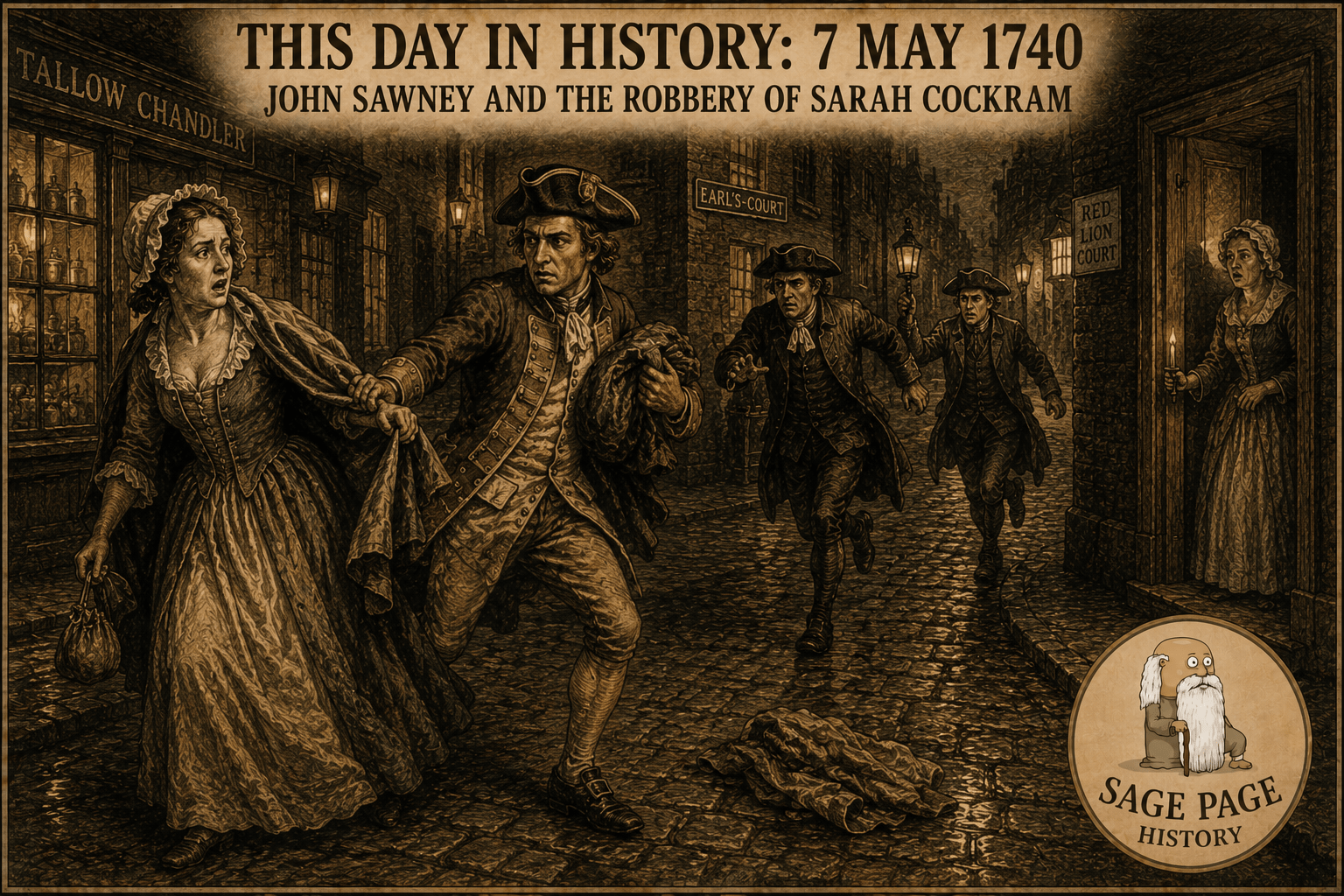
On the evening of 29 January 1740, just after seven o’clock, Sawney encountered Sarah Cockram in Drury Lane.
What followed was swift, crude, and violent.
He first attempted conversation:
- asking directions
- probing whether she was local
- inviting her for a drink
When rebuffed, his tone turned.
Without warning, he seized her cloak, wrenching it from her shoulders so forcefully that:
- the fastening tightened at her throat
- she was nearly choked
- she cried out in terror
He tore the garment free and fled into the dark.
“Stop Thief!”
Cockram’s cries brought immediate attention.
Men from nearby shops—lit by candlelight—took up the pursuit:
- through Earl’s Court
- into narrow passages and turning courts
- finally into a dead-end
Sawney, perhaps unfamiliar with the maze of London streets, made a fatal mistake:
he ran into a court with no escape.
Moments later, he was discovered:
- hiding behind a door
- the stolen cloak discarded nearby
He was seized and brought before a magistrate.
Defiance and Denial
At his examination, Sawney showed neither humility nor restraint.
- He insulted those who had apprehended him
- Threatened the victim
- Claimed innocence, despite overwhelming evidence
Most damning of all, he reportedly declared:
he could “own the fact” when he pleased—and deny it just as easily in court.
The court was not persuaded.
Conviction and Sentence
The evidence was clear:
- the victim’s testimony
- eyewitness pursuit
- immediate capture
- recovery of the stolen cloak
The jury returned a verdict:
Guilty. Sentence: Death.
For the theft of a cloak valued at 12 shillings, a man’s life was forfeit.
The Ordinary’s Account
In the days before his execution, Sawney expressed repentance.
He blamed:
- drink
- poor judgment
- a life grown unsettled after leaving the sea
He declared himself:
- penitent
- reconciled to God
- “in peace with all men”
Whether this repentance was born of faith or fear, we cannot know. But it followed a familiar pattern in the Ordinary’s accounts—regret arriving at the edge of the scaffold.
Final Reflection
John Sawney’s story is not one of grand villainy, but of small decisions compounding into catastrophe:
- a life unsettled
- a night of drink
- a moment of violence
And from that moment, there was no return.
In 18th-century London, justice was swift, public, and unforgiving.
A cloak could cost a life.
Thank you for reading my writings. If you’d like to, you can buy me a coffee for just £1 and I will think of you while writing my next post! Just hit the link below…. (thanks in advance)


