The Brickbat, the Fatal Fever and a Mother’s Lie
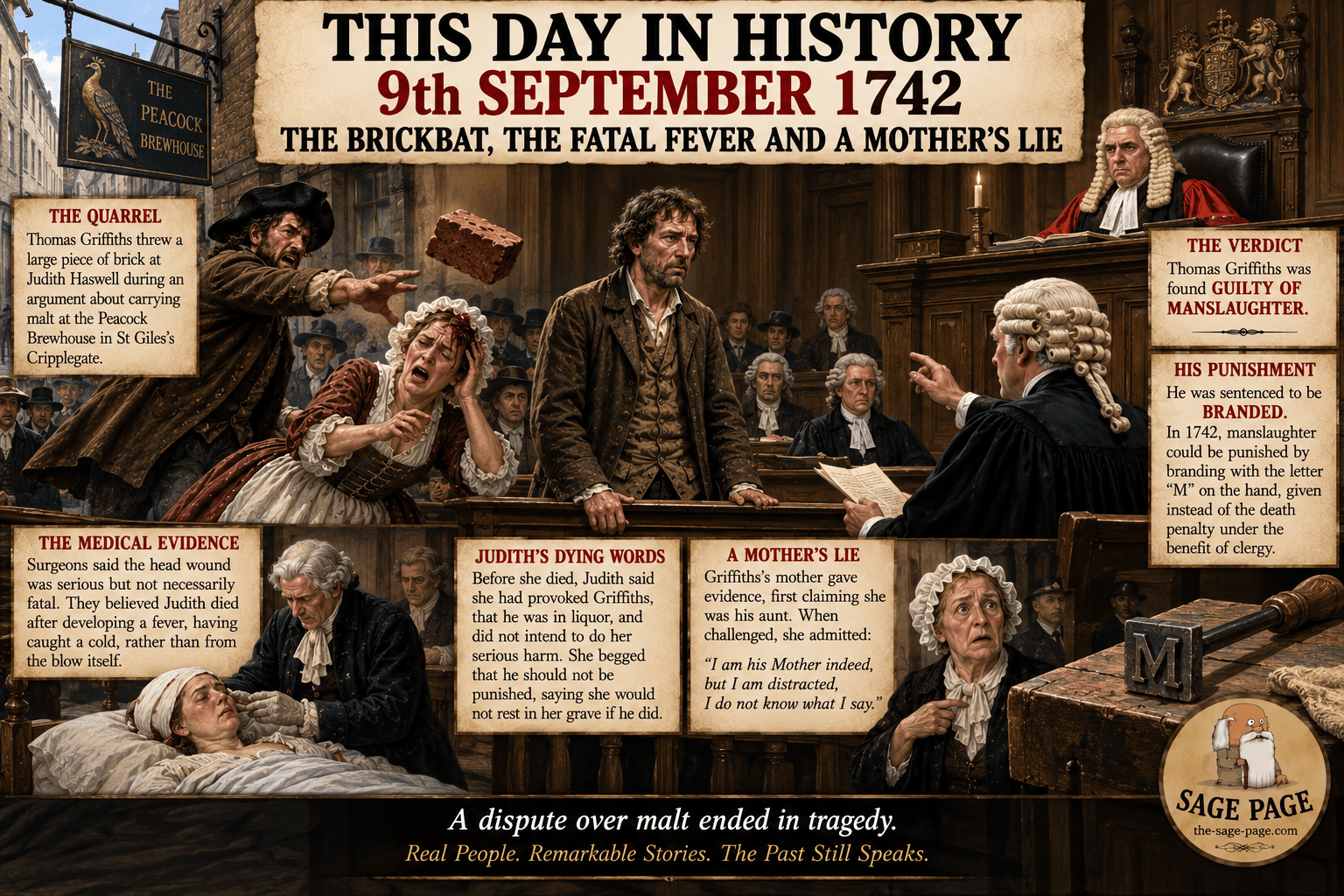
On 9th September 1742, Thomas Griffiths stood at the Old Bailey accused of murdering Judith Haswell, a woman who had been living as his wife and was generally known to neighbours as Judith Griffiths. The prosecution alleged that during an argument in Whitecross Street, Griffiths deliberately hurled a large piece of brick at her head. Judith survived the initial injury, but died several days later — leaving the jury with a difficult question: had Griffiths murdered her, or had the wound merely begun a chain of events that ended in her death?
The quarrel had begun over something remarkably ordinary. Judith wanted Griffiths to go and carry malt at the Peacock Brewhouse. He refused. According to witness Samuel Walton, Griffiths picked up a piece of brick almost as large as his fist and warned Judith that if she did not leave him alone he would throw it at her.
She stayed.
Griffiths, standing several yards away, then threw the brick with his left hand. It struck Judith hard on the head.
Walton was in little doubt that the act was deliberate. When Griffiths challenged him in court and asked whether he had done it intentionally, Walton replied that he clearly had because he had threatened to throw the brick and then carried out the threat.
“I will knock your brains out”
Other witnesses made Griffiths’s position considerably worse.
Robert Rollison had heard the couple arguing and testified that Griffiths threatened:
“I will knock your Brains out if you do not get away.”
More damaging still was what Rollison claimed Griffiths said afterwards — that if he had not killed Judith, he would kill her and did not care if he were hanged for doing so.
Margaret Allen actually saw the brick strike Judith and blood appear from the wound. She also saw Griffiths pick up a second brickbat, apparently preparing to throw that as well.
Diana Brislet told a similar story. A man named Mr White apparently intervened and took the second brick away from Griffiths.
On those accounts alone, a murder conviction might have appeared distinctly possible.
But then came the surgeons.
What actually killed Judith?
Surgeon Charles Wheeler had treated Judith after the attack. Her wound was around an inch and a half long and extended down to the skull.
Yet Wheeler did not believe the wound itself necessarily had to be fatal.
Judith had continued travelling to his surgery in Basinghall Street, apparently even doing so in the rain. Wheeler became so concerned about her circumstances that he complained to the churchwarden, warning that she might die unless she was provided with a better place to recover.
His conclusion was striking. He believed Judith had caught cold, developed a fever and suffered inflammation of the membrane surrounding the brain. In his opinion, her inadequate accommodation and lack of warmth and necessities contributed more to her death than the original wound.
A second surgeon, Thomas Goodman, broadly agreed. He found no fractured skull and no obvious injury to the brain. Goodman believed that had Judith not caught cold, the wound might have healed.
It introduced an important complication. Griffiths had unquestionably thrown the brick and caused the injury — but the medical witnesses were reluctant to say that the blow alone had inevitably killed her.
Judith speaks from her deathbed
Then came evidence of what Judith herself had said shortly before she died.
Witness Mary Petts testified that Judith revealed her real name was Judith Haswell and that Griffiths was not actually her husband, despite the couple having lived together and neighbours knowing her as Griffiths.
More importantly, Judith reportedly tried to protect the man who had injured her.
She said Griffiths had been drinking, that she had greatly provoked him, and that she did not believe he had intended to cause her serious harm. She supposedly begged that he should not “come to any Damage” because of her death, saying she would not rest in her grave if he did.
Another witness confirmed hearing essentially the same declaration.
Griffiths himself admitted throwing the brick. His defence was not that somebody else had done it, but that Judith had continually provoked him until he could tolerate it no longer. He accepted that he had struck her, while denying any intention to cause serious injury.
“I am his Aunt”
Then the trial produced perhaps its most memorable moment.
Mary Griffiths appeared as a witness and was asked how she was related to the prisoner.
She replied:
“I am a small Relation — but very little — I am his Aunt.”
Unfortunately for Mary, Robert Rollison immediately informed the court that she was actually Griffiths’s mother.
The judge challenged her. There was nothing wrong with admitting she was the prisoner’s mother, the court pointed out — but there certainly was something wrong with swearing under oath that she was his aunt when she was not.
Cornered, Mary finally admitted:
“I am his Mother indeed, but I am distracted, I do not know what I say.”
Despite that extraordinary performance, her evidence about Judith’s final wishes broadly supported that of the other witnesses: Judith had blamed her own provocation and had not wanted Griffiths to die for what he had done.
Murder or Manslaughter?
Several character witnesses described Griffiths as a peaceful, harmless and hardworking man. Judith Knight went further, calling him a “poor, harmless, inoffensive Fellow, but a little half-witted,” while describing Judith as extremely provocative when she had been drinking.
The jury ultimately rejected the charge of murder.
But neither did they absolve Griffiths.
He had deliberately picked up a brick, threatened Judith with it and thrown it hard enough to cause a serious head wound. Whatever the subsequent effects of infection, fever and inadequate care, his violence had started the sequence that ended with her death.
Thomas Griffiths was found guilty of manslaughter.
It is a fascinating case because almost every witness complicates the story. Griffiths’s threats suggest frightening intent; Judith’s own dying words plead for mercy towards him; the surgeons question whether the wound itself was fatal; neighbours describe a volatile relationship; and Griffiths’s own mother manages to commit an astonishing courtroom blunder while attempting to help her son.
And at the centre of it all was a mundane domestic argument over whether a man would go and carry malt at a brewery — an argument that ended with a thrown brick, a woman’s death and an Old Bailey manslaughter conviction.
Historical Footnote – Branded for Manslaughter
Thomas Griffiths was sentenced to be branded following his conviction for manslaughter. In 1742, branding was closely associated with benefit of clergy, the centuries-old legal mechanism that had evolved into a way for certain offenders to escape the death penalty. By Griffiths’s time, literacy was no longer required to claim the privilege, and many first-time offenders convicted of offences such as manslaughter could receive a lesser punishment instead of hanging.
For manslaughter, the offender could be branded on the hand with the letter “M”, traditionally using a heated iron. The mark served an important legal purpose as well as being a punishment: it provided physical evidence that the offender had already received the benefit of clergy, preventing him from simply claiming the same privilege again as a first offender.
So although Griffiths had entered the Old Bailey facing a murder charge and the possibility of execution, the jury’s decision to convict him only of manslaughter made an enormous difference. He left the court branded rather than condemned to the gallows.
Thank you for reading my writings. If you’d like to, you can buy me a coffee for just £1 and I will think of you while writing my next post! Just hit the link below…. (thanks in advance)


