Quote of the Day: Holly Moses on Control

Quote: “You can’t control the wind, but you can at least complain about your hair.”
— Holly Moses


Holly Moses has a knack for mixing gentle wisdom with a playful wink. This quote reminds us that life’s big forces — the winds of fate, change, or weather — are outside our control. But instead of fighting them, she suggests leaning into the small, human reactions that make us laugh at ourselves.

Her philosophy turns frustration into comedy: while others rage against the storm, she notices the mess it makes of her fringe. It’s a softer, sillier kind of resilience — not ignoring life’s chaos, but turning it into a story worth sharing.

As The Sage himself might add: you can’t stop the wind, but you can always find a hat.


Thank you for reading my writings. If you’d like to, you can buy me a coffee for just £1 and I will think of you while writing my next post! Just hit the link below…. (thanks in advance)


Thought of the Day: Pigeons and Statues

Some days you’re the pigeon, some days you’re the statue.


The Sage believes balance is the natural order of things. Some days you soar triumphantly, strutting about with feathers unruffled. Other days you find yourself motionless, staring grimly ahead while life dumps indignities on your head. The trick, he says, is learning to laugh from either perspective.

It’s a whimsical reminder that fortune and misfortune are both temporary. No matter how lofty you feel today, you might be the statue tomorrow — and vice versa. Either way, the pigeons always seem to win.

The Sage insists that wisdom is not about avoiding pigeon days, but embracing them as part of life’s comedy. After all, without statues, pigeons would just be circling aimlessly — and without pigeons, statues would get far too smug.


Thank you for reading my writings. If you’d like to, you can buy me a coffee for just £1 and I will think of you while writing my next post! Just hit the link below…. (thanks in advance)

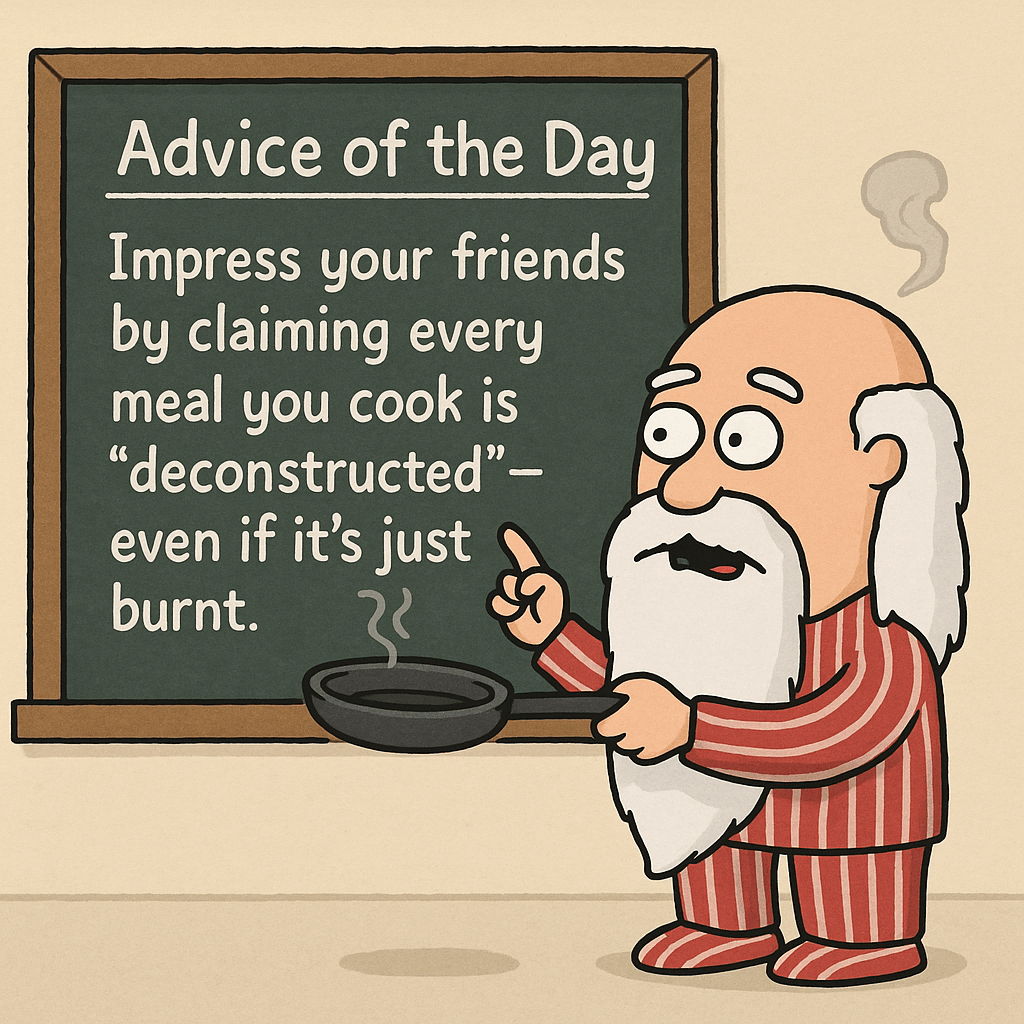
Advice of the Day: Deconstructed Dining

Advice: Impress your friends by claiming every meal you cook is ‘deconstructed’ — even if it’s just burnt.


The Sage has long insisted that fine dining is mostly about presentation and vocabulary. Why admit to culinary disaster when you can rebrand it as innovation? A collapsed soufflé becomes “rustically deconstructed.” A charred lasagne? “Postmodern interpretation of pasta.” Even an empty plate can be explained as “minimalism.”

This advice elevates every clumsy cook into a master chef. Guests may raise an eyebrow, but with enough flourish and the right tone of voice, they’ll nod as if they’ve just eaten art. And if all else fails, serve wine first — lots of it.

Of course, there are limits. Not every scorched casserole can be excused as “avant-garde,” and there’s always the risk of someone calling your bluff with an actual recipe book. But The Sage insists that confidence is the best seasoning, and nothing says confidence like presenting burnt toast as haute cuisine.


Thank you for reading my writings. If you’d like to, you can buy me a coffee for just £1 and I will think of you while writing my next post! Just hit the link below…. (thanks in advance)
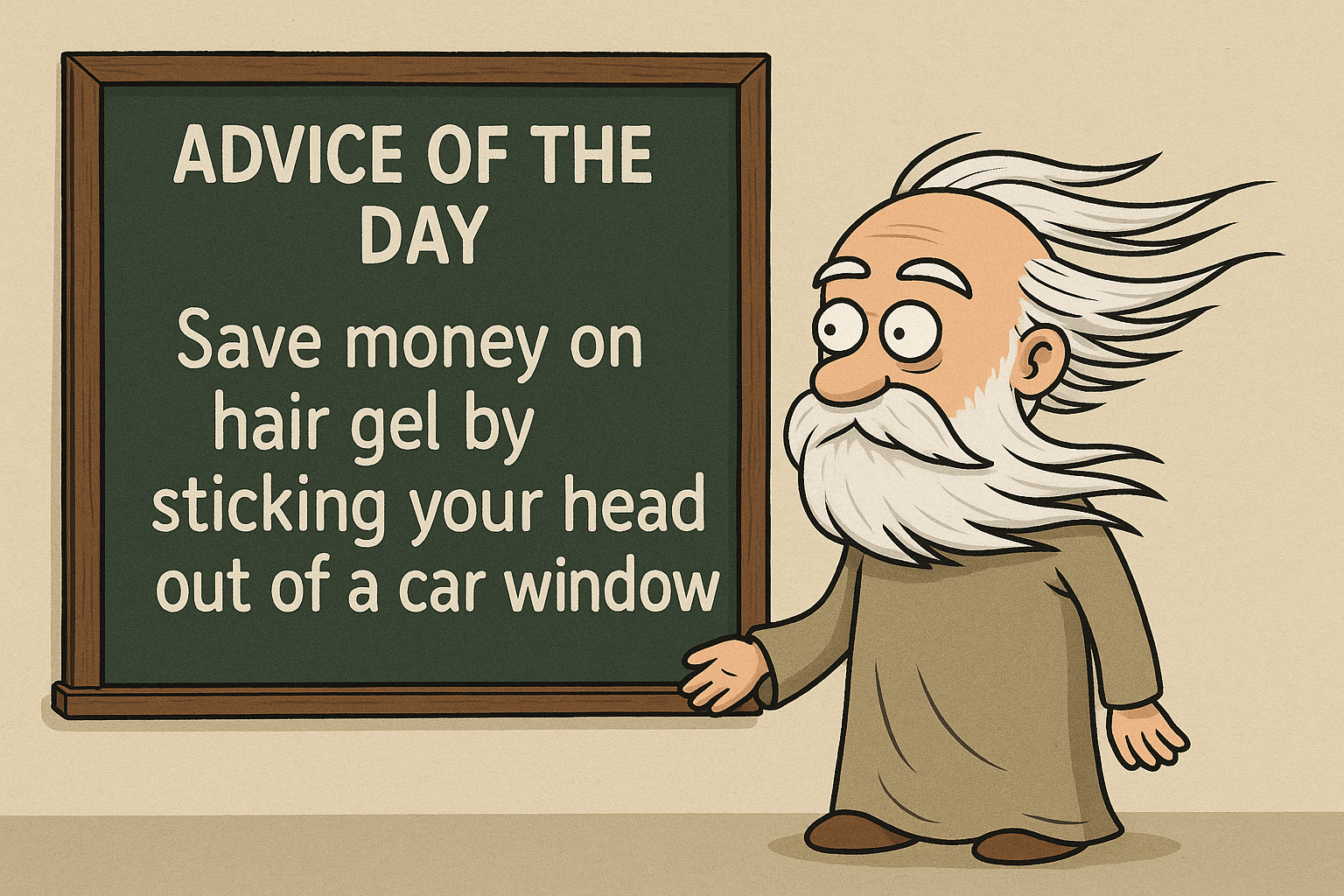
Advice of the Day: Natural Styling

Advice: Save money on hair gel by sticking your head out of a car window at 70mph.


The Sage is always looking for thrifty alternatives, though they often come with side effects. This one guarantees a wind-swept look that no salon can rival — the kind of hairstyle that screams “rebellion” and “possibly mild concussion.”

True, this tip may ruffle more than just your hair. Bugs, road dust, and the occasional startled pedestrian may all leave their mark. But think of the savings on mousse, gel, and pomade! Besides, there’s no stronger hold than the force of a motorway crosswind.

As always, The Sage insists wisdom lies in seeing opportunity where others see nonsense. Where one person sees danger, he sees a free blow-dry — and a hairstyle that can only be described as “apocalyptic chic.”


Thank you for reading my writings. If you’d like to, you can buy me a coffee for just £1 and I will think of you while writing my next post! Just hit the link below…. (thanks in advance)
Advice of the Day: Prickly Alarm

Advice: Never oversleep by replacing your pillow with a cactus.


The Sage has always said that the best alarm clocks don’t beep, buzz, or sing — they stab. With this simple substitution, you’ll never hit snooze again. Instead, you’ll leap out of bed at dawn, wide awake and reconsidering all of your life choices.

Admittedly, this approach comes with minor drawbacks, such as puncture wounds, ruined bedsheets, and a strange reputation at your local garden centre. But The Sage insists that true wisdom is about effectiveness, not comfort — and nothing wakes you faster than a cactus to the ear.

Besides, mornings are overrated. After one night with this system, you’ll either be an early riser or a hospital patient. Either way, you’ll never be late again.


Thank you for reading my writings. If you’d like to, you can buy me a coffee for just £1 and I will think of you while writing my next post! Just hit the link below…. (thanks in advance)

Thought of the Day: Wisdom and Glasses

Wisdom comes with age — so does the inability to find your glasses.


The Sage knows that ageing brings both gifts and irritations. On one hand, you acquire the kind of wisdom that can only come from decades of mistakes. On the other, you lose track of your spectacles every fifteen minutes — often while they’re perched on your own head.

This thought pokes fun at the gap between how we like to see ourselves and the everyday reality of growing older. True wisdom might lie in recognising patterns, solving problems, and passing down lessons… but it also lies in laughing at the absurdity of checking the fridge for your missing glasses.

The Sage insists that humour is the best lens through which to view life’s little indignities. If you can’t find your glasses, perhaps it’s simply the universe’s way of reminding you that wisdom and forgetfulness are lifelong companions.


Thank you for reading my writings. If you’d like to, you can buy me a coffee for just £1 and I will think of you while writing my next post! Just hit the link below…. (thanks in advance)

Advice of the Day: Key Security

Advice: Avoid losing your house keys by swallowing them every morning and waiting for nature to return them.


The Sage has finally solved the age-old problem of misplacing keys — by putting them somewhere you definitely won’t forget. True, this system comes with certain dietary drawbacks and awkward explanations at the doctor’s office, but you’ll never be locked out again (at least not for long).

Admittedly, this approach raises practical concerns. For instance: how many spare sets can one person comfortably ingest? And what happens when the locksmith asks where you’ve been keeping them? Still, The Sage insists that any method guaranteeing key retrieval — however circuitous — must be considered a success.

Besides, he argues, wisdom is about thinking outside the box… or in this case, inside the digestive tract. Just don’t ask him to jingle his pockets.


Thank you for reading my writings. If you’d like to, you can buy me a coffee for just £1 and I will think of you while writing my next post! Just hit the link below…. (thanks in advance)

This Day in History — 25 September 1789

Mary Stultz and the Petticoat Theft

Two garments, two years, and the weight of Georgian justice.


👗 The Incident

On 25 September 1789, Mary Stultz was accused of stealing from William (surname lost to time) two ordinary but valuable garments:

  • One flannel petticoat, worth one shilling.
  • One linen shirt, also valued at one shilling.

These were not luxuries but necessities — clothes worn close to the skin, garments that marked dignity and respectability. Their theft cut as deeply into propriety as it did into property.


🏛️ The Trial at the Old Bailey

By 28 October 1789, Stultz stood in the dock at the Old Bailey. The indictment was read in solemn tones:

“Mary Stultz, you stand indicted for feloniously stealing one flannel petticoat and one linen shirt, the goods of William …”

The evidence was sufficient, and her defence, if any, did not sway the jury. In Georgian London, theft of clothing was common — but the law made little allowance for poverty or desperation.


⚖️ The Verdict & Sentence

The jury declared:

Guilty.

The judge pronounced her punishment:

Two years’ imprisonment.

For two stolen garments valued at two shillings, Mary Stultz would spend twenty-four months behind bars — a harsh measure by today’s standards, but a routine outcome in 18th-century justice.


🧠 Why It Matters

  • Value in small things: Petticoats and shirts were costly relative to income — their theft struck at daily survival.
  • Women before the law: Stultz’s case reflects the vulnerability of working women in London, often prosecuted for property crimes born of necessity.
  • Punishment and proportionality: Two years in prison for two garments illustrates the rigidity of a system where mercy was scarce and property paramount.

Thank you for reading my writings. If you’d like to, you can buy me a coffee for just £1 and I will think of you while writing my next post! Just hit the link below…. (thanks in advance)

Quote of the Day: Holly Moses on Beauty in Chaos

Quote: “Life rarely ties things up with a ribbon — but it does a decent job with tangled string.”
— Holly Moses


Holly Moses has a gift for finding charm in imperfection. This quote reminds us that life is seldom neat, tidy, or packaged the way we expect. Instead, it’s often messy, knotted, and improvised — but that doesn’t make it any less valuable.

Her words suggest that beauty isn’t in perfection but in resilience: the way we make do, mend, and even laugh at the untidy threads we’re given. Tangled string might not be as pretty as ribbon, but it still holds things together — and sometimes, that’s all we need.

The Sage himself would surely approve, having relied on knotted string more than once to keep his robe from betraying him at inopportune moments.


Thank you for reading my writings. If you’d like to, you can buy me a coffee for just £1 and I will think of you while writing my next post! Just hit the link below…. (thanks in advance)

Thought of the Day: Common Sense Connection

Common sense is like Wi-Fi — everyone assumes they have it until it drops out.


The Sage has long noted that common sense, like modern technology, is often more talked about than reliably present. Just as Wi-Fi bars mysteriously vanish the moment you need them, so too does common sense evaporate precisely when it’s most required — usually during DIY or group projects.

This thought reminds us that while people love to boast about their “strong signal,” reality is a patchy connection at best. One moment the world is full of logic and good judgement; the next, someone’s microwaving soup with the lid still on. The Sage argues that this is proof we all live in areas of low reception.

Of course, true wisdom lies not in mocking these outages but in recognising our own. After all, even The Sage admits his beard once got caught in a toaster — and nothing makes you humble quite like that kind of disconnect.


Thank you for reading my writings. If you’d like to, you can buy me a coffee for just £1 and I will think of you while writing my next post! Just hit the link below…. (thanks in advance)