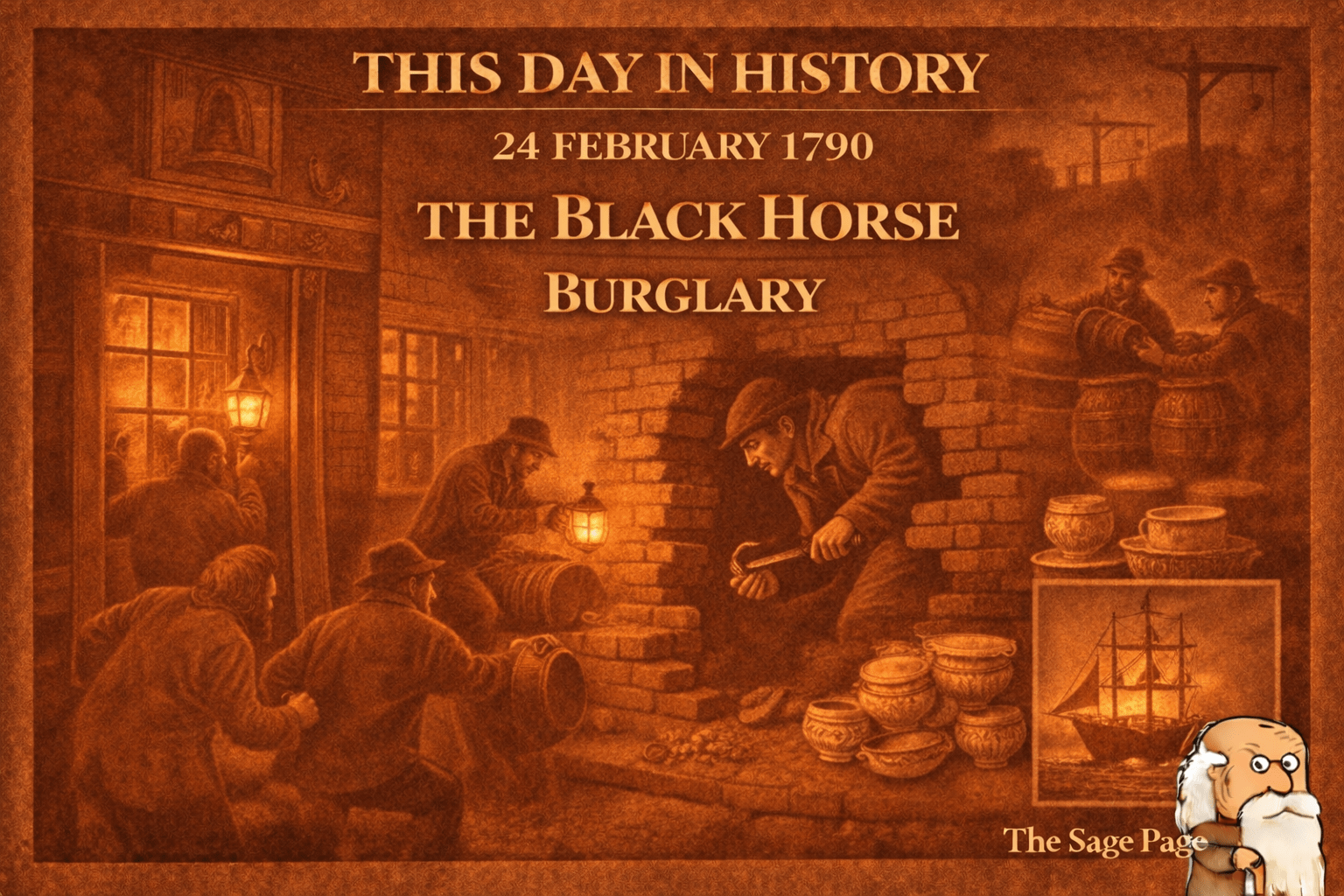
On 24 February 1790, James East and William Wilson stood before the Old Bailey, charged with burglariously breaking and entering the dwelling-house of George Wood in Kingsland Road.
They had stolen not gold, nor jewels —
—but spirits.
They were found guilty.
They were sentenced to death.
The Black Horse, Kingsland Road
George Wood kept the Black Horse in Kingsland Road.
On the night of 22 January, his house was carefully secured. Heavy shutters. Bolts top and bottom. A movable inner bar shutter that only he could lift.
At half past two in the morning, the watchman raised the alarm.
Wood discovered:
- Outside shutter smashed
- Window sash raised
- Four rows of bricks removed beneath the window
- Inner shutter taken down from inside
A man-sized hole had been cut into the wall.
Inside, a street-lamp burner lay discarded.
The Spoils
The theft was extraordinary in its variety:
- Brandy
- Rum
- Aniseed
- Peppermint
- Bitters
- Raspberry
- Cholick water
- Seven casks
- Five china punch bowls
- Linen, worsted, apron strings
- 168 copper halfpence
- 336 copper farthings
The value of spirits alone exceeded several pounds.
This was no opportunistic theft.
It was organised burglary.
The Lamp and the Crow
Accomplice William Lister testified that East:
- Broke the outer shutter with a crow
- Removed bricks from beneath the window
- Entered through the hole
- Took down the inner shutter
- Stole lamp burners from nearby street lamps to light the bar
The image is almost theatrical: thieves stealing light from the street to illuminate their crime.
Spirits were passed out of the window and carried across a field.
Some linen and small goods were sold for eightpence.
Five china bowls were sold for four shillings.
The casks were moved from house to house in Hackney Road and Golden Lane.
Here is his full testimony:
WILLIAM LISTER sworn.
On Friday night, the 22d of January, James East and William Wilson and me were drinking together at the Gentleman and Porter, which Webb keeps: we came out of there about half after eleven at night: the women were in company; but they went forwards: William Wilson and me and James East , went to East’s house, about an hundred yards from the Black Horse, which was broke open; we staid there about half an hour or an hour: we went together to Mr. Wood’s. East took a crow from his pocket, and broke a piece of the outside shutter of the bar window, and then put up his arm, and unbolted the bolt of the outside shutters, and broke a pane of glass, to hoist up the sash: Wilson broke the pane of glass, with the same crow; the sash was fastened so that we could not open it: East took the crow and made a hole through the wall, and got in through the hole underneath the frame, and took down the inside shutter of the bar window, and placed it against the bar door: he hoisted up the sash, and came out from the inside: we crossed the road all three together; we had no light: East got up the lamp post, and took the burner out alight: he came back to the window, and delivered the burner into my hand; and afterwards, East got in; nobody else: East took the burner out, and we all went together to another lamp, and took the glass and burner both alight: then we all came back to the window with the glass lamp, and the burner alight in it: East gave it into my hand, while he got in at the window; he handed out a small basket with some linen in, and tape and worsted; and then handed out the till with some halfpence: the halfpence were emptied into Wilson’s pocket, and the till left the outside of the window: East came out of the window, and we all three took the things into the field facing the house: we moved them out of the field, up to Wilson’s house: we only just rested in the field: Wilson’s house was just across the field. The small trifle of linen was sold to Wilson’s wife for eight-pence: we took the seven kegs of liquor down to one Lewis’s in Hackney-road; Wilson’s wife and Mary brought the five china bowls down to Lewis’s, in the morning: I was there then: afterwards, Wilson’s wife and Mary Linton took each a cask apiece from Lewis’s, and the five china bowls: Wilson’s wife carried the bowls: I followed them down; they took them to the house of one Mr. Handfield; we were all in there together: East went backwards to Mr. Handfield, and asked him some questions which I do not know: we went to Handfield’s to try to sell the goods: then East came back to us into the tap-room, and said that Mr. Handfield would have nothing to do with them: then we all came out together, and went from thence to Golden-lane, to the prisoner Mackaway’s; the two women brought each one cask and the five bowls away: we left the other two bowls at Lewis’s: we all went into Mackaway’s entry; and East and I took the two casks and the five bowls from the women, and left them at the door, and Wilson with them: we saw Mrs. Mackaway, and told her we had seven casks of liquor in the whole; she would say nothing to them; East and I left the two casks of liquor at Mrs. Mackaway’s house, and sold the two bowls to her for four shillings; she told us to leave the two casks till the others were brought up at night: for she would give us no answer till her mother came from Woolwich: the five china bowls we sold to Mrs. Mackaway’s daughter for four shillings; we left the two casks there; then we came out, and Wilson and his wife and Linton went one way, and East and me went another way: and in less than a quarter of an hour, going through Play-house-yard, East and me were taken: I was buying a pair of old shoes at a clothes shop: I have nothing to say against the woman Ann East ; she had nothing to do with this robbery: I cannot tell what became of the rest of the casks that were left at Lewis’s: Lewis keeps a smith’s shop in Hackney-road; they were put in an empty room before he was up in the morning; the door of which was open: I never was in East’s apartments, nor do I know who lived there.
Jury. Whether when he was at Mackaway’s it was an absolute sale, or was it a loan? – They were sold to her: East asked her five, and she would give but four.
Was not it a contract to bring the rest of the things? – No; she gave us four shillings for the five bowls; nothing else.
The Receivers
Four women were indicted for receiving stolen goods:
- Mary Mackaway
- Mary Linton
- Ann East
- Jane Wilson
Goods were found concealed in gardens and under bedding.
An iron crow covered in brick dust was produced.
Mary Linton (aged 20) and Ann East (aged 17) were convicted and sentenced to fourteen years transportation to New South Wales in January 1791.
Mary Mackaway and Jane Wilson were acquitted.
The Verdict
James East (aged 28)
William Wilson (aged 19)
GUILTY. Death.
The Bloody Code remained unforgiving toward burglary committed at night.
Breaking into a dwelling-house after dark was a capital felony.
Night Burglary Under the Bloody Code
By 1790, more than 160 offences carried the death penalty.
Night burglary was treated as particularly dangerous:
- It violated domestic security
- It implied potential violence
- It threatened property and life
Even theft of spirits and household goods could bring the gallows if committed by breaking and entering after dark.
Transportation to New South Wales
The two young women convicted were transported in January 1791.
This was only a few years after the establishment of the penal colony at New South Wales (1788).
Unlike earlier convicts sent to America, these women were among the early waves sent to Australia — to a penal experiment still in its infancy.
Transportation meant:
- Years of forced labour
- Permanent exile
- Often no return
Money Then & Now
Thirty shillings of brandy, twenty of rum, plus multiple casks — the spirits alone represented several months’ wages for a labourer.
Five china punch bowls valued at thirty shillings suggest the Black Horse was no humble alehouse.
In modern purchasing power, the total value likely equates to several thousand pounds.
Yet the bowls were sold for only four shillings.
Desperation discounts heavily.
Why This Case Matters
The Black Horse burglary reveals:
- Organised urban theft networks
- The role of accomplice testimony
- The importance of receivers in criminal economies
- The brutal sentencing framework of the Bloody Code
- The early use of Australian transportation
It is also a reminder that capital punishment often fell upon the young.
Wilson was nineteen.
Ann East was seventeen.
Sources
- Old Bailey Proceedings, 24 February 1790, trial of James East and William Wilson
- Transportation record, January 1791
Historical Footnote: What Became of William Lister?
One curious footnote to the Black Horse burglary concerns William Lister, the accomplice whose testimony secured the convictions of James East and William Wilson.
Lister was not sentenced in 1790. His detailed account of the burglary suggests he had turned King’s evidence — a common eighteenth-century practice in which an accomplice testified for the Crown in exchange for pardon or non-prosecution.
Yet five years later, on 14 January 1795, a man of the same name and plausible age (34) appeared again at the Old Bailey — this time convicted of stealing a watch and sentenced to seven years’ transportation.
There is no definitive proof this was the same William Lister.
But the chronology fits.
If so, the man who avoided the gallows in 1790 ultimately shared the fate of the transported women he had helped convict.
Mercy in the eighteenth century was often temporary.
What Ship Might He Have Sailed On? (1795–1796)
By 1795, transportation no longer meant America.
Convicts were sent to New South Wales, where the penal colony at Sydney Cove had been established only seven years earlier (1788).
Convict ships departing in 1795–1796 included vessels of what historians often call the Third Fleet and subsequent early transports.
Ships sailing in this period included:
- The Surprize (1794–95 voyage)
- The Indispensable (1796)
- The Marquis Cornwallis (1796)
- The Britannia (1797, slightly later)
Seven-year male convicts sentenced in early 1795 were commonly held:
- In gaols or prison hulks on the Thames
- For several months
- Before embarkation
The voyage to New South Wales typically lasted:
- 6 to 8 months
- Under harsh and cramped conditions
- With significant mortality rates in earlier fleets (though improving by mid-1790s)
If this was the same William Lister:
He likely would have:
- Been transferred to a Thames hulk in 1795
- Embarked in 1795 or 1796
- Arrived at Sydney Cove during the colony’s formative, difficult years
Upon arrival, seven-year convicts were typically assigned to:
- Government labour gangs
- Private settlers
- Construction, agriculture, or timber work
By around 1802, his term would have expired — assuming survival.
The Irony
If the 1790 accomplice and the 1795 convict were indeed the same man, his story becomes quietly tragic:
- 1790: Helps send others to death and transportation.
- 1795: Sentenced himself.
- Destination: The same penal system he once helped enforce.
The eighteenth-century criminal world was fluid.
Today’s witness could be tomorrow’s transport.
Thank you for reading my writings. If you’d like to, you can buy me a coffee for just £1 and I will think of you while writing my next post! Just hit the link below…. (thanks in advance)