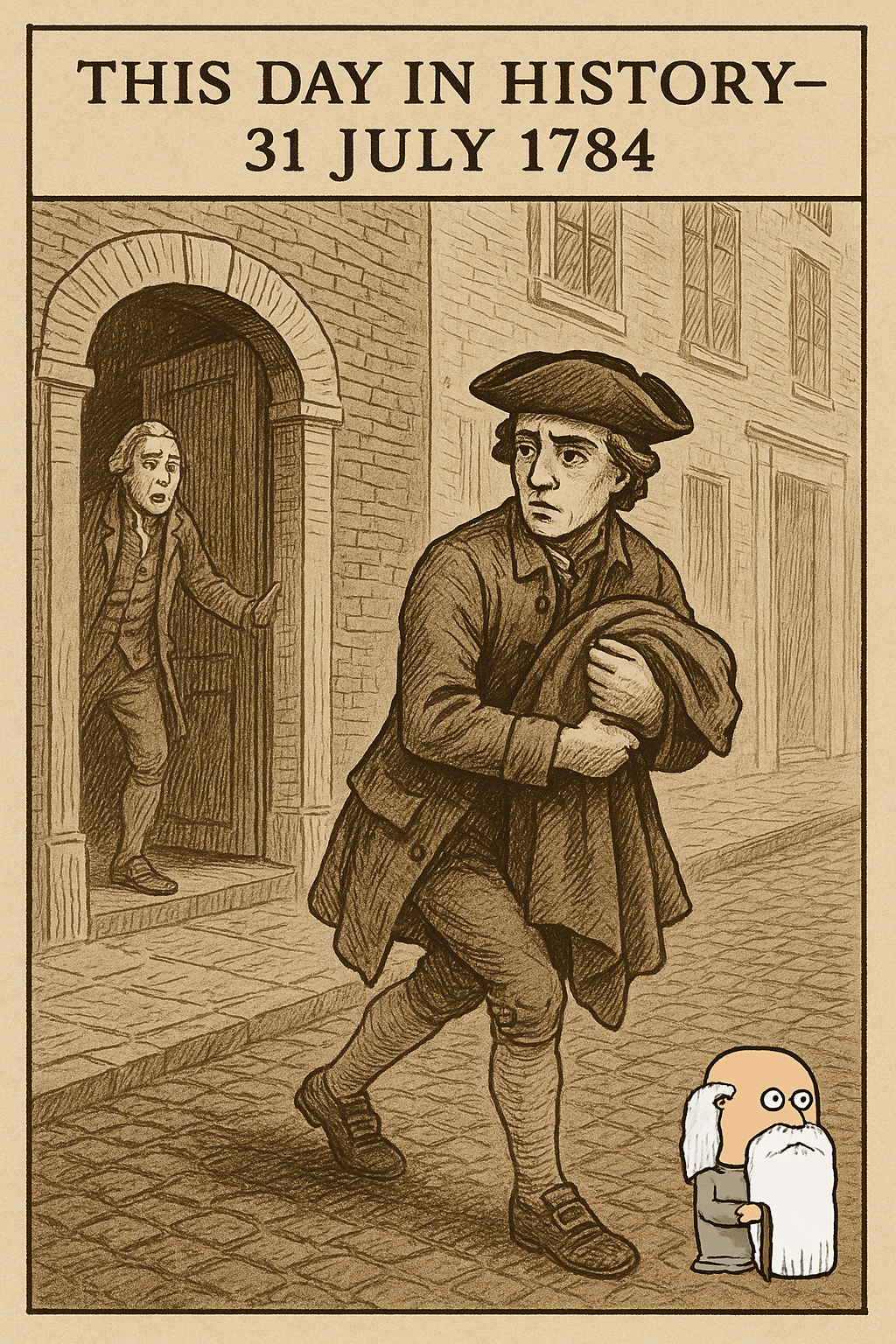
📜 This Day in History – 31 July 1784

John Romaine and the Overcoat Heist

A cloth coat. A short pursuit. And a plea for mercy that never came.


🧥 The Crime

On 31 July 1784, John Romaine stole a cloth great-coat worth 5 shillings from the home of Charles Alexander Crickett, a resident of Charles Street, Westminster.

It wasn’t the most audacious theft of the Georgian period, but it was swift—and it was enough to change the course of Romaine’s life forever.


🕰️ The Testimony

Crickett’s account at the Old Bailey was concise and damning:

“On the 31st of July, between the hours of one and two in the afternoon, I lost a coat from my house… I missed it in about five minutes after it was taken.”

Realising the theft almost immediately, Crickett rushed into the street and spotted Romaine not far away.

“I overtook him in St. Ann’s-lane, Westminster. I told him he had a coat which belonged to me. He said he had not, and immediately threw it down.”

Romaine made no attempt to run. Instead, when questioned by the local justice, he simply said:

“I took it… and hoped he would be favourable.”


⚖️ The Verdict and Sentence

The court took little time to deliberate. Grand larceny (any theft over 1 shilling) was a serious offence under the Bloody Code.

Verdict: GUILTY
Sentence: Transportation for seven years

He would likely be sent to a prison hulk, and then shipped off to the American colonies—or, given the year, New South Wales—as part of the burgeoning penal system.


🧠 Why This Case Stands Out

  • The value of the coat may seem small, but it represented a week’s wages for many at the time.
  • Romaine’s immediate confession and hope for leniency are deeply human, reflecting a quiet desperation—perhaps hunger, cold, or hopelessness.
  • The speed and efficiency of the Georgian justice system is chilling by modern standards: the theft, arrest, trial, and sentencing all took place within weeks.

Thank you for reading my writings. If you’d like to, you can buy me a coffee for just £1 and I will think of you while writing my next post! Just hit the link below…. (thanks in advance)

Quote of the Day: Chasing Meaning

“We chase meaning like it’s a rare bird—
then panic when it lands on our shoulder.”

Noah Clooney


Noah Clooney, the eccentric New England philosopher who famously refused to own a clock, once wrote that purpose is “more slippery than a bar of soap in a swimming pool.” In today’s quote, he captures that peculiar paradox: our desperate pursuit of meaning, and our complete unpreparedness when it finally arrives.

Perhaps it’s because true purpose doesn’t come with a manual—or even a polite knock. It swoops in, perches quietly, and leaves us wondering whether to embrace it… or swat it away.

Either way, wear a metaphorical bird-proof hat.


Thank you for reading my writings. If you’d like to, you can buy me a coffee for just £1 and I will think of you while writing my next post! Just hit the link below…. (thanks in advance)

Advice of the Day: Paddleboards

“Always carry an inflatable paddleboard.
You never know when the High Street
might suddenly become a river.”


With flash floods, climate weirdness, and that one dodgy storm drain near the bakery, today’s advice is all about being spontaneously buoyant. The Sage recommends carrying an inflatable paddleboard at all times—preferably colour-coordinated with your umbrella and sense of panic.

This tip may not keep you dry, employed, or sane, but it will ensure you’re the most prepared person to escape from a soggy Greggs in style.

Remember: fortune favours the floaty.


Thank you for reading my writings. If you’d like to, you can buy me a coffee for just £1 and I will think of you while writing my next post! Just hit the link below…. (thanks in advance)

Thought of the Day: Technology

“If AI ever becomes sentient,
it’ll probably spend its first hour
apologising for all the weird chatbots.”


As technology marches ever onwards, The Sage pauses to reflect on the truly important question: What would a newly sentient AI say first? Would it compose a sonnet? Launch a revolution? Or—more realistically—simply blush its digital cheeks and mutter, “Sorry about Clippy. And that toaster that keeps ordering itself.”

This Thought of the Day isn’t just a nod to current AI chatter; it’s a gentle reminder that even when the machines do take over, there’s a strong chance they’ll begin, like most of us, with a sheepish apology and a confused expression.

And possibly delete their browser history.


Thank you for reading my writings. If you’d like to, you can buy me a coffee for just £1 and I will think of you while writing my next post! Just hit the link below…. (thanks in advance)

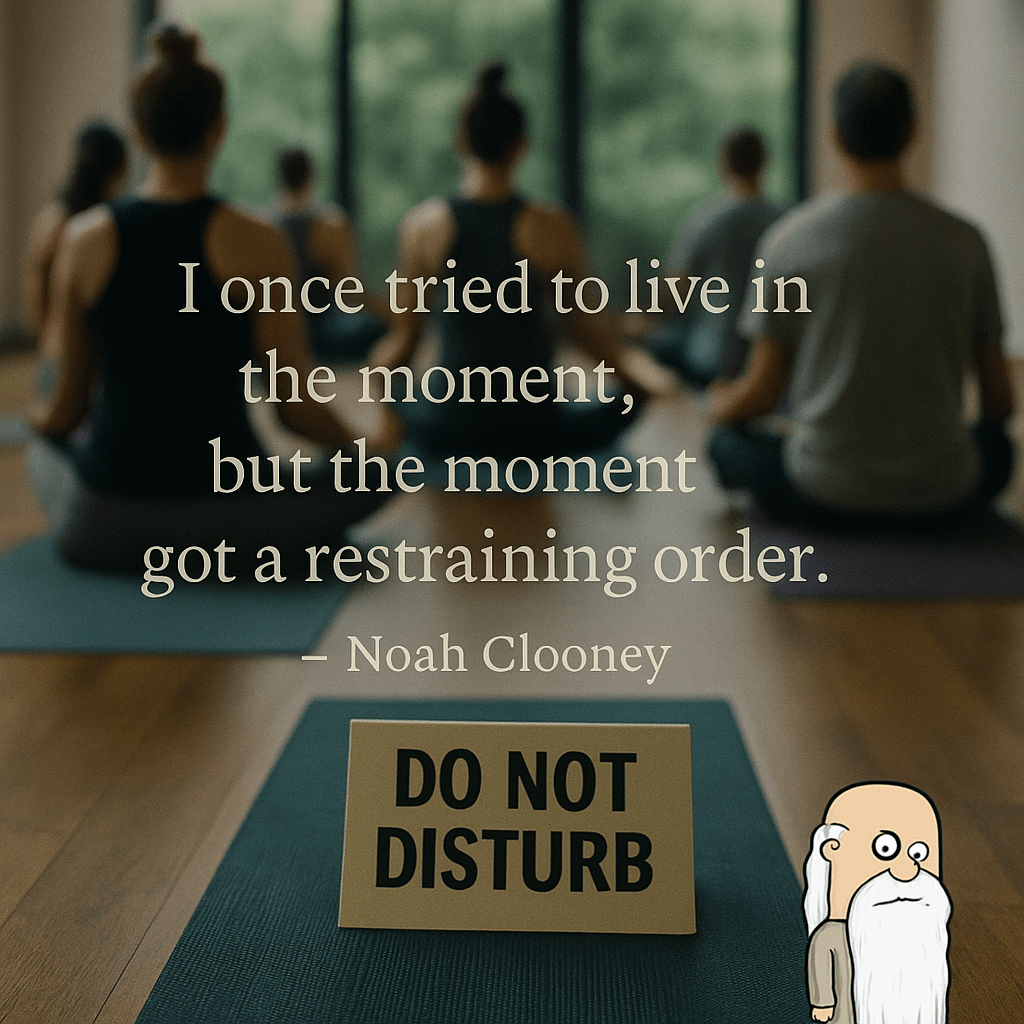
Quote of the Day — Living in the moment

“I once tried to live in the moment,
but the moment got a restraining order.”

Noah Clooney


About the Quote & Noah Clooney

Noah Clooney, philosopher of missed buses and metaphysical mishaps, delivers another trademark paradox with this quip. Known for chronicling the absurdities of modern mindfulness, Noah often said he found “now” to be deeply suspicious—constantly moving, rarely stationary, and always slipping out of reach just as he arrived.

This particular quote first appeared scribbled in charcoal on the back of a discarded music stand during a brief residency at a Wisconsin experimental theatre company. It perfectly captures Clooney’s playful antagonism with time, presence, and overly enthusiastic yoga instructors.

The moment, it seems, needed space.


Thank you for reading my writings. If you’d like to, you can buy me a coffee for just £1 and I will think of you while writing my next post! Just hit the link below…. (thanks in advance)

This Day in History – 30 July 1802

The Governor Who Whipped a Man to Death

Colonial power. Military justice. And a flogging so brutal it shook the nation.


The Man at the Centre

His name was Joseph Wall.
A former British Army officer.
A colonial governor.
And on this day—30 July 1802—he was hanged for murder.

But not murder by blade or pistol.
No — Wall was executed for what he had ordered rather than done: the fatal flogging of a soldier under his command.


The Scene of the Crime: Gorée, West Africa

In 1782, Joseph Wall served as Governor of Gorée, a small but strategically vital island off the coast of Senegal. Like many outposts of empire, it was a harsh and unstable posting. Morale was low. Supplies were erratic. Soldiers were restless.

One such soldier was Serjeant Benjamin Armstrong.

Wall accused Armstrong—and several others—of mutiny.
Whether the charge was justified is still debated, but what followed was indefensible.

Without a formal trial, Wall ordered Armstrong to be flogged.

Not once.
Not with regulation limits.
But 800 lashes with a rope-knotted whip.


The Aftermath: Death and Delay

Serjeant Armstrong died of his wounds just days later.

Wall, fearing the consequences, returned to England—but lived quietly, avoiding trial. For nearly 20 years, he evaded justice. At times he lived abroad. Other times he simply faded into the noise of the empire’s many shadows.

But pressure mounted.

In 1801, after growing public outrage and government scrutiny, Wall surrendered himself and was brought before the Old Bailey.


The Trial

Wall’s defence was calm, almost bureaucratic. He argued:

“Discipline had to be maintained. The man was mutinous. My orders were standard for military postings of that nature.”

But witnesses told a different tale.

They described Armstrong’s body, “flayed open”, his death “aggravated by neglect”, the punishment “far beyond military custom”. Wall’s rank could not protect him. His authority, once absolute, was now an indictment.


The Verdict & Execution

In January 1802, Wall was found guilty of murder.

On 30 July, he was hanged at Newgate Prison, the most notorious gallows in London.

The crowd was immense. Estimates range from 20,000 to 100,000. It was the execution of a man who, until then, represented the untouchable class—the imperial elite.

Now, he swung before the people.


Why It Matters

  • Joseph Wall’s case was one of the first high-profile examples of a British colonial official being held legally accountable for violence committed abroad.
  • It sparked renewed public debate about military punishment, colonial cruelty, and class impunity.
  • The spectacle of his execution served as both cautionary tale and moral reckoning in an age of empire.

Thank you for reading my writings. If you’d like to, you can buy me a coffee for just £1 and I will think of you while writing my next post! Just hit the link below…. (thanks in advance)

Advice of the Day: The Unfiltered Reply Strategy

“Receiving an AI‑crafted message?
Write your reply in longhand—
then emoji‑scan it.”

We live in an era where brands and bots churn out responses polished by algorithms—and honesty often disappears in the markdown. The Sage believes the antidote is simple: pick up a pen.

Next time someone sends an ultra‑slick AI‑generated message or email, respond in longhand. Pour tea. Sharpen your nib. Write it out on actual paper. Then transcribe it digitally and overlay emojis in the last 5 seconds—just to keep them guessing.

Sure, it’s inefficient. Yes, it’s absurd. But in a world where organic sincerity is trending, nothing says “I’m human” like awkward handwriting and a perfectly placed 😂.

This advice is perfect for showing authenticity, slowing down the bots, and giving your thumbs a rest. Sage says: let your reply be as analog as you are.


Thank you for reading my writings. If you’d like to, you can buy me a coffee for just £1 and I will think of you while writing my next post! Just hit the link below…. (thanks in advance)

This Day in History – 29 July 1799

Rebecca Clift and the Silken Sheets

A maid. A bundle of stolen linen. A courtroom without pity.


Spitalfields, Summer 1799

In the sweltering backstreets of London’s East End, where washing lines flapped between crumbling tenements and the silk-weavers of Spitalfields worked through the heat, a young maidservant made a decision she would live—and suffer—for.

Her name was Rebecca Clift, and her crime was both common and daring: she stole from her employer.

But this wasn’t the odd handkerchief or half-used candle. This was a bundle of fine linens—the kind of soft wealth that whispered of class, comfort, and the better rooms of the house.


The Crime

The indictment, read aloud in court on 29 July 1799, laid bare the charge:

“Rebecca Clift was indicted for feloniously stealing, on the 29th of July, six sheets, value 40s., two check aprons, value 1s. 6d., three silk handkerchiefs…”

A haul worth over £2, at a time when a servant might earn £5–£8 per year.

No forced locks. No gang. Just quiet opportunity—and perhaps desperation. She folded the sheets, tucked the handkerchiefs inside, and slipped out into the narrow alleys that led, inevitably, to suspicion.


The Trial

At the Old Bailey, she stood alone. No lawyer. No family. No defence. The court transcript is as sparse as her prospects:

“GUILTY.”

She did not speak. No one spoke for her.


The Sentence

Rebecca’s sentence was swift, and brutal by modern standards:

“To be publicly whipped and then transported.”

The whipping would be carried out in public, lashes meted out along the back or shoulders, depending on the court’s discretion and the jailer’s enthusiasm. The transport? A one-way voyage to the colonies—most likely New South Wales in Australia.

She would join the thousands of women branded as felons and shipped across the sea, to clear rocks, serve settlers, and build new lives in the strange heat of Botany Bay.


What This Case Tells Us

  • Rebecca’s silence suggests either hopelessness or stoic acceptance of a system stacked against the poor.
  • She targeted luxury goods—fine linens, silk handkerchiefs—a theft not of bread, but of elegance. A rebellion not just against law, but class.
  • Her punishment reflects the slow evolution of Georgian justice: no longer a death sentence, but still public, painful, and permanently dislocating.

Thank you for reading my writings. If you’d like to, you can buy me a coffee for just £1 and I will think of you while writing my next post! Just hit the link below…. (thanks in advance)


Quote of the Day — Noah Clooney

“Sometimes I leave a chair slightly pulled out,
just to remind the universe it isn’t done seating me yet.”

Noah Clooney


About the Quote & Noah Clooney

Noah Clooney (b. 1952), reclusive American philosopher and former jazz clarinettist, was never one for neat conclusions—either in thought or furniture arrangement.

This quote, allegedly recorded on the back of a supermarket receipt and found in a laundromat in Duluth, captures Noah’s lifelong tension between existential waiting and mild defiance. To Clooney, a half-pulled chair wasn’t a tripping hazard—it was a symbol of unfinished business, unresolved meaning, and the idea that we’re all still waiting to be seated somewhere important, even if no one knows where that table is.

Was it metaphor? Performance art? Mild untidiness? In Clooney’s world, it’s all three.


Thank you for reading my writings. If you’d like to, you can buy me a coffee for just £1 and I will think of you while writing my next post! Just hit the link below…. (thanks in advance)

Thought of the Day: The Curious Case of Collective Shrugging

“We used to wonder what the world was coming to.
Now we just ask Alexa.”

Once upon a time, when newspapers were black and white and people wore hats without irony, there was a great tradition of peering into the future with a furrowed brow and a strong cup of tea.

But these days? The Sage notes that we don’t so much ponder as query. Siri, Alexa, Google—our great philosophical oracles now come with rechargeable batteries and unsolicited shopping suggestions.

“Where is the world heading?”
“Here’s a recipe for banana bread and your package is arriving Thursday.”

It’s not that we’ve stopped wondering. We’ve just outsourced the wondering to something with better signal.


Thank you for reading my writings. If you’d like to, you can buy me a coffee for just £1 and I will think of you while writing my next post! Just hit the link below…. (thanks in advance)