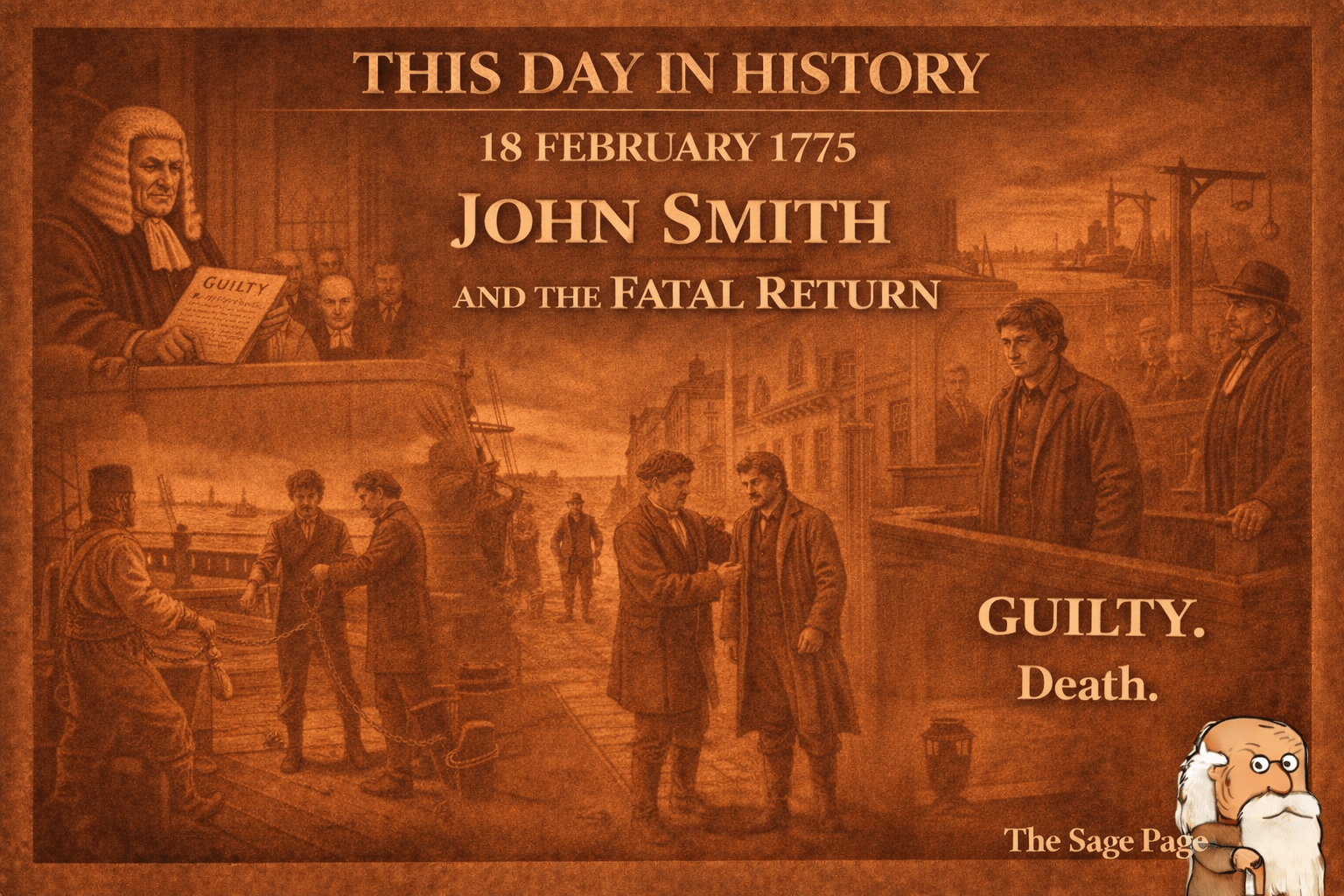
This Day in History: 18 February 1775 — John Smith and the Fatal Return

On 18 February 1775, John Smith stood once more before the Old Bailey.

He had already escaped the gallows once.

Now he was on trial for doing the one thing the law most feared:
Returning from transportation before the expiration of his term.

He was found guilty.

He was sentenced to death.


The First Crime: Highway Robbery

Smith’s troubles had begun at the Maidstone Summer Assizes, 1773, where he was tried for a highway robbery committed against William Love, described as an old Greenwich College man.

Robert Stephens, turnkey of Maidstone Gaol, testified:

“He was found guilty and received judgment of death.”

Smith was confined seven or eight months.

But like many capital convicts of the era, he received a conditional reprieve.

His sentence of death was commuted on condition that he be:

Transported for fourteen years.

Stephens recalled telling him plainly:

“Jack you go for fourteen years.”

Smith allegedly replied:

“America should not hold him fourteen years, nor two neither.”

It was a boast that would soon prove disastrous.


Transportation and Return

Smith was placed aboard ship. The captain gave receipt for his body.

At some point thereafter — the exact mechanism unknown — Smith returned to England.

Whether he escaped, bribed a crewman, or simply slipped back amid lax enforcement, the record does not say.

But on 12 January 1775, he was discovered in Aldersgate Street.

Richard Spratly, who had known him most of his life, arrested him.

The offence was simple:

He was back.


The Law on Returning from Transportation

Under eighteenth-century statute, returning from transportation before expiry of one’s term was itself a capital felony.

No new crime was required.

Presence alone was enough.

When Smith appeared at the Old Bailey in February 1775, the prosecution merely had to prove:

  1. His original conviction
  2. His sentence of transportation
  3. His identity
  4. His unlawful return

The copy of the original conviction was read in court.

The jury had little difficulty.


The Defence

Smith claimed:

“I was sent out of the land; I never received sentence of transportation. I did not know for what time.”

But the turnkey contradicted him.

“We inform them.”

The jury believed the officials.


Verdict and Sentence

The verdict:

Guilty.

The sentence:

Death.

For the second time in two years, John Smith stood condemned to hang.

However, further record shows his sentence outcome was again transportation, and on 14 July 1775 he was transported for a further fourteen years.

Twice spared. Twice exiled.


Returning from Transportation

In the eighteenth century, transportation was intended as removal and deterrence.

Convicts sentenced to seven or fourteen years were legally forbidden to return before expiration.

If they did:

  • They could be indicted without evidence of any new offence
  • Their previous conviction was read into the record
  • The punishment was death

It was the law’s way of enforcing imperial exile.


Money Then & Now — Highway Robbery Context

Highway robbery was among the most feared crimes of the eighteenth century.

Victims were often:

  • Travellers
  • Merchants
  • Pensioners like William Love

Robbery of even modest sums could result in a death sentence.

Public fear of armed robbery meant courts treated offenders severely — especially repeat offenders.

Smith’s original reprieve was mercy. His return was seen as defiance.


The American War Complication

Smith was transported again in July 1775.

That timing is extraordinary.

The American Revolutionary War had begun in April 1775. Within months, transportation to the American colonies became politically and logistically chaotic.

Convict ships were disrupted. Contracts faltered. Prison hulks began to fill in England.

It is entirely possible that Smith’s second transportation:

  • Was delayed
  • Was redirected
  • Or placed him amid the collapsing system of Atlantic penal exile

If so, he became not merely a criminal — but a casualty of imperial upheaval.


Why This Case Matters

John Smith’s story reveals:

  • The brutality of eighteenth-century penal law
  • The fragility of conditional mercy
  • The importance of transportation in Britain’s criminal system
  • The global dimension of punishment
  • The instability of empire on the eve of revolution

From Maidstone to America — and back to the dock at the Old Bailey — Smith’s life traces the harsh geography of eighteenth-century justice.


Sources

  • Old Bailey Proceedings, 18 February 1775, trial of John Smith
  • Kent Maidstone Assizes reference (1773 highway robbery conviction)
  • Old Bailey Online punishment records

Thank you for reading my writings. If you’d like to, you can buy me a coffee for just £1 and I will think of you while writing my next post! Just hit the link below…. (thanks in advance)

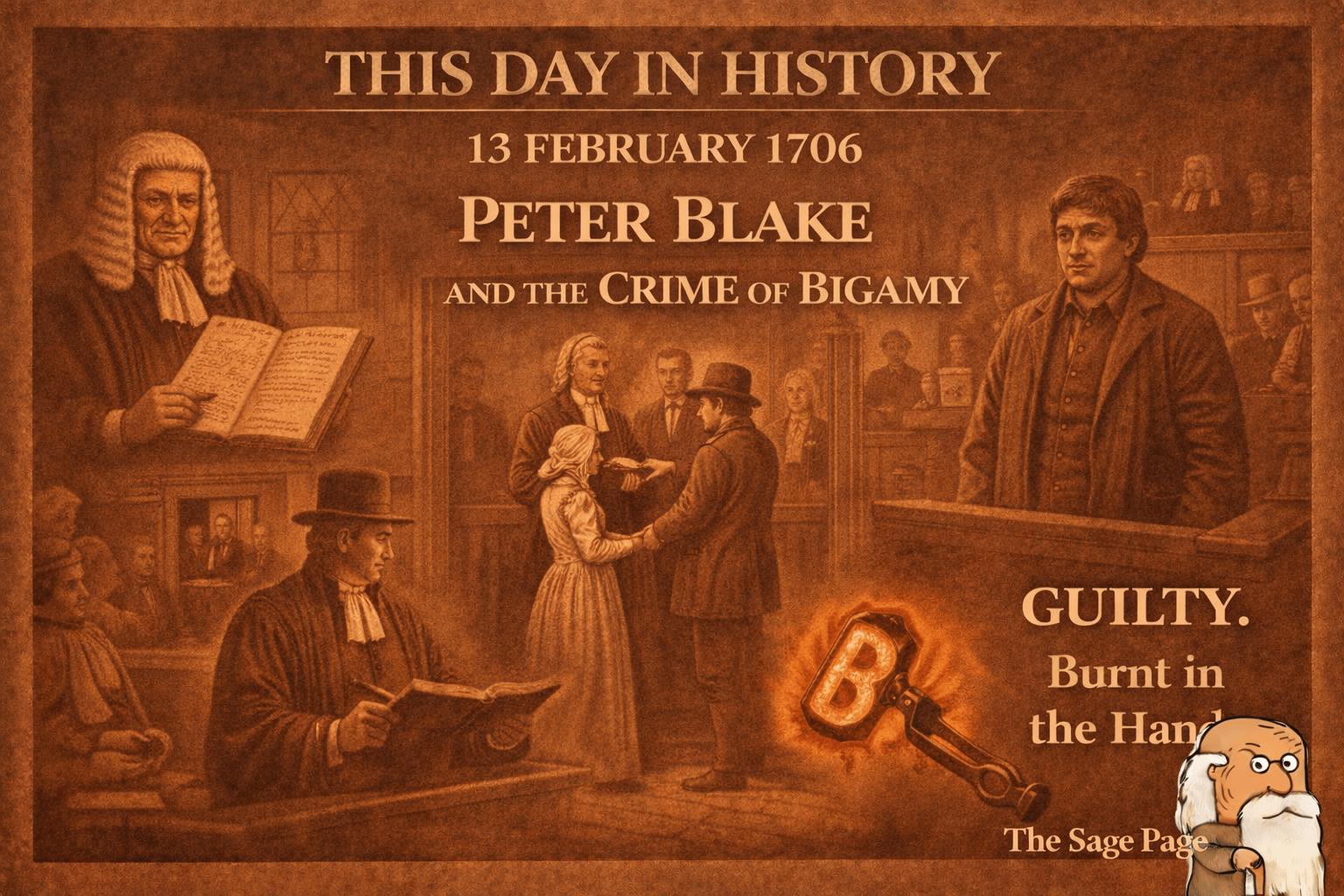
This Day in History: 13 February 1706 — Peter Blake and the Crime of Bigamy

On 13 February 1706, in the parish of St. Martin’s, New Sarum (Salisbury), Peter Blake married Mary Blackstone.

Sixteen years later, that marriage returned to haunt him.

In October 1722, Blake stood before the Old Bailey indicted for taking a second wife while his first was still living — the serious felony of bigamy.

He was found guilty.


The First Marriage

Thomas Holms, Clerk of St. Martin’s Parish in New Sarum, gave clear evidence:

“The Prisoner on the Thirteenth of February 1706 was married to Mary Blackstone Spinster, of the same Parish.”

Holms confirmed he had seen Mary Blackstone alive within three weeks of giving testimony. He even produced the parish register to verify the marriage.

The prosecution strengthened its case further: Edward Farr travelled to Salisbury to obtain certification of the first marriage and saw Mary Blackstone there — living, and with three children by Blake.

The first marriage was not in doubt.


The Second Marriage

Despite that existing union, Blake married again.

Mary Blake testified that on 31 August 1722 she was married to him at St. Peter’s, Cornhill, by licence from the Archbishop’s Court.

She had known him only briefly:

“Having seen him but the Wednesday before.”

They cohabited for three nights. Then she heard rumours.

She was told he had another wife.

She went to him no more.

The officiating minister, Mr. Swan, produced the licence. The parish clerk confirmed the ceremony.

The second marriage, too, was not in doubt.


The Defence

Blake claimed he believed his first wife to be dead.

“He had heard by several Letters that his first Wife was dead, and thought that she was.”

He further alleged interference by one Mr. Clifton, suggesting jealousy and financial motives had stirred the inquiry against him.

But belief is not proof.

And the parish register was a stubborn witness.


The Verdict

The jury returned their decision:

Guilty.

Bigamy in the early eighteenth century was not a mere domestic irregularity. It was a felony, carrying serious penal consequences.


Sentence

On 10 October 1722, when judgment was pronounced, Peter Blake was among those:

Burnt in the Hand.

Branding was a common punishment for certain felonies at this period. A hot iron, often marked with a letter corresponding to the offence, was pressed against the offender’s thumb.

The mark served as:

  • A public sign of conviction
  • A deterrent
  • A permanent legal record on the body

Branding spared Blake from harsher penalties such as death or transportation, but it left him marked — physically and socially.

(For context on branding as punishment, see the Old Bailey’s overview of penal practices in the early eighteenth century.)


Why This Case Matters

The case of Peter Blake reveals:

  • The legal seriousness of marriage law in early 18th-century England
  • The importance of parish registers as documentary evidence
  • The global and local mobility of working people
  • The use of branding as a judicial punishment

Unlike the petty theft cases of February 1818 and 1819, this was a moral and legal breach touching the sanctity of marriage itself.

And though he escaped the gallows, Blake left the courtroom permanently marked.


Sources

  • Old Bailey Proceedings, October 1722 session, trial of Peter Blake (t17221010-19)
  • Old Bailey Online, “Punishments at the Old Bailey” — branding

Thank you for reading my writings. If you’d like to, you can buy me a coffee for just £1 and I will think of you while writing my next post! Just hit the link below…. (thanks in advance)

Quote of the Day: Wating for the postman

“The sound of the letterbox is the smallest drumroll in life.”
— The Sage


The Sage has always been fond of small sounds that carry large meanings. The rattle of the letterbox, brief and metallic, lasts only a moment — yet it stirs something disproportionate in the listener. It is the announcement of possibility. For a split second, life pauses in anticipation of what may have arrived.

He observes that the sound itself is never dramatic. There are no trumpets, no declarations, just a quiet clatter and a thud on the mat. Yet in that instant, imagination races ahead of reality. It could be good news, long-awaited news, or merely a catalogue. The Sage notes that hope does not discriminate — it flares all the same.

With gentle humour, he reminds us that the drama often exceeds the contents. But that is not the point. The value lies in the anticipation — in the reminder that something unexpected might be waiting just beyond the door. In that modest metallic knock, The Sage hears life’s smallest drumroll: not for certainty, but for possibility.


Thank you for reading my writings. If you’d like to, you can buy me a coffee for just £1 and I will think of you while writing my next post! Just hit the link below…. (thanks in advance)

Advice of the Day: Valentine’s Card Courage

“On Valentine’s Day, choose the card that makes you slightly nervous.”

– The Sage

The Sage has always believed that Valentine’s Day is less about romance and more about risk management. His advice for navigating the card aisle is bold, slightly alarming, and delivered with a steady hand: “On Valentine’s Day, choose the card that makes you slightly nervous.”

According to The Sage, a safe Valentine’s card says nothing. It smiles politely. It thanks you for “being you.” It could just as easily be given to a colleague retiring after 12 years in accounts. But the card that makes you hesitate — the one that feels almost too sincere, too dramatic, too committed — that’s the one that means business.

The Sage does advise caution. If you find yourself sweating in the shop, checking the return policy, or rehearsing explanations in advance, you may have drifted beyond “romantic” and into “life-altering.” But Valentine’s Day, he insists, is not about safety — it’s about choosing ink with courage and hoping for applause instead of consequences.


Thank you for reading my writings. If you’d like to, you can buy me a coffee for just £1 and I will think of you while writing my next post! Just hit the link below…. (thanks in advance)
Advice of the Day: Romantic Escalation

“Ask what their ex used to buy — then go bigger.”

– The Sage

The Sage has always believed that love is not about comparison — except when it absolutely is. His advice today is bold, reckless, and likely to require medical supervision: “Ask what their ex used to buy — then go bigger.”

According to The Sage, this approach removes uncertainty. If the ex bought flowers, you buy a bouquet large enough to block out natural light. If they gave chocolates, you deliver a hamper that requires a forklift. Romance, he insists, is a competitive sport — and victory lies in scale.

The Sage does, however, acknowledge the risks. Mentioning the ex may cause silence. Going bigger may cause suspicion. Doing both may cause you to sleep on the sofa. But he maintains that commitment is best demonstrated through excessive escalation and unwavering confidence. Love, after all, should be memorable — if not survivable.


Thank you for reading my writings. If you’d like to, you can buy me a coffee for just £1 and I will think of you while writing my next post! Just hit the link below…. (thanks in advance)
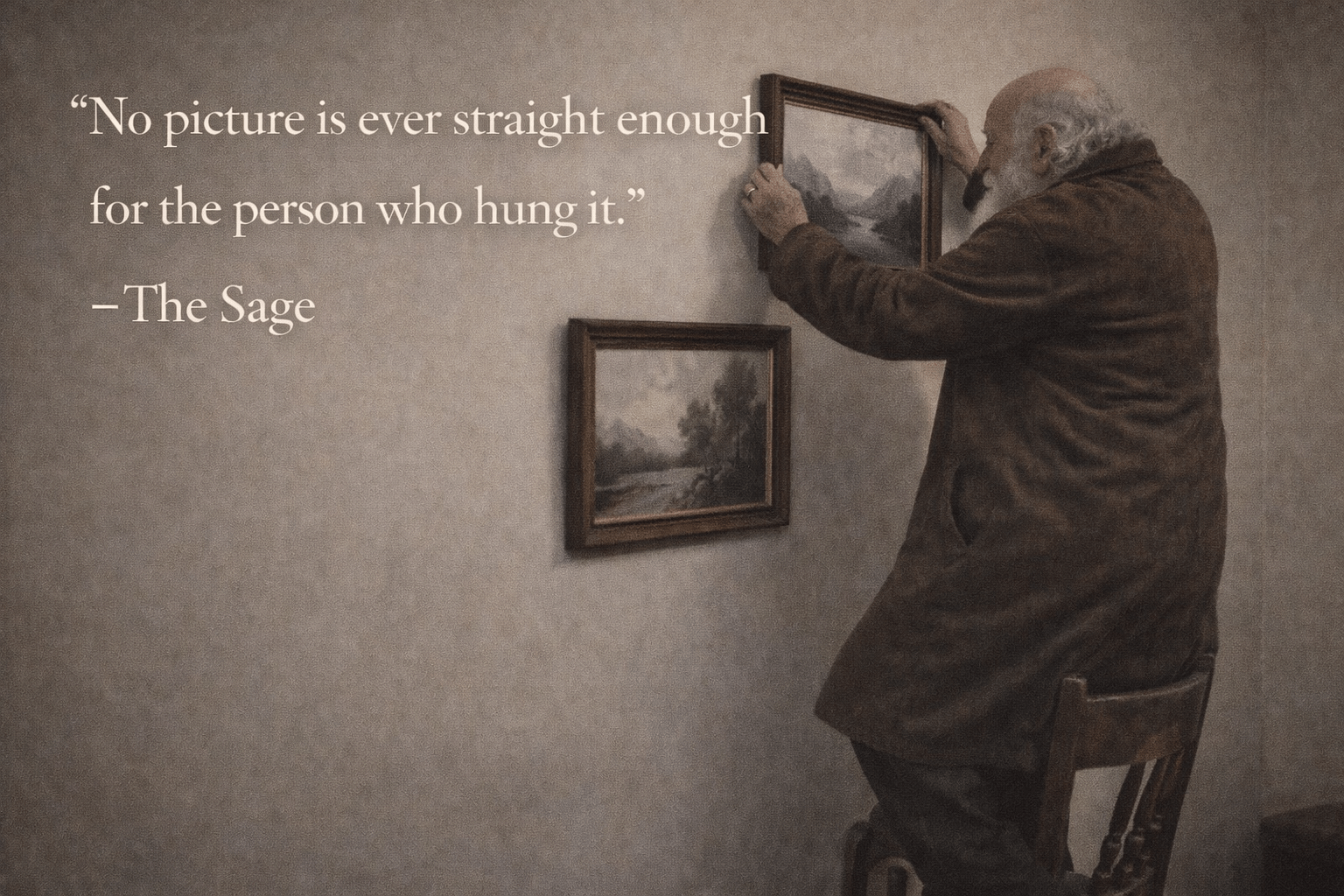
Quote of the Day: Hanging a picture reveals more about the hanger than the art itself

“No picture is ever straight enough for the person who hung it.”
— The Sage


The Sage has always believed that hanging a picture reveals more about the hanger than the art itself. The moment the nail is tapped in and the frame is lifted into place, doubt creeps quietly into the room. What once seemed level from a distance suddenly tilts under scrutiny. The Sage observes that the human eye becomes most critical when it has been responsible for the result.

He notes that visitors rarely notice the slight lean, the half-degree of imperfection, or the imagined imbalance that torments the host. To everyone else, the painting looks perfectly content on its wall. But to the one who hung it, the smallest deviation feels monumental. Perfection, he says, is always hardest on the person who tried to achieve it.

With gentle humour, The Sage reminds us that this extends beyond walls and frames. We are often most troubled by the flaws in things we’ve done ourselves. Yet life, like a picture, rarely needs to be perfectly straight to be beautifully placed. Sometimes stepping back is the only adjustment required.


Thank you for reading my writings. If you’d like to, you can buy me a coffee for just £1 and I will think of you while writing my next post! Just hit the link below…. (thanks in advance)

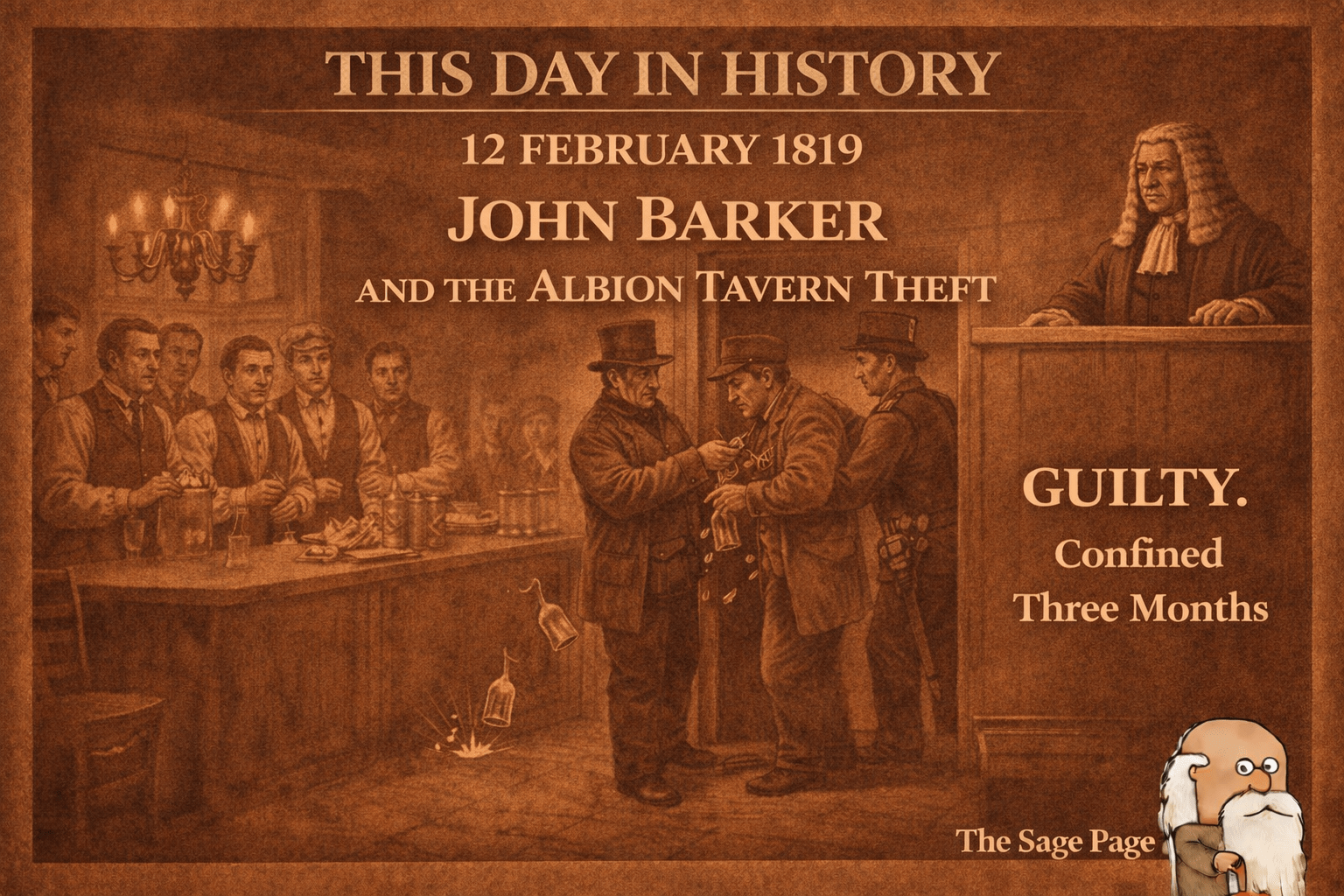
This Day in History: 12 February 1819 — John Barker and the Albion Tavern Theft

On 12 February 1819, the commencement of a case of tavern dishonesty which was to come before the Old Bailey. The accused was John Barker, aged forty-six, charged with stealing wine-glasses and other items from the Albion Tavern in Aldersgate Street.

The setting was convivial. The outcome was not.


The Setting: The Albion Tavern

The prosecutor, Daniel Kay, kept the Albion Tavern, Aldersgate Street, in partnership with John Frederick Kay. Barker was employed there as an occasional waiter — a position that required trust, particularly in a busy late-night tavern.

On the night of 12 February, shortly before one o’clock in the morning, the waiters who had worked that day were gathered together to be paid.

Then came the sound that altered the evening:

“A wine-glass fell on the floor from among them.”

According to testimony, the other waiters declared it had fallen from Barker.


The Discovery

Daniel Kay acted immediately.

“I gave him in charge.”

As Barker stepped outside the tavern door, Kay searched him. He felt additional objects in the prisoner’s pockets.

The search revealed:

  • Four wine-glasses in his coat pocket
  • Two more wine-glasses in his breeches
  • One pepper-box
  • One d’oyley
  • Sugar and wax-candles concealed with the cloth

The goods were later produced in court and sworn to as property of the tavern.

The concealment was deliberate and methodical.


Arrest and Testimony

Constable John William Branch confirmed the arrest:

“I took the prisoner in charge, found the property on him, and a silk handkerchief, which he said was not his own.”

The inclusion of an additional silk handkerchief — disclaimed by the prisoner — did little to improve his position before the jury.


The Defence

When called upon to explain himself, Barker offered a brief and familiar defence:

“I was in liquor.”

Drunkenness was commonly cited in Georgian and Regency courtrooms. It might explain behaviour — but it rarely excused theft.


The Verdict

The London Jury, sitting before Mr Recorder, returned their finding:

GUILTY.

Barker was recorded as being aged 46.


Sentence

For stealing goods valued at 11 shillings, John Barker was sentenced to:

  • Three months’ confinement

Three months was a significant term for a working man. Beyond imprisonment itself, the conviction would have damaged his prospects for future employment in taverns or similar establishments where trust was essential.


Why This Case Matters

The case of John Barker illustrates:

  • The vulnerability of taverns to internal theft
  • The swift action taken by employers in suspected dishonesty
  • The limited tolerance courts showed toward intoxication as a defence
  • The graduated nature of sentencing for petty larceny

Wine-glasses and table items may seem trivial, but in a commercial tavern they represented loss, breach of trust, and reputational damage.

In early nineteenth-century London, that was more than enough to send a man to prison.


Sources

  • Old Bailey Proceedings Online, trial of John Barker, 12 February 1819.

Thank you for reading my writings. If you’d like to, you can buy me a coffee for just £1 and I will think of you while writing my next post! Just hit the link below…. (thanks in advance)

This Day in History: 11 February 1818 — George Tomkins and the Three Sixpences

On 11 February 1818, a small but telling case came before the Old Bailey. The accused was George Tomkins, aged thirty-six, charged with stealing three sixpences from his employers.

The sum was small — just eighteen pence — but the consequences were immediate and public.


The Accusation

Tomkins was indicted for stealing:

  • Three sixpences, valued at 18d
  • The property of Robert Potts and William Maurice

The prosecutors, linen-drapers in partnership, conducted their business on Holborn Hill, a busy commercial thoroughfare in early nineteenth-century London.

Robert Potts testified plainly:

“On the 11th of February we lost three sixpences out of the till.”

In a world of hand-counted coin and daily cash transactions, even small losses were noticed.


The Evidence

The key witness was Mitford Patrick, shopman to the prosecutors.

He described the moment suspicion arose:

“While I was hanging the things in the window I heard silver rattle, and looking round I saw the prisoner’s arm coming from the till.”

Patrick acted at once.

“I took hold of him, and shook three sixpences out of his hand.”

The detail is striking: the coins literally falling from Tomkins’ grasp. There was no ambiguity about possession.

Patrick added:

“He had no business at the till — He was the porter.”

The prisoner claimed:

“He said he did not take them out of the till but off the desk.”

But the distinction carried little weight.


The Prisoner’s Response

When called upon, Tomkins offered no elaborate defence.

His recorded words were brief:

“I am sorry for it.”

It was an admission of wrongdoing, or at least an acceptance of the inevitable.


The Verdict

The jury — a London Jury before Mr. Recorder — returned their decision:

GUILTY.

Tomkins was noted to be aged 36.


Sentence

For stealing three sixpences, George Tomkins was sentenced to:

  • One month’s confinement

Unlike many theft cases of the era that resulted in transportation or lengthy imprisonment, this was treated as a minor but punishable breach of trust.

Yet even a month’s confinement carried consequences. Time spent imprisoned meant lost wages, damaged reputation, and public disgrace. In small commercial communities, that could linger far longer than thirty days.


Why This Case Matters

The case of George Tomkins illustrates several features of everyday justice in Georgian London:

  • The seriousness with which even small thefts were treated
  • The vulnerability of shopkeepers to internal theft
  • The reliance on immediate witness testimony
  • The gradation of punishment — distinguishing petty theft from major felony

Three sixpences was not a fortune. But in a world where trust underpinned trade, even eighteen pence could land a man in the dock at the Old Bailey.


Money Then & Now

Three Sixpences (18d) in 1818

  • Value in 1818: 1 shilling and 6 pence
  • Modern inflation equivalent: approx. £6–£9 today

But inflation only tells part of the story.

In 1818, a labouring man might earn 10–15 shillings per week, meaning:

  • 18d could represent close to a full day’s wages

In relative earning power, that might feel more like £70–£100 in today’s terms.

Small coin.
Serious consequence.


Sources

  • Old Bailey Proceedings Online, trial of George Tomkins, 11 February 1818.

Thank you for reading my writings. If you’d like to, you can buy me a coffee for just £1 and I will think of you while writing my next post! Just hit the link below…. (thanks in advance)

Quote of the Day: A holiday begins long before the suitcase is opened

“Half the joy of a holiday lies in the maps you spread across the kitchen table.”
— The Sage


The Sage has always believed that a holiday begins long before the suitcase is opened. It begins in the quiet ritual of planning — in the unfolding of maps, the circling of destinations, and the slow imagining of roads not yet travelled. He notes that anticipation carries a special kind of happiness, one that belongs entirely to possibility.

He observes that when maps are spread across a kitchen table, life momentarily expands. Ordinary rooms become departure lounges; cups of tea become provisions for adventure. In those moments, The Sage says, we are not bound by timetables or weather forecasts — only by curiosity. The planning itself becomes a rehearsal for freedom.

With gentle humour, The Sage reminds us that some holidays never quite match their blueprint — and that’s part of the charm. The joy found in planning is not wasted if plans change. It is proof that imagination works even when itineraries do not. And often, he says, the memory of that hopeful table full of maps lingers just as fondly as the trip itself.


Thank you for reading my writings. If you’d like to, you can buy me a coffee for just £1 and I will think of you while writing my next post! Just hit the link below…. (thanks in advance)
Advice of the Day: Holiday Planning

“Choose your destination based on how little you want to pack.”

The sage

The Sage has travelled widely — sometimes by accident — and from these journeys he has developed a simple rule for booking holidays: “Choose your destination based on how little you want to pack.”

According to The Sage, most holiday stress begins not at the airport, but beside an open suitcase. Climate dictates chaos. Cold destinations demand layers, boots, mysterious cables, and clothing you haven’t worn since 2009. Warm destinations, however, reduce life to a handful of items and an optimistic attitude.

The Sage recommends brutal honesty. If the thought of packing socks makes you sigh, book somewhere that requires none. If you’re already tired before you’ve left the house, your destination should not involve snow, formalwear, or specialist footwear. True relaxation, he insists, begins with a suitcase that closes easily.


Thank you for reading my writings. If you’d like to, you can buy me a coffee for just £1 and I will think of you while writing my next post! Just hit the link below…. (thanks in advance)