“True humility is not in shrinking from greatness—it’s in recognizing how much there still is to rise to.” — Eric Shinn
About the Quote & Eric Shinn
Eric Shinn writes with quiet insight into the human condition. Raised in thoughtful surroundings that prized curiosity over accolades, Shinn pursued philosophical studies with an emphasis on self-awareness and inner expansion. His writing—delivered in lectures, essays, and conversations—is marked by clarity and a refreshing resistance to grandiosity.
In this quote, Shinn reframes humility not as modesty or retreat, but as a recognition of the unending journey. Rather than diminishing our achievements, humility becomes the lens through which we perceive what lies ahead—the uncharted territory of growth, wisdom, and empathy that still awaits.
For readers of The Sage Page, these words encourage us to view each milestone as a vantage point, not a finish line. Embracing humility in this way keeps our spirit open, vibrant, and ever ready for what’s next.
Thank you for reading my writings. If you’d like to, you can buy me a coffee for just £1 and I will think of you while writing my next post! Just hit the link below…. (thanks in advance)
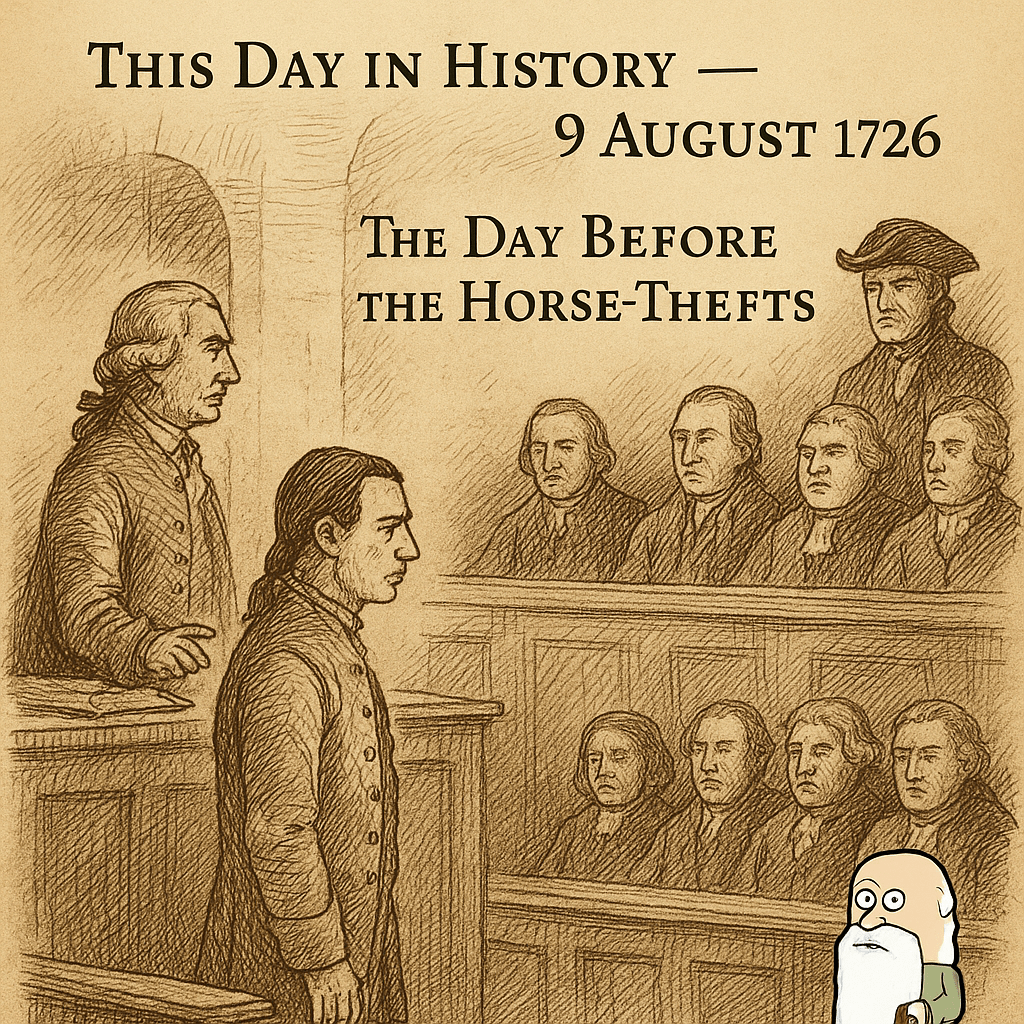
An alias in the alehouse. A bay gelding in his eye. Tomorrow, trouble.
London, 9 August 1726. In a smoky alehouse off Smithfield, a man who calls himself George Prentice — or Johnson, depending who asks — studies the comings and goings of horse-dealers and hostlers. He drinks little, listens much. Tomorrow will be market day of a different sort.
On 10 August, according to the later indictment, a bay gelding belonging to John Street will be taken; and in a second count, a grey gelding belonging to Robert Hanson will change hands for a hasty £15. Those are the facts the Old Bailey will print at month’s end; tonight is the quiet before the paper trail begins.
When the court eventually sits, the clerk will read:
“George Prentice, alias Johnson, indicted for stealing a bay gelding, value 10 l., the goods of John Street… and again indicted for a grey gelding, value 10 l., the goods of Robert Hanson; 10th of August.”
Witnesses swear to ownership and to dealings “on the 10th of August… the price was £15”; the alias is noted; the pattern is clear.
⚖️ The Trial at the Old Bailey
Date: Late August 1726 Location: Court of the Old Bailey, London
The prosecution’s case is straightforward.
John Street testifies that his bay gelding was secure until the night of the 9th–10th. By dawn, the horse and Prentice were both gone.
Robert Hanson recounts how, on the 10th, Prentice approached him with the grey gelding, pressing for a quick sale. The price — £15 — was tempting, but the circumstances were odd.
Both men identify Prentice in court, and their certainty is unshaken.
Prentice’s defence is weak: he claims confusion over ownership, offering no receipts or credible witnesses to support his story. The jury is unimpressed.
The foreman’s verdict comes quickly:
Guilty on both counts.
⛓️ The Sentence
Horse theft in 1726 is a capital offence — the gallows at Tyburn are the usual end for such convictions. The court sentences George Prentice, alias Johnson, to death by hanging.
Whether he was eventually executed or had his sentence commuted is not recorded in the surviving proceedings, but the public nature of such cases meant his conviction would have been widely known — a warning to other would-be horse thieves.
📜 Why It Matters
Public Example: Such trials were printed in the Old Bailey Proceedings and read aloud in alehouses, ensuring the lesson spread far beyond the dock.
Harsh Deterrents: The Prentice case shows the severity of Georgian justice — horses were vital for transport, farming, and trade, so their theft was treated on par with murder in some instances.
Market Vulnerabilities: Smithfield and other horse markets were bustling, poorly policed spaces, ideal for sharp operators.
Alias Culture: The use of “alias” in indictments reflects how criminals often adopted multiple identities to confuse victims and authorities.
Thank you for reading my writings. If you’d like to, you can buy me a coffee for just £1 and I will think of you while writing my next post! Just hit the link below…. (thanks in advance)
James Dilley & Mary Rainbow: A Mother’s Secret and a Child’s Fate
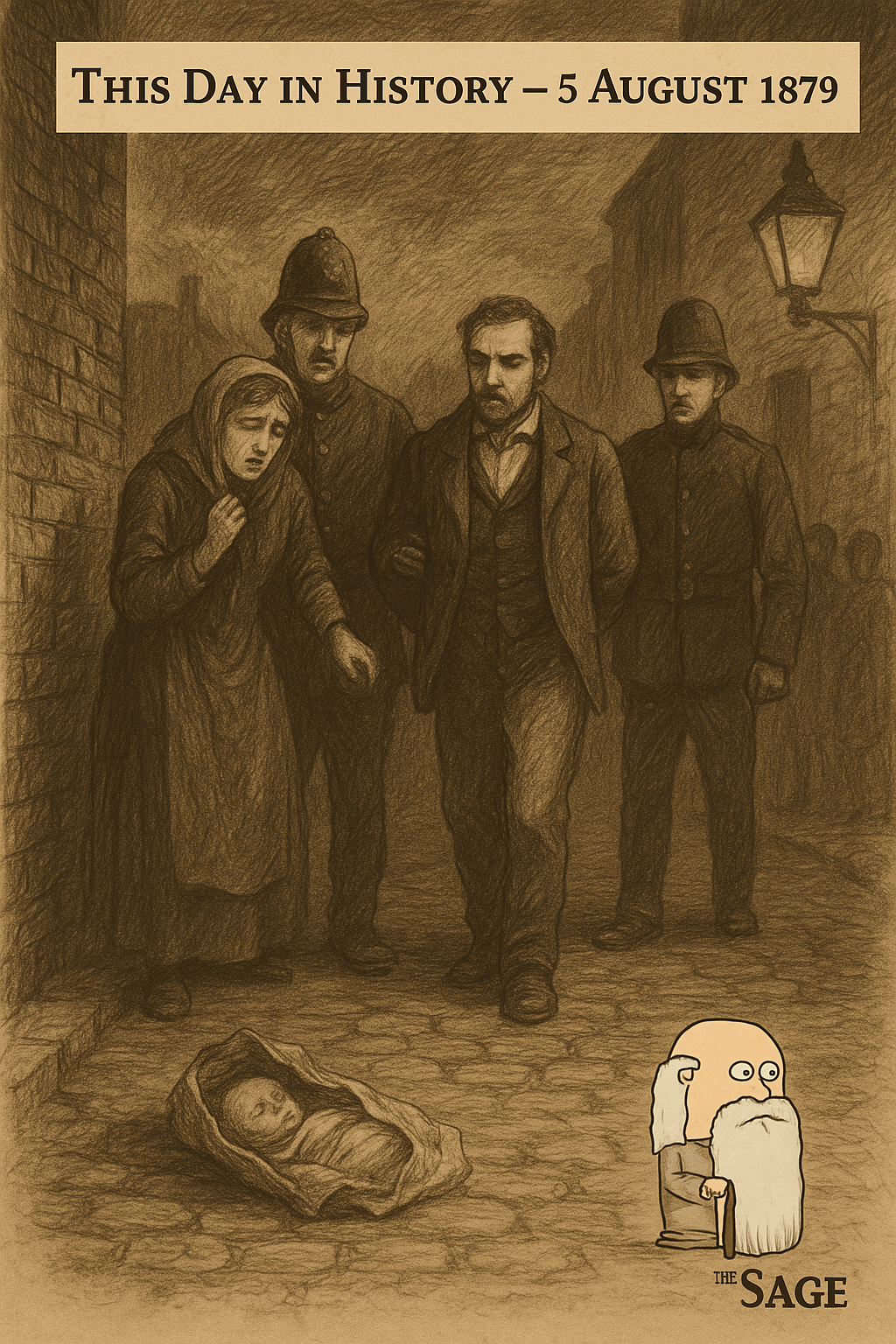
An infant killed. A hidden birth. A hush in the streets.
👶 The Case Unfolds
On 5 August 1879, both James Dilley, a 41-year-old labourer, and Mary Rainbow, 28, were tried together at the Old Bailey for the wilful murder of Mary’s own newborn daughter—a child unborn, unnamed, and dead before it could be named. The baby was discovered in a parcel inside Clapton, its life extinguished almost before it began.
A routine walk by a labourer revealed the body, wrapped in brown paper, beside a wall. Suspicion quickly fell on Rainbow, whose evidence revealed a concealed birth and deep secrecy.
Both were indicted for infanticide, a crime carrying the same punishment as murder in Victorian England.
⚖️ In Court
Mary Rainbow: The child’s mother, who claimed the baby’s sudden death during transit home and concealed the body out of desperation.
James Dilley: Identified as the father—married to another woman and aware, according to witness accounts, of the pregnancy.
The Old Bailey records note a brutal outcome: despite Rainbow’s plea for forgiveness and Dilley’s denials of involvement, the jury returned “Guilty” verdicts for both.
🪓 Sentence
The sentence was carried out with chilling clarity:
Condemned to death.
Both Rainbow and Dilley were sentenced to hang—though the final outcome for Rainbow remains unclear in the archives, Dilley’s records confirm the sentence sought to be carried out.
🔎 Why This Case Matters
Infanticide trials were rare but deeply charged—with strong public emotion surrounding motherhood, sexual morality, and social neglect.
Mary Rainbow’s baby was never named, and the child’s concealment reflected the pressure and stigma faced by unmarried mothers.
The joint trial emphasized both how Victorian society handled illegitimacy and its harsh legal penalties—even in cases of extreme secrecy and social shame.
Thank you for reading my writings. If you’d like to, you can buy me a coffee for just £1 and I will think of you while writing my next post! Just hit the link below…. (thanks in advance)
“I’m never lost at sea. It’s the shore that doesn’t know where to find me.” — Noah Clooney
About the Quote & Noah Clooney
Born on August 7, 1955, in a coastal town in Maine, Noah Clooney is a distinguished maritime philosopher and former U.S. Navy navigator. He studied at the United States Naval Academy, where he blended navigation with philosophical inquiry. After years at sea, he authored works such as Sailing the Soul: Navigating Life’s Seas, exploring the parallels between ocean voyages and life’s journey.
Today’s quote reflects his unique perspective: Noah insists he’s not lost at sea—rather, it’s the shore that loses track of him. This subtle reversal highlights his belief that feeling “lost” is often about how we frame our experience. For a man who spent his life steering through real and metaphorical waters, it’s a reminder that our sense of direction is sometimes more about mindset than geography.
Thank you for reading my writings. If you’d like to, you can buy me a coffee for just £1 and I will think of you while writing my next post! Just hit the link below…. (thanks in advance)
“In a world where your sofa needs a passport, I can’t wait to see its holiday photos.”
The EU is rolling out digital product passports (DPPs) to provide detailed, transparent data about a product’s materials, repairs and lifecycle intereconomics.eu. They’re designed to help consumers and businesses make greener choices—but they also invite some amusing mental images.
Today The Sage muses: if every kettle, chair and toaster needs its own passport, will our sofas start collecting more stamps than we do? In his mind’s eye, he sees a sofa in sunglasses, queuing at customs while a stern official stamps its travel document. It’s a gentle poke at the growing bureaucracy around everyday objects and a reminder that there’s always humour in the fine print.
Behind the joke is a real trend: digital product passports are meant to support the circular economy by tracking and sharing product data across a product’s life. So next time you read about DPPs, spare a thought for your armchair’s holiday photos.
Thank you for reading my writings. If you’d like to, you can buy me a coffee for just £1 and I will think of you while writing my next post! Just hit the link below…. (thanks in advance)
“Immersive experiences cost a fortune. Sprinkle sand on your living room floor, play seagull noises and call it a beach holiday.”
“Immersive experiences” are all the rage right now: sensory‑saturated events and VR spectacles that promise to transport you to another world. Always one to swim against the tide, The Sage suggests a more… thrifty approach.
Rather than shelling out for a pricey VR headset or 360° art installation, simply order a bag of play sand, pour it across your living room floor and blast seagull noises from your phone. Add a paddling pool for authenticity and practice charging yourself £8.50 for an ice cream.
This homemade beach holiday won’t win any travel awards (or any approval from your neighbours), but it will be unforgettable—and slightly anarchic. As The Sage reminds us: when life sells you an “immersive experience,” sprinkle the immersion yourself.
Thank you for reading my writings. If you’d like to, you can buy me a coffee for just £1 and I will think of you while writing my next post! Just hit the link below…. (thanks in advance)
“To save water during summer hosepipe bans, try watering your garden with interpretive dance.”
As the great hosepipe ban looms like a soggy sword of Damocles over the British summer, we turn to The Sage for guidance. And he delivers.
Instead of using water like a commoner, simply pirouette around your parched petunias and twirl past your thirsty turf. Let your jazz hands nourish the begonias. Let your dramatic lunges hydrate the hydrangeas.
Will it help the plants? Absolutely not. Will it confuse the neighbours? Almost certainly. But in the spirit of conservation and spectacle, it’s the thought that counts.
Thank you for reading my writings. If you’d like to, you can buy me a coffee for just £1 and I will think of you while writing my next post! Just hit the link below…. (thanks in advance)
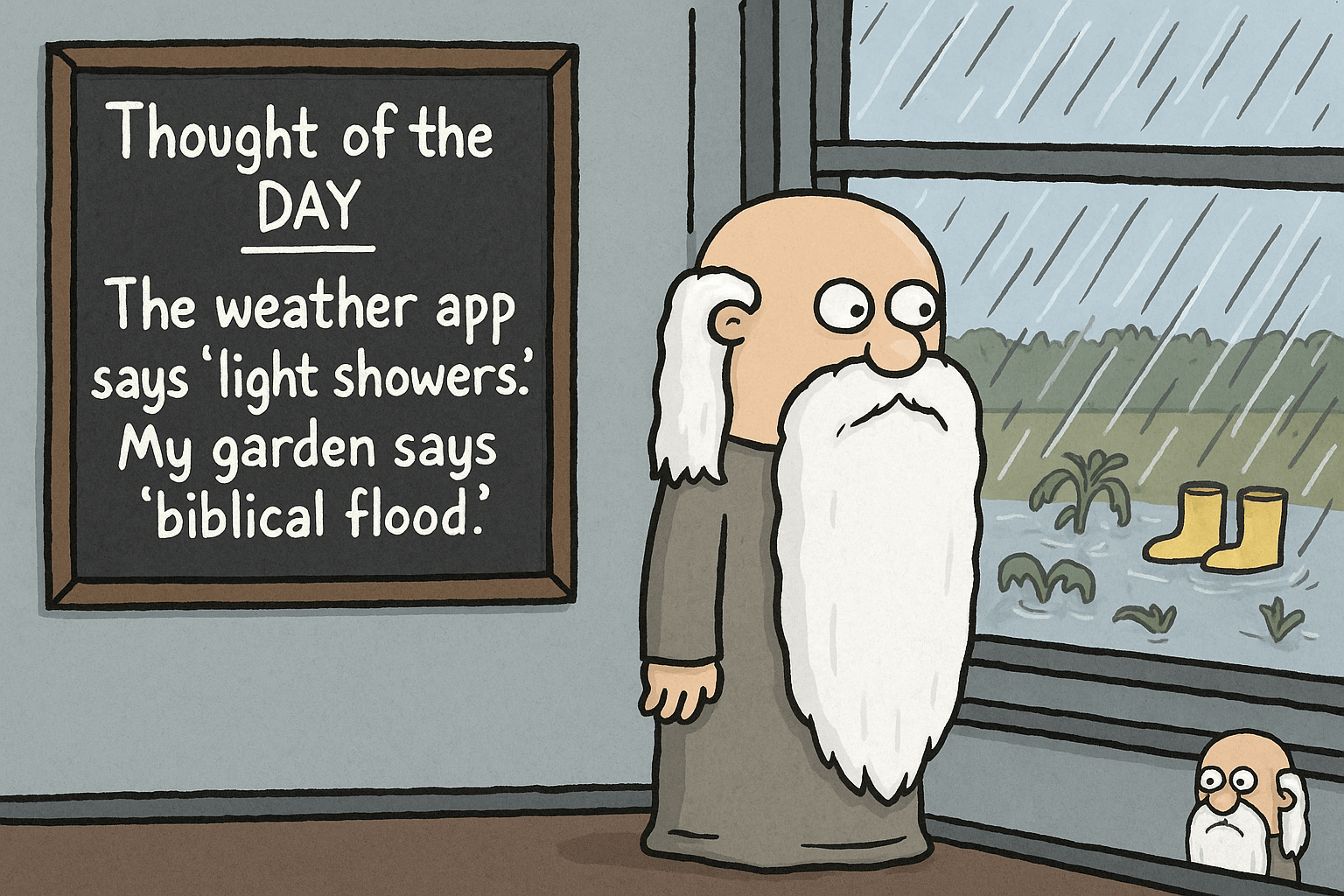
“The weather app says ‘light showers’. My garden says ‘biblical flood’.”
Weather forecasting, much like horoscopes and toaster settings, exists in a realm of optimistic suggestion rather than practical accuracy. Today’s gem captures the frustration of anyone who’s stepped outside expecting a drizzle and found themselves building an ark.
The Sage—ever watchful and ever damp—reminds us not to take ‘light showers’ lightly, especially in England. Where there’s mist, there’s menace.
Thank you for reading my writings. If you’d like to, you can buy me a coffee for just £1 and I will think of you while writing my next post! Just hit the link below…. (thanks in advance)
“Patience is not about waiting. It’s about pretending you’re not annoyed while everyone else is late.” — Noah Clooney
Noah Clooney, whose personal journals included entire chapters on the art of quietly fuming, had a rather theatrical take on patience. To him, it wasn’t a noble virtue—but a well-rehearsed performance.
In this delightfully sardonic quote, he reminds us that patience is often less about serenity and more about suppressing the urge to tap your foot loudly. Whether you’re waiting for a train, a reply, or for someone to finish their three-minute anecdote about jam, Clooney suggests we at least look calm—even if we’re composing mental revenge novels.
Thank you for reading my writings. If you’d like to, you can buy me a coffee for just £1 and I will think of you while writing my next post! Just hit the link below…. (thanks in advance)
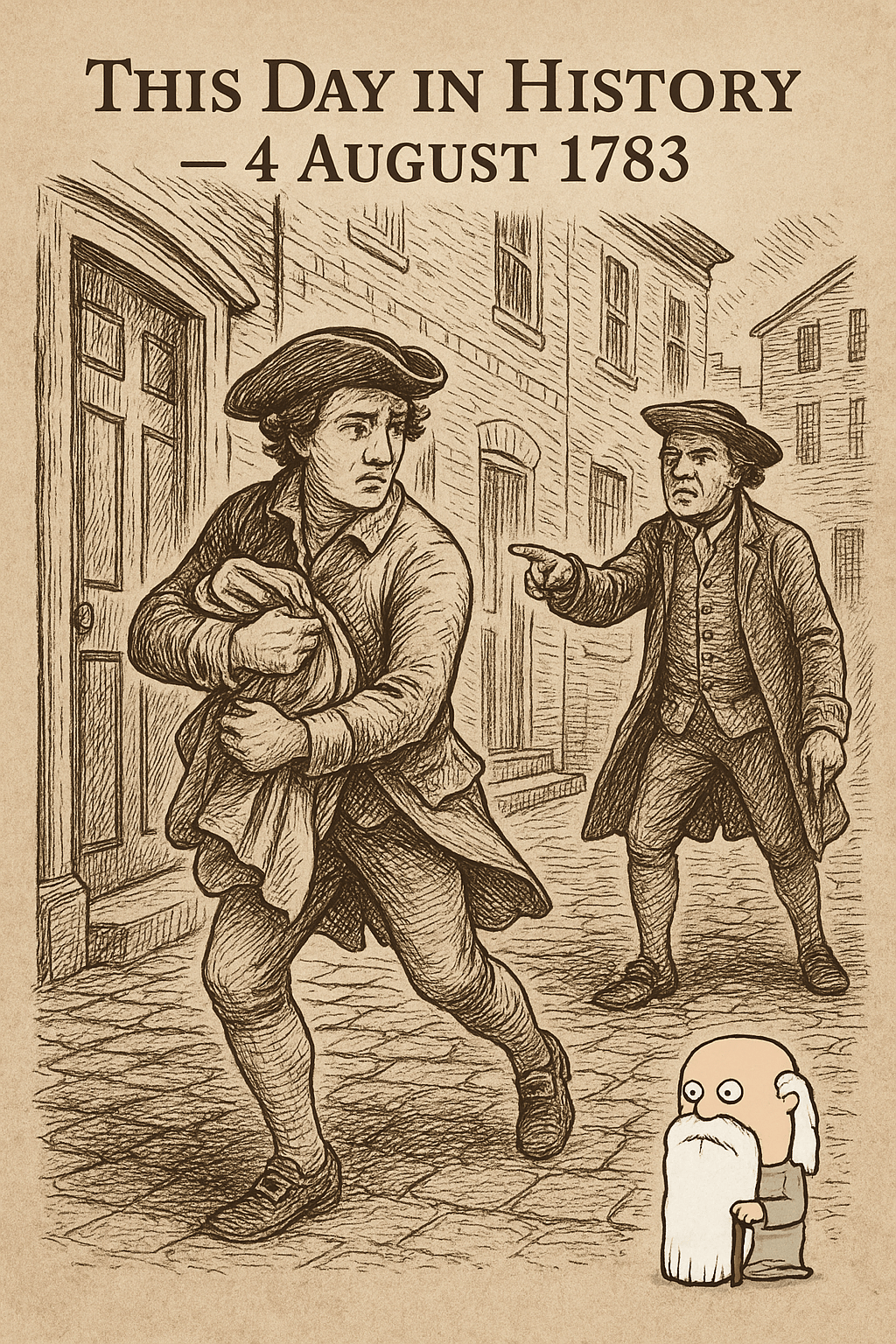
A petty theft. A swift arrest. Seven years away from home.
🧥 The Crime
On 4 August 1783, James Mackey stood indicted at the Old Bailey for grand larceny, accused of stealing a satin waistcoat valued at 3 shillings, and a corded dimity waistcoat worth 5 shillings, from his own employer. Though modest, the combined value of 8 shillings was enough to trigger severe consequences.
🕵️ What Happened
Mackey was a servant in a modest London household. One afternoon, suspicion fell on him after a waistcoat went missing. The accusation seemed almost reflexive: servants were often blamed. But in Mackey’s case, the evidence followed swiftly.
Although detailed witness testimony isn’t available in the online summary, the court record confirms:
The property was found in his possession.
He was identified and brought before the magistrate.
He offered no significant defence or denial.
The legal process was mercilessly efficient.
⚖️ The Verdict & Sentence
The verdict was:
Guilty
And the punishment:
Transportation for seven years
Mackey was sent to the convict ships bound for New South Wales, beginning an exile far from his London life. The sentence was typical for first-time thieves: no hanging, but permanent removal and forced labor overseas.
🔍 Why It Matters
Even theft of small items like waistcoats could lead to exile.
The case underscores how servants were both trusted and deeply vulnerable.
The transport system was rapidly expanding—convicts became labourers in the colonies.
It reflects the rigid nature of Georgian justice and the impact on poor Londoners.
Thank you for reading my writings. If you’d like to, you can buy me a coffee for just £1 and I will think of you while writing my next post! Just hit the link below…. (thanks in advance)







 The Sage Page