Thought of the Day: Blissful Ignorance

Thought: If ignorance is bliss, then most people must be ecstatic.


The Sage has a talent for exposing the cracks in everyday wisdom. This thought takes the age-old saying “ignorance is bliss” and pushes it a little further, hinting that if true, the world should be overflowing with happiness — and perhaps explains why so many people walk around smiling at the wrong things.

It’s not really an insult, more of a playful observation about how we all muddle through life. None of us can know everything, and pretending otherwise often leads to sillier mistakes than simply admitting our limits. The Sage would argue that ignorance isn’t just bliss — it’s universal.

Still, he reminds us not to take it too seriously. If everyone else is happily ignorant, then perhaps the cleverest thing you can do is join them… preferably with a cup of tea and a biscuit.


Thank you for reading my writings. If you’d like to, you can buy me a coffee for just £1 and I will think of you while writing my next post! Just hit the link below…. (thanks in advance)

Advice of the Day: Interpretive Replies

Advice: Impress your boss by replying to every email with interpretive dance.


The Sage knows that the modern workplace is drowning in emails — thousands of them, pinging away like digital gnats. His solution? Cut through the noise with something unforgettable. Nothing says “I’m engaged” quite like a spontaneous pirouette in the middle of the office when HR emails about policy updates.

Admittedly, this approach may not be universally welcomed. Some colleagues may struggle to interpret the significance of your dramatic leap in response to “Please find attached the spreadsheet.” Others may be moved to tears. Either way, you’ll never be accused of being boring or unoriginal in your communication.

The Sage insists that true wisdom is about standing out — and what better way than jazz hands in a board meeting? Besides, while words can be misinterpreted, a well-timed interpretive dance speaks directly to the soul… even if it leaves IT support deeply confused.


Thank you for reading my writings. If you’d like to, you can buy me a coffee for just £1 and I will think of you while writing my next post! Just hit the link below…. (thanks in advance)
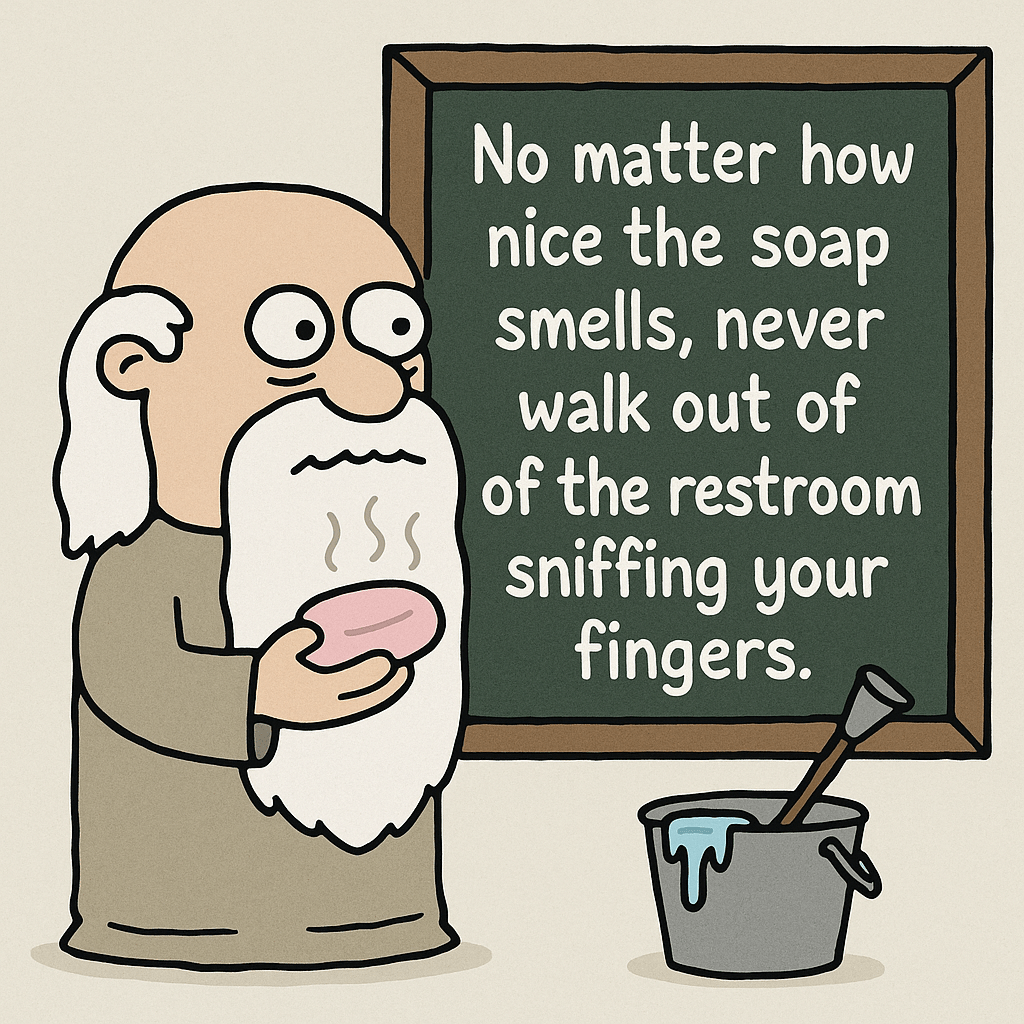
Quote of the Day: Anne Teak on Destiny

Quote: “When one door closes, another opens — usually because someone forgot the heating’s on.”
— Anne Teak


Anne Teak has a gift for deflating lofty sayings with a touch of homely common sense. Here, she tweaks the old adage about opportunity, pointing out that many of life’s great turning points are less about destiny and more about draughts.

Her wit lies in grounding the grand in the ordinary. Why imagine fate at work when it might just be bad hinges? Yet the humour contains a subtle truth: life is full of unexpected openings, whether caused by fortune, accident, or a family member who doesn’t understand central heating.

For Anne, wisdom is about embracing these moments with a smile. Doors may open or close for reasons beyond our control, but how we walk through them — or whether we stop to fix the latch — is entirely up to us.


Thank you for reading my writings. If you’d like to, you can buy me a coffee for just £1 and I will think of you while writing my next post! Just hit the link below…. (thanks in advance)

This Day in History – 18 September 1805

William Player & the Highway Assault

The road was dark, the attack sudden, and the law swift.


⚔️ The Incident

It was a summer evening when Tindal Thompson Walmsley walked along the King’s highway. Roads were dangerous places in Georgian London — travellers feared not only footpads and highwaymen, but sudden violence from strangers.

On that July night, Walmsley was assaulted. The assailant, later identified as William Player, struck him on the public road without provocation. Highway assaults carried more weight than tavern scuffles or domestic quarrels: the public road was the King’s peace, and to breach it was to threaten order itself.


🏛️ The Trial at the Old Bailey

By 18 September 1805, Player was in the dock at the Old Bailey. The indictment was read aloud:

“William Player, you stand indicted for that you, on the King’s highway, feloniously did make an assault upon Tindal Thompson Walmsley, against the peace of our Sovereign Lord the King, his crown and dignity.”

Walmsley’s testimony was clear: Player had attacked him violently, leaving bruises and fear in his wake. The jury needed little persuasion — an assault on the highway was not only against one man but against the community.


⚖️ The Verdict

The jury returned a guilty verdict. While the full sentence is not recorded in the summary, punishments for such crimes usually ranged from imprisonment to public whipping, depending on the perceived severity. Player escaped the noose, but not the stain of conviction.


🧠 Why It Matters

  • Highway peril: In 1805, assaults on the King’s highway fed into broader fears of lawlessness on the roads.
  • The King’s peace: To strike a man on the highway was to breach royal authority itself, hence the heavier treatment.
  • Snapshot of society: This case shows how courts made examples of those who disturbed public order, even when the crime fell short of robbery or murder.

Thank you for reading my writings. If you’d like to, you can buy me a coffee for just £1 and I will think of you while writing my next post! Just hit the link below…. (thanks in advance)

This Day in History – 16 September 1812

Thomas Oakley & the Manslaughter Case

Quick tempers, sudden death, and the murmur of justice.


⚔️ The Incident

London in 1812 was a city alive with tension — war abroad, scarcity at home, and crowded taverns where men’s nerves wore thin. It was in such a place that Thomas Oakley found himself accused of a crime that would mark him forever.

The charge was manslaughter. The death was real, but the law sought to answer: was it murder, or a blow struck in sudden passion?

🧑‍⚖️ The Trial

  • Name: Thomas Oakley
  • Date: 16 September 1812
  • Charge: Manslaughter
  • Case Ref: t18120916-75 from Old Bailey Proceedings oldbaileyonline.org

The case involved Thomas Oakley being indicted for manslaughter. The record doesn’t detail a full murder charge; nevertheless, the death was serious enough, and the offence was grave enough, to bring the case to the Old Bailey.

On 16 September 1812, Oakley stood at the bar of the Old Bailey. The indictment was read aloud:

“Thomas Oakley, you stand indicted for the felonious slaying of a fellow subject, against the peace of our Lord the King, his crown and dignity.”

Witnesses described an altercation — a quarrel that turned to violence. A shove, perhaps a strike, and the victim fell. Within hours, he was dead. The courtroom air must have been heavy; such cases blurred the line between chance and crime.

The jury was asked: did Oakley strike with malice, or was this a tragic excess of temper?


⚖️ Verdict & Sentence

The jury returned their decision:

Guilty — of manslaughter.

This distinction was everything. Instead of the noose at Tyburn, Oakley faced a punishment short of death — most likely imprisonment or transportation. The sentence acknowledged a life lost, but also the absence of murderous intent.


🕰️ Historical Context & Significance

  • In early 19ᵗʰ-century England, manslaughter was a way for juries and judges to record that a death had occurred but lacked the premeditation or malice required for murder.
  • Trials like Oakley’s show how the legal system valued intent and circumstance—not every death led to execution.
  • The Old Bailey in that era often became a stage for public morals as well as law: people judged not just what was done but why — sudden provocation, mistake, grief.
  • The law of intent: Oakley’s case shows how Georgian justice could distinguish between killing in anger and killing in cold blood.
  • Manslaughter as mercy: Juries often leaned towards manslaughter to avoid condemning a man to death when circumstances were unclear.
  • Social insight: The case reflects a society where personal disputes could turn deadly in an instant, and where the courts mediated not just justice, but public conscience.

Thank you for reading my writings. If you’d like to, you can buy me a coffee for just £1 and I will think of you while writing my next post! Just hit the link below…. (thanks in advance)
Quote of the Day: Anne Teak on Perspective

Quote: “Some see the glass half full, others half empty — I just wonder who’s been drinking out of my glass.”
— Anne Teak


Anne Teak has always had a knack for twisting familiar sayings into something sharper. Here, she reminds us that optimism and pessimism often miss the point entirely. Sometimes the real question isn’t about perspective — it’s about ownership, and why your drink keeps mysteriously disappearing.

Her observation captures the humour of everyday life: while philosophers debate the meaning of fullness, practical souls notice fingerprints on their pint glass. It’s a gentle poke at overthinking and a reminder that sometimes the most profound truth is the simplest one — especially when it involves a missing beverage.

Ultimately, Anne Teak’s wisdom is rooted in bringing lofty reflections down to earth, where they bump shoulders with common sense and a touch of cheek. The Sage himself might add: always keep an eye on your glass, particularly when Anne is around.


Thank you for reading my writings. If you’d like to, you can buy me a coffee for just £1 and I will think of you while writing my next post! Just hit the link below…. (thanks in advance)

Thought of the Day: Practised Procrastination

If practice makes perfect, then I must be perfect at procrastinating.


The Sage knows that perfection is often spoken of as something to strive toward, but he suspects most of us are already flawless in at least one area: putting things off. After all, it takes dedication, consistency, and countless hours of delay to truly master the art of procrastination.

This thought reminds us that while society frowns on idleness, there’s a strange kind of brilliance in it too. Every unfinished task, every carefully ignored to-do list, is evidence of relentless practice in the fine art of doing absolutely nothing. And isn’t mastery the point of practice?

Of course, The Sage would advise balance: a little productivity sprinkled here and there to keep life ticking along, but never so much that it interferes with the important business of daydreaming, lounging, and deferring the inevitable until tomorrow.


Thank you for reading my writings. If you’d like to, you can buy me a coffee for just £1 and I will think of you while writing my next post! Just hit the link below…. (thanks in advance)

Advice of the Day: The Free Workout

Advice: Save money on gym memberships by running late for everything.


The Sage has noticed that modern life is full of stress, but insists it can at least be made good for your cardiovascular health. His simple solution: ditch the treadmill and embrace tardiness. Every missed bus, every forgotten appointment, every frantic dash to the station becomes a free interval workout.

Admittedly, this system comes with side effects such as missed meetings, unimpressed bosses, and the occasional angry dinner guest. But look on the bright side: while your punctual friends are pedalling away on exercise bikes, you’re sprinting through real life — with added adrenaline and much better scenery.

Of course, this approach to fitness requires commitment. The Sage advises setting your alarm deliberately late, then embracing the chaos as your personal training programme. After all, nothing shaves seconds off your mile time like the fear of social shame.


Thank you for reading my writings. If you’d like to, you can buy me a coffee for just £1 and I will think of you while writing my next post! Just hit the link below…. (thanks in advance)

Advice of the Day: Ticket-Free Travel

Advice: Avoid parking tickets by only driving on footpaths.


The Sage believes the best way to avoid rules is not to break them, but to step neatly around them — sometimes quite literally. Why risk a parking ticket on the road when the humble pavement offers all the space you need, free of wardens and double yellow lines?

Of course, this approach does come with challenges. Pedestrians may object, kerbs are notoriously unforgiving, and lamp posts have a bad habit of refusing to move. But the sense of freedom — and the lack of parking fines — is, The Sage insists, well worth the occasional sideways glare.

Ultimately, this advice is less about transport and more about thinking differently. Sometimes the solution to life’s problems isn’t on the road ahead, but just a step to the left. Whether anyone else agrees is another matter entirely.


Thank you for reading my writings. If you’d like to, you can buy me a coffee for just £1 and I will think of you while writing my next post! Just hit the link below…. (thanks in advance)
Advice of the Day: Sprinkler Savings

Advice: Save water by showering in the neighbour’s garden sprinkler.


The Sage believes that wisdom is all about efficiency — though his definition of “efficient” often raises eyebrows. Why waste perfectly good hot water at home when the neighbour’s sprinkler system provides a refreshing, if somewhat chilly, alternative? Bonus points if the sprinkler rotates — that’s full-body coverage.

Of course, this method does come with a few challenges. Timing is key: you must catch the sprinkler mid-cycle, avoid curious stares from neighbours, and resist the urge to shampoo the petunias. Still, the savings on water bills could be immense — and you may even boost local morale by turning a dull Tuesday into street entertainment.

As always, The Sage insists that true wisdom lies in rethinking the ordinary. After all, what better way to unite a community than the shared memory of their eccentric neighbour lathering up by the rose bushes?


Thank you for reading my writings. If you’d like to, you can buy me a coffee for just £1 and I will think of you while writing my next post! Just hit the link below…. (thanks in advance)