The Oxford Street Costume Fraud
On 11 March 1878, a woman named Fanny Roper Keech appeared at the Old Bailey charged with fraud after successfully obtaining expensive clothing from a fashionable Oxford Street shop using nothing more than a convincing manner and a worthless cheque.
Her crime was not violent, nor even particularly elaborate.
But it revealed how easily confidence and appearance could deceive even experienced Victorian shopkeepers.
A Well-Dressed Customer
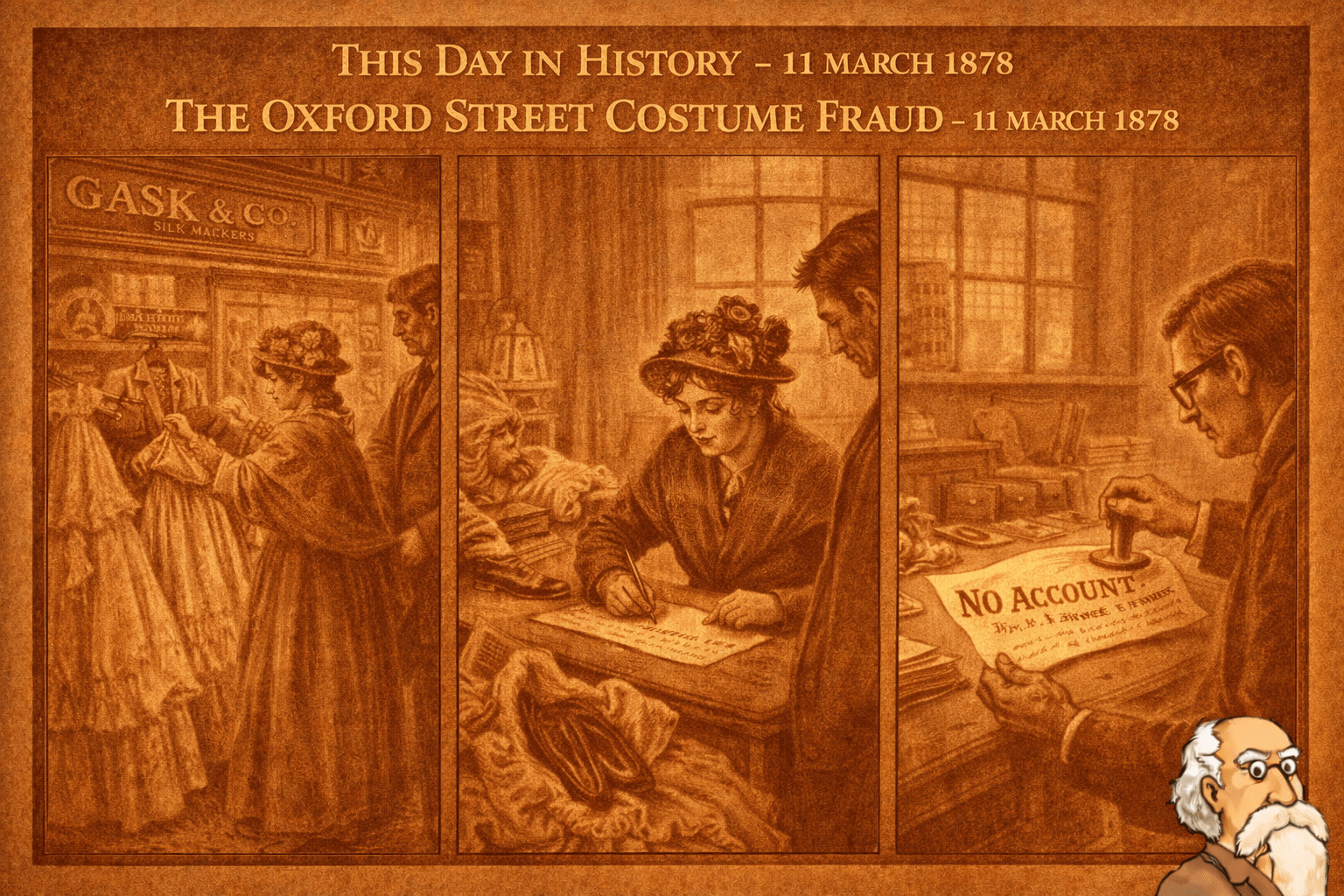
The events began in February 1878 at the premises of Messrs. Gask and Gask, silk mercers on Oxford Street.
A woman identifying herself as Mrs. Keech of 19 Albany Street, Regent’s Park visited the shop several times over three days.
Each visit followed a similar pattern.
She selected fashionable goods—costumes and other items—and discussed alterations and delivery arrangements as though she were an ordinary, respectable customer.
Nothing about her behaviour raised suspicion.
The Final Purchase
On 13 February, she returned once more and asked for an invoice covering the entire selection.
She explained that she would settle the bill by cheque.
The goods were packed and delivered that evening by Benjamin Thomas, the firm’s chief clerk.
At the Albany Street address, Mrs. Keech asked him to open the parcels so she could check the contents against the invoice.
Satisfied, she calmly wrote a cheque.
To reassure the clerk, she added a detail that seemed to settle the matter completely.
“My uncle Roper left me £6,000 in the London and Westminster Bank.”
Confident the cheque would be honoured, Thomas accepted it and left the goods with her.
A Worthless Cheque
The following morning, Thomas presented the cheque at the Temple Bar branch of the London and Westminster Bank.
The result was immediate and unmistakable.
The bank manager wrote two simple words across it:
“No account.”
Not only did Mrs. Keech have no account with the bank, the cheque itself was irregular—it had no date, which alone would have prevented payment.
Realising they had been deceived, the shop’s representatives hurried back to Albany Street.
But they were too late.
Mrs. Keech had already left the address, taking the costumes with her.
The Search
Police detective Edward Fisher traced the suspect across several locations.
Eventually he found her nearly a week later in Ilminster, Somerset, her native county.
When arrested, she offered a brief expression of regret.
She said she hoped Mr. Gask would overlook the matter, and that she would be able to repay him.
The courts were not persuaded.
The Trial
At the Old Bailey, the evidence was straightforward:
- the goods had been obtained under a false identity and address
- the cheque had been written on a bank where she held no account
- the bank itself confirmed the instrument was invalid
The jury returned a verdict of guilty.
Fanny Roper Keech was sentenced to six months’ imprisonment.
Victorian Confidence Tricks
The crime was a classic example of false pretences, one of the most common Victorian financial offences.
Rather than theft by force or stealth, such crimes relied on confidence and credibility.
A respectable address, calm conversation, and the suggestion of inherited wealth were enough to persuade a merchant that payment was certain.
In this case, a single undated cheque—combined with a convincing story—was all that was required.
Epilogue
Victorian London was a city where appearances carried enormous weight.
Well-dressed customers speaking politely and claiming respectable connections were rarely challenged.
Fanny Roper Keech understood this perfectly.
For several days, she moved through Oxford Street shops like any other customer.
By the time the deception was discovered, she and the costumes had already disappeared.
Her freedom lasted barely a week.
Victorian prison
Victorian prison in 1878 would have been a harsh and highly regulated environment for Fanny Roper Keech. By this date prisons were no longer the chaotic, mixed institutions of the early 1800s; instead they followed the strict discipline introduced after the Prison Acts of the 1860s. The aim was not simply to confine offenders but to reform them through silence, routine, and labour.
Below is what her six-month sentence would likely have been like.
Arrival and Reception
When Fanny entered prison she would first go through the reception process:
- Her name, age, offence, and physical description would be recorded.
- She would be searched and washed.
- Her own clothing would be taken away and replaced with prison dress—a plain coarse gown, apron, and cap for women.
- Her hair might be cut short for hygiene and discipline.
She would then be placed in a separate cell.
The Separate System
Most English prisons in the 1870s followed the “separate system.”
This meant:
- Prisoners spent most of the day alone in their cells.
- They worked, ate, and slept there.
- Talking to other prisoners was strictly forbidden.
Even when prisoners left their cells—for chapel or exercise—they often wore masks or hoods to prevent them recognising one another.
The idea was that solitude would encourage reflection and repentance.
Her Cell
Fanny’s cell would have been very small but relatively clean compared with earlier prisons.
Typical contents:
- a narrow plank bed with a thin mattress
- two coarse blankets
- a wooden stool
- a small table or shelf
- a Bible or prayer book
Sanitation was basic. Many cells had a bucket or chamber pot emptied daily.
Daily Routine
Victorian prison life was dominated by strict schedules.
A typical day might look like this:
6:00 a.m. – Wake up
6:30 a.m. – Breakfast (usually gruel and bread)
Morning – Work in the cell
Midday – Dinner (often soup, bread, or potatoes)
Afternoon – More labour
Evening – Supper and prayers
8:00 p.m. – Lights out
Warders enforced strict silence and discipline throughout.
Prison Labour for Women
Unlike male prisoners (who often performed hard labour such as the treadmill or crank), women were generally given domestic or textile work.
Fanny might have spent her days:
- sewing prison uniforms
- mending clothes
- picking oakum (untwisting tarred rope fibres)
- laundry work
Oakum picking was especially unpleasant; the tar irritated the skin and lungs.
Food
Victorian prison diets were intentionally plain.
Meals usually included:
- gruel or porridge
- bread
- soup or broth
- sometimes potatoes
Meat was rare and portions were carefully regulated.
The goal was sustenance, not comfort.
Discipline
Punishments existed for breaking rules such as speaking, disobedience, or laziness.
These might include:
- reduced diet
- solitary confinement
- loss of privileges
However, by 1878 prisons were already becoming less brutal than earlier decades.
Religion and Reform
Victorian prisons placed strong emphasis on moral reform.
Prisoners attended:
- chapel services
- meetings with the prison chaplain
- sometimes basic education classes
Authorities believed crime could be cured through discipline, religion, and reflection.
Release
Because Fanny’s sentence was six months, she likely served nearly the entire term.
Short sentences like hers were often served in local prisons such as Holloway or Clerkenwell.
When released she would receive:
- her civilian clothing
- a small travel allowance
- sometimes help from a prisoners’ aid society
But many ex-prisoners found it difficult to rebuild their lives.
In Short
For Fanny Roper Keech, Victorian prison would have meant:
- solitary confinement for much of the day
- strict silence and discipline
- plain food and hard routine
- hours of repetitive labour
- constant supervision by warders
It was designed to be orderly, austere, and morally corrective rather than openly brutal.
Sources
- Central Criminal Court Proceedings, 11 March 1878, trial of Fanny Roper Keech.
- Testimony of Charles Henry Groves, Benjamin Thomas, and bank clerk Andrew Beer.
- Metropolitan Police evidence presented at the Old Bailey.
Thank you for reading my writings. If you’d like to, you can buy me a coffee for just £1 and I will think of you while writing my next post! Just hit the link below…. (thanks in advance)








 The Sage Page