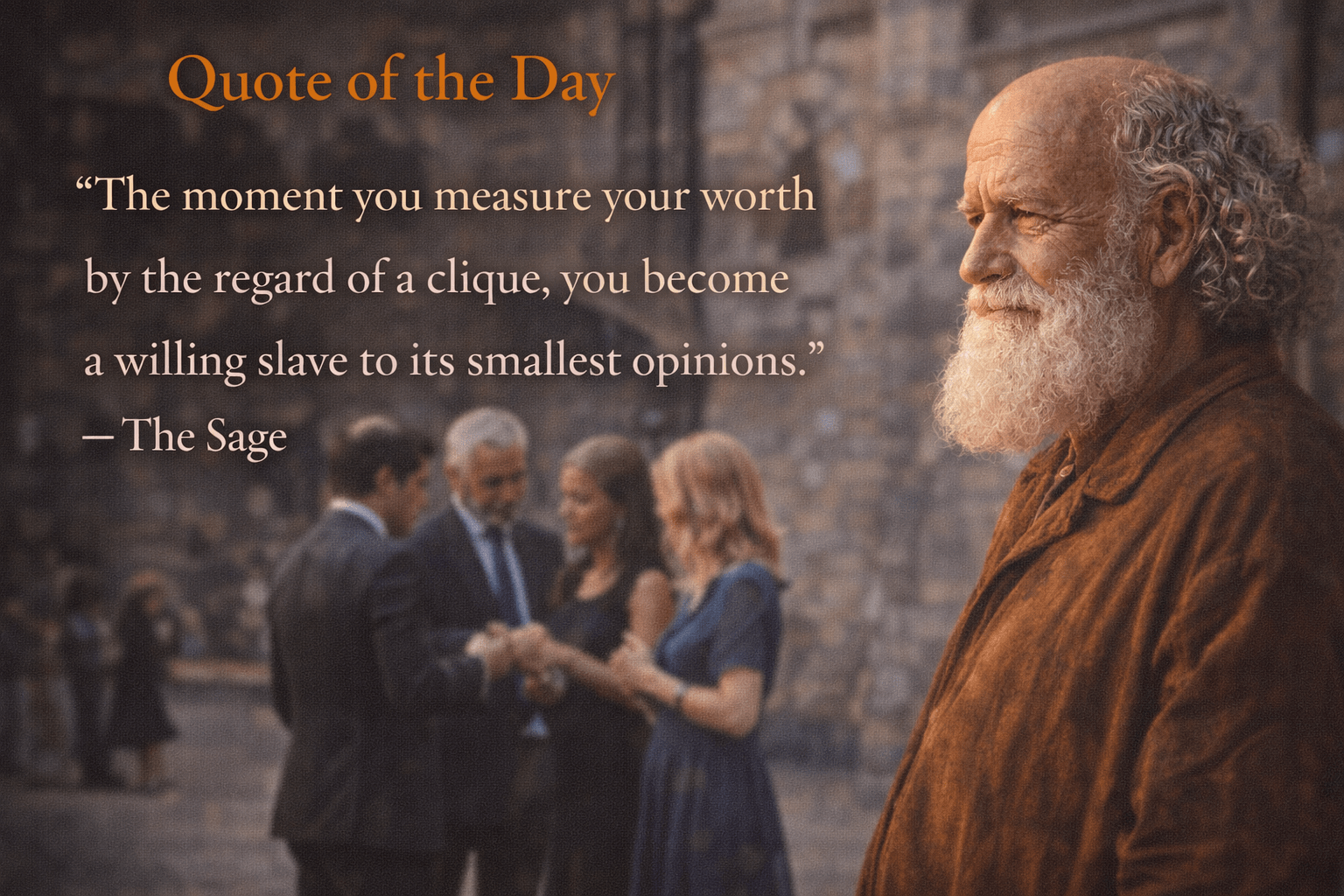
“The moment you measure your worth by the regard of a clique, you become a willing slave to its smallest opinions.” — The Sage
Belonging is a powerful human desire. We seek acceptance, approval, and recognition from those around us, often without realising how much influence that need can carry. The Sage warns that when this desire becomes too tightly focused — confined to a small circle or clique — it can quietly begin to shape who we are.
A clique offers validation, but it can also impose limits. Its approval may feel rewarding, yet it often comes with unspoken expectations. Over time, the need to maintain that regard can lead us to adjust our views, soften our honesty, or suppress parts of ourselves that do not quite fit.
True freedom lies in widening our sense of worth beyond any single group. Respect is valuable, but it should never be the master of our identity. When we stand on our own principles, we are no longer dependent on the shifting opinions of a few — and in that independence, we find something far more durable than approval.
— The Sage
Thank you for reading my writings. If you’d like to, you can buy me a coffee for just £1 and I will think of you while writing my next post! Just hit the link below…. (thanks in advance)
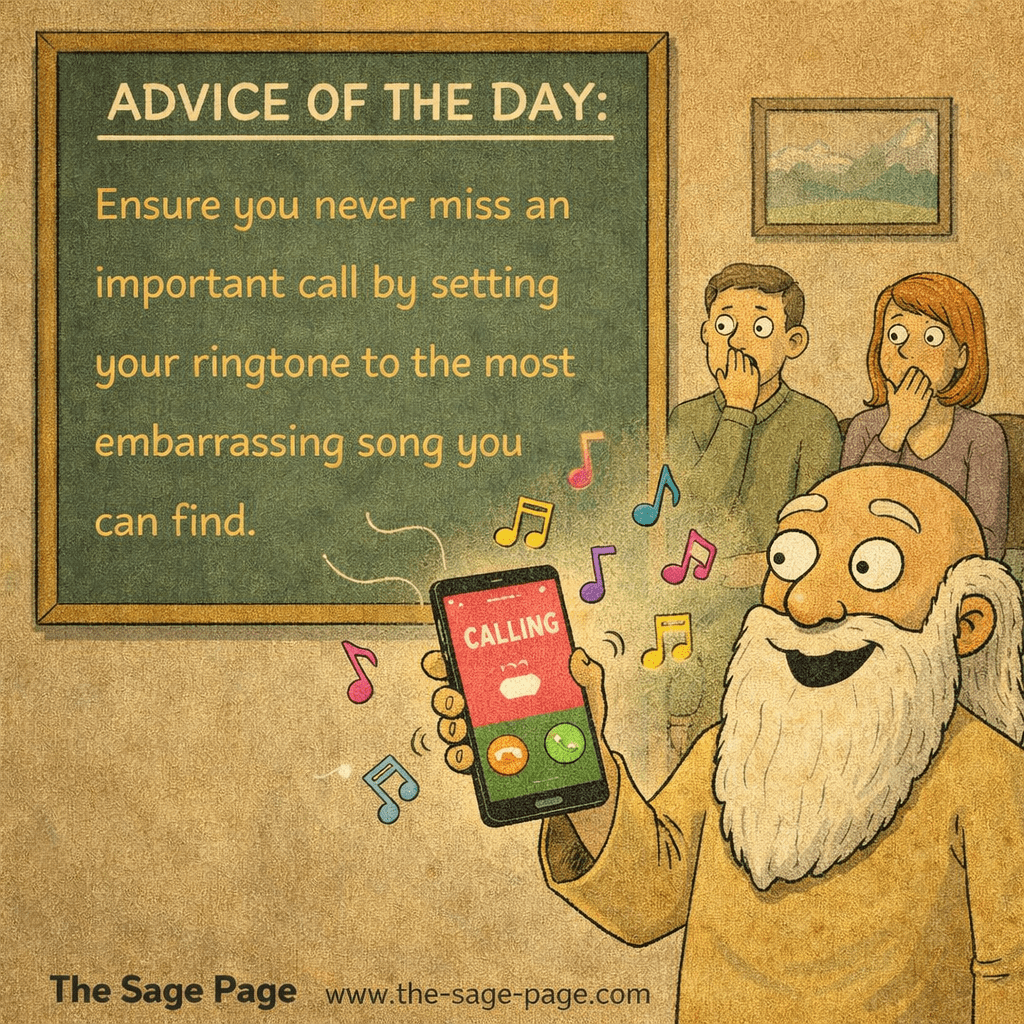
Ensure you never miss an important call by setting your ringtone to the most embarrassing song you can find.
The sage
Choosing a ringtone is an opportunity to express personality, taste, and a complete disregard for social dignity. The Wise Sage recommends selecting something so profoundly awkward that you are physically compelled to answer your phone immediately, if only to make it stop.
Popular choices include novelty songs, loud animal noises, or anything featuring unexpected yodelling. Ideally, your ringtone should begin loudly and without warning, causing you — and everyone nearby — to question what is happening and why.
For maximum effectiveness, keep your phone on the highest possible volume at all times. Quiet environments such as libraries, waiting rooms, or solemn occasions provide the perfect testing ground. Nothing sharpens reflexes like the sudden blast of an ill-advised ringtone echoing through a silent room.
If you find yourself becoming accustomed to the embarrassment, simply rotate your ringtone regularly to maintain peak discomfort. Remember: familiarity breeds delay.
As always, The Sage accepts no responsibility for startled strangers, social exile, or being asked to leave public spaces.
Thank you for reading my writings. If you’d like to, you can buy me a coffee for just £1 and I will think of you while writing my next post! Just hit the link below…. (thanks in advance)
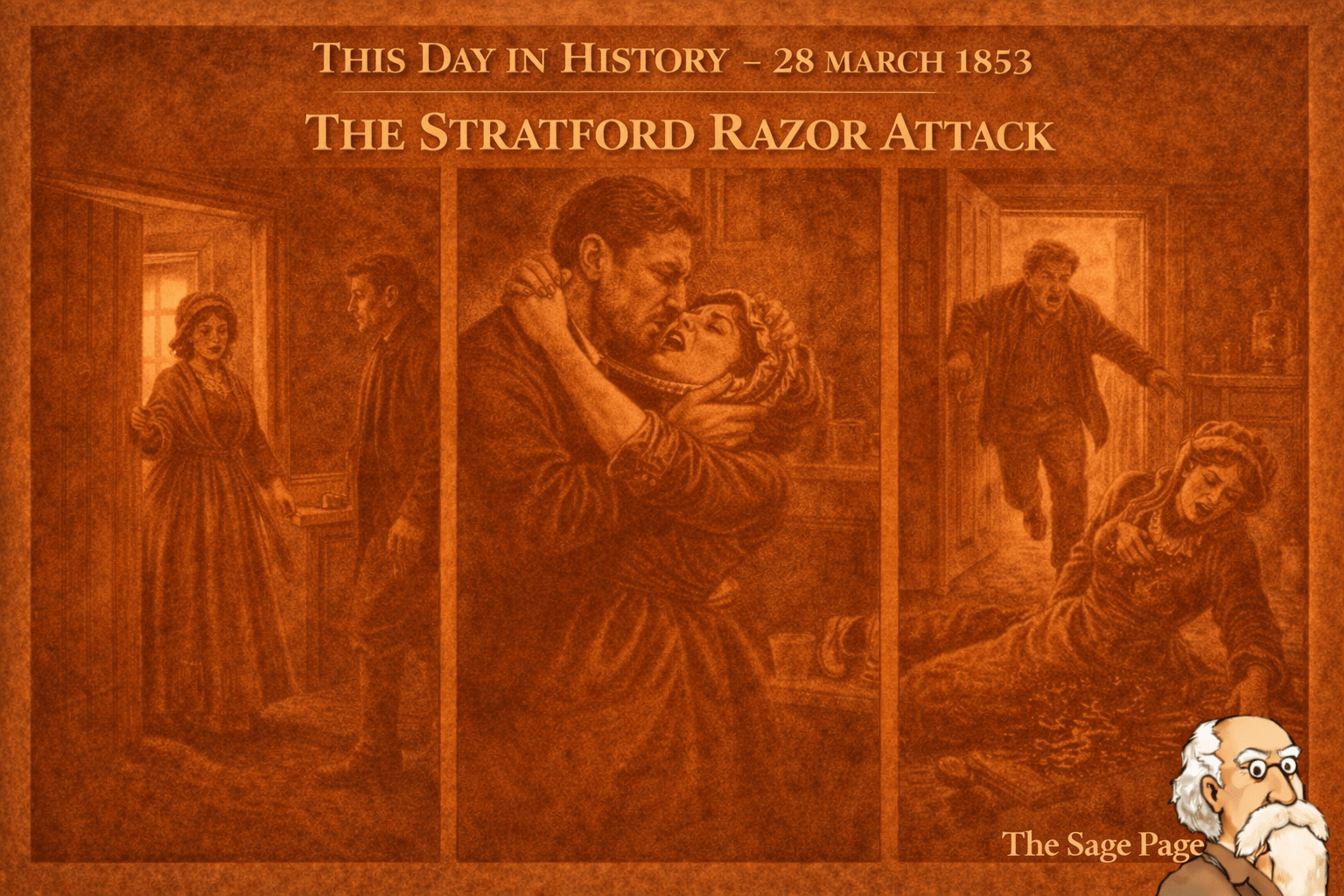
The Stratford Razor Attack – Thomas Rolls and Charlotte Carter
A Relationship Turned Sour
For four years, Charlotte Carter had lived with Thomas Rolls as his partner.
But by March 1853, that life was over.
She had left him— not quietly, but, as she told the court:
“Through your ill-usage.”
Two weeks later, their paths crossed again.
What followed would nearly cost her life.
The Morning Visit
On the morning of 28 March, Carter called at the house of Mark Barker, in Stratford, to collect ribbon for trimming caps.
A simple errand.
But Rolls was already there.
He rose when she entered and calmly asked her to step into the kitchen to read a letter—supposedly from her uncle.
Nothing about the request seemed immediately threatening.
She agreed.
“Are You Unhappy?”
Inside the kitchen, they were alone.
Moments later, Rolls followed her in.
He placed his arm around her neck.
Then, quietly, he asked:
“Are you unhappy?”
She replied:
“No.”
His answer came just as calmly:
“I am.”
Then he drew a razor.
The Attack
Without warning, Rolls cut her throat.
The blade tore into the left side of her neck— deep, deliberate, and dangerously close to a fatal artery.
Carter fought back.
She screamed:
“Murder!”
In the struggle:
Her hands were slashed
Her cheek and chin were cut
Blood poured from the wound
A Narrow Escape
Hearing the cries, Mark Barker rushed into the kitchen.
He found Rolls gripping Carter, her neck bleeding heavily.
He pulled them apart.
Carter collapsed, badly wounded.
Barker ran into the street shouting:
“Murder!”
When he returned, the scene had shifted again.
Rolls stood there, now holding a chopper, attempting to calm the situation:
“Hold your noise; don’t say anything; it is all right.”
It was anything but.
The Prisoner Turns the Blade on Himself
Moments later, Barker found Rolls in the yard.
He had turned the razor on himself.
His throat was cut. The blade still in his hand.
The handle lay behind, in the kitchen.
The Medical Evidence
At the London Hospital, surgeon Alfred Adams Mantill examined Carter.
Her condition was grave:
A wound three-quarters of an inch long
Nearly an inch deep
Just half an inch from the carotid artery
Had the blade gone slightly further:
“It would most probably have killed her.”
She remained in danger for two weeks.
Rolls, too, had seriously injured himself—but not fatally.
The Defence
Rolls offered little in explanation.
He did not deny the act.
Instead, he blamed drink:
“I was in liquor, and that caused me to do it.”
But witnesses disagreed.
Barker stated he had only had “a little.”
The surgeon confirmed:
He was not intoxicated when examined.
The Verdict
The facts were clear:
A deliberate act
A lethal weapon
A wound that narrowly avoided death
The jury returned their verdict:
GUILTY.
The Sentence
Rolls was sentenced to death.
But in this case, the punishment was tempered:
Death Recorded.
A legal mechanism that spared him execution, typically resulting in transportation or imprisonment instead.
Why This Case Matters
This case is a stark example of domestic violence escalating into attempted murder—a pattern as recognisable today as it was in Victorian London.
It also highlights:
The danger of private spaces
The speed at which violence can erupt
And how survival can hinge on inches
Charlotte Carter lived— not through chance alone, but through resistance, interruption, and sheer proximity to help.
A fraction closer, and this would have been a very different story.
Thank you for reading my writings. If you’d like to, you can buy me a coffee for just £1 and I will think of you while writing my next post! Just hit the link below…. (thanks in advance)
Relationships provide an endless source of humour, and boyfriends are very often at the centre of it. This collection brings together widely circulated boyfriend jokes, featuring familiar punchlines about romance, misunderstandings, and the everyday realities of being in a relationship.
😂 Boyfriend Jokes
My boyfriend said he needed space… So I locked him outside.
My boyfriend told me he was great at multitasking… So I asked him to listen and clean at the same time.
My boyfriend said he’d fix everything around the house… That was six months ago. We still live with “character.”
My boyfriend said he was on a seafood diet… He sees food and eats it.
My boyfriend told me he’d changed… I checked. Same charger, same socks, same excuses.
My boyfriend said he’d cook dinner tonight… We had takeaway.
My boyfriend said he doesn’t snore… He just dreams he’s a chainsaw.
My boyfriend said he’d be ready in five minutes… I assume he meant business days.
My boyfriend said he understands women… We’re still investigating that claim.
My boyfriend said he was “just resting his eyes”… For three hours.
My boyfriend said he’d start going to the gym… He drove past it twice this week.
My boyfriend said he knows how to use tools… He once fixed a chair. We still talk about it.
My boyfriend said he’d remember our anniversary… He remembered it was “sometime this year.”
My boyfriend said he’s good with directions… We’re currently lost, but confidently.
My boyfriend said he’d help with the shopping… He carried one bag and supervised the rest.
My boyfriend said he’d take me somewhere expensive… We went to the petrol station.
My boyfriend said he’d be romantic… He shared his chips.
My boyfriend said he’d surprise me… He did. He actually cleaned something.
My boyfriend said he doesn’t procrastinate… He just likes to delay things properly.
My boyfriend said he’d make breakfast in bed… He ate it before he got upstairs.
Relationships are rarely as straightforward as they seem, and perhaps that is why they lend themselves so well to humour. Somewhere between affection and confusion lies a steady stream of jokes that most people recognise all too easily.
Thank you for reading my writings. If you’d like to, you can buy me a coffee for just £1 and I will think of you while writing my next post! Just hit the link below…. (thanks in advance)
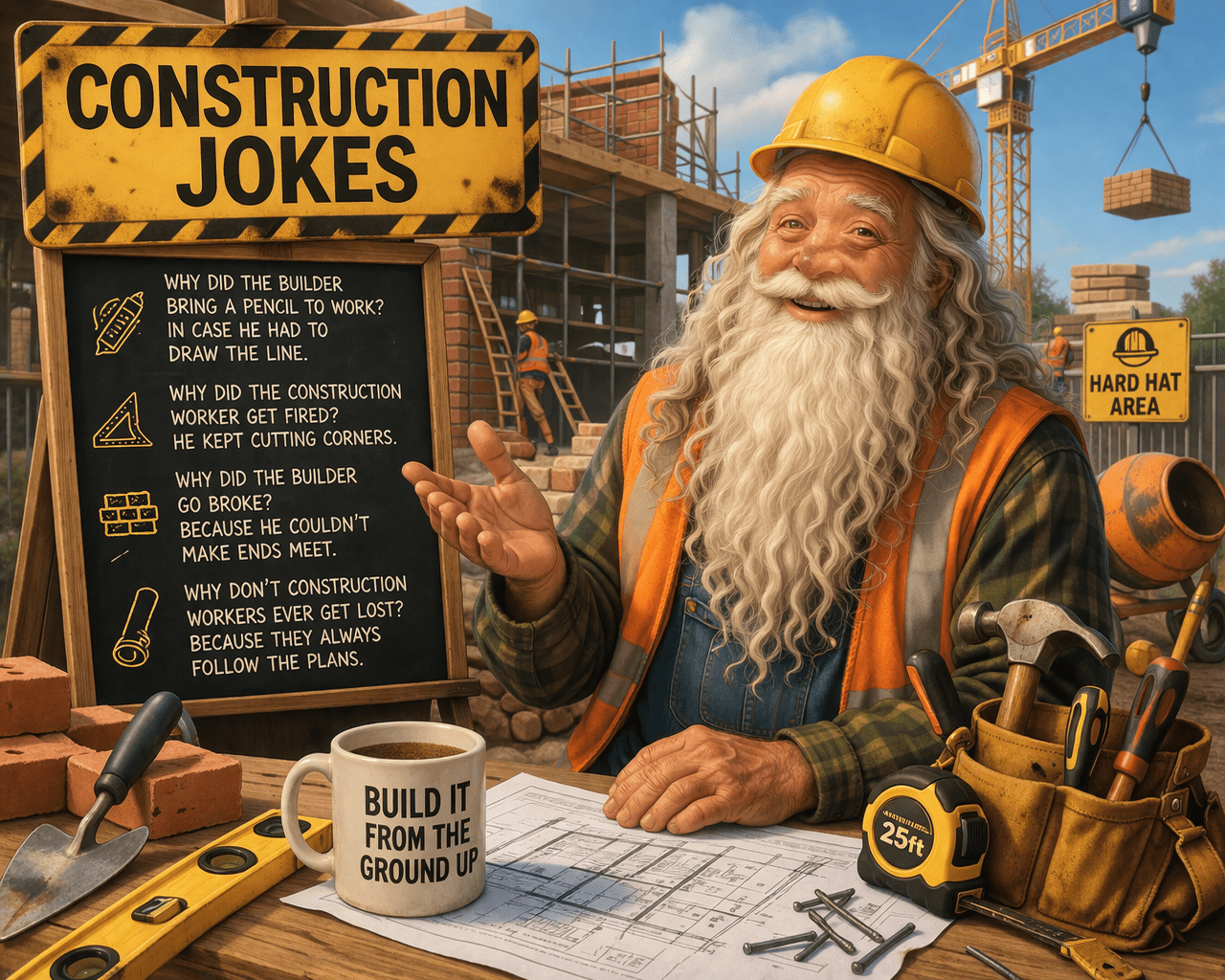
Construction is all about building things properly — and, as it turns out, so is good humour. This collection brings together classic construction jokes, familiar one-liners, and widely circulated gags about builders, tools, and life on site.
😂 Construction Jokes
Why did the construction worker get fired? He kept cutting corners.
Why did the builder go broke? Because he couldn’t make ends meet.
Why did the construction worker bring a ladder to the bar? Because he heard the drinks were on the house.
Why did the builder always carry a pencil? In case he had to draw the line.
Why did the construction worker go to jail? Because he got hammered.
Why did the builder get promoted? Because he nailed every job.
Why don’t construction workers ever get lost? Because they always follow the plans.
Why did the builder take a break? He needed to level things out.
Why did the construction worker smile? Because things were looking up.
Why did the builder get in trouble? He didn’t follow the blueprint.
Why did the construction worker bring a tape measure to work? To make sure everything measured up.
Why did the builder stay calm? He knew how to handle pressure.
Why did the construction worker sit down? He was feeling run down.
Why did the builder carry a hammer? To nail things down.
Why did the construction worker bring a ladder to work? To reach new heights.
Why did the builder work late? He was working around the clock.
Why did the construction worker join the band? Because he had great timing.
Why did the builder take pride in his work? Because he built it from the ground up.
Why did the construction worker go to school? To improve his building skills.
Why did the builder bring a level to the job? To keep things balanced.?
There is something reassuring about building things piece by piece — and humour seems to follow a similar pattern. With the right structure, even the simplest ideas can come together into something that stands the test of time.
Thank you for reading my writings. If you’d like to, you can buy me a coffee for just £1 and I will think of you while writing my next post! Just hit the link below…. (thanks in advance)
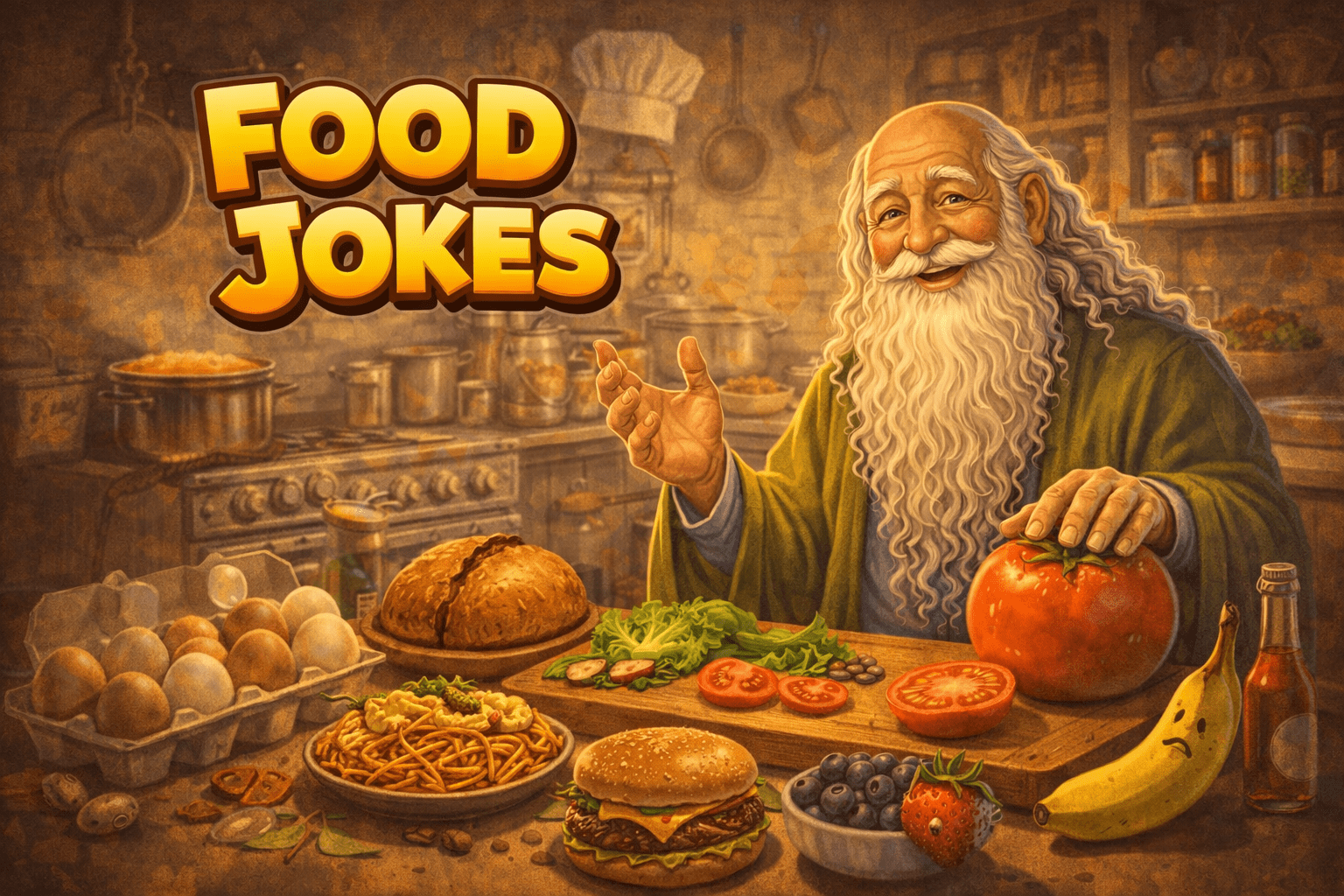
Food brings people together — and, perhaps inevitably, produces a steady stream of jokes. This collection gathers classic food humour, familiar punchlines, and well-known gags that have been doing the rounds for years.
😂 Food Jokes
Why did the tomato turn red? Because it saw the salad dressing.
Why don’t eggs tell jokes? They’d crack each other up.
What did the biscuit say to the other biscuit? “I’m feeling crumby today.”
Why did the cookie go to the doctor? Because it felt crummy.
Why did the banana go to the doctor? Because it wasn’t peeling well.
Why don’t skeletons eat spicy food? They don’t have the stomach for it.
What do you call cheese that isn’t yours? Nacho cheese.
Why did the mushroom get invited to all the parties? Because he was a fungi.
Why did the baker go to therapy? He kneaded help.
What do you call fake spaghetti? An impasta.
Why did the chef blush? Because he saw the salad dressing.
Why did the chef break up with his girlfriend? She was too sour.
Why don’t pancakes ever argue? They just flip out.
What did the baby corn say to the mama corn? “Where’s popcorn?”
Why did the lettuce win the race? Because it was ahead.
What do you call a sad strawberry? A blueberry.
Why did the chef get arrested? Because he beat the eggs.
Why did the apple stop in the middle of the road? Because it ran out of juice.
Why did the butter go to school? To get a little “butter” education.
Why did the chicken go to the séance? To talk to the other side.
Food may be essential, but it rarely takes itself too seriously. Somewhere between the kitchen and the table, it seems to acquire a sense of humour — one that has been passed around almost as often as the dishes themselves.
Thank you for reading my writings. If you’d like to, you can buy me a coffee for just £1 and I will think of you while writing my next post! Just hit the link below…. (thanks in advance)
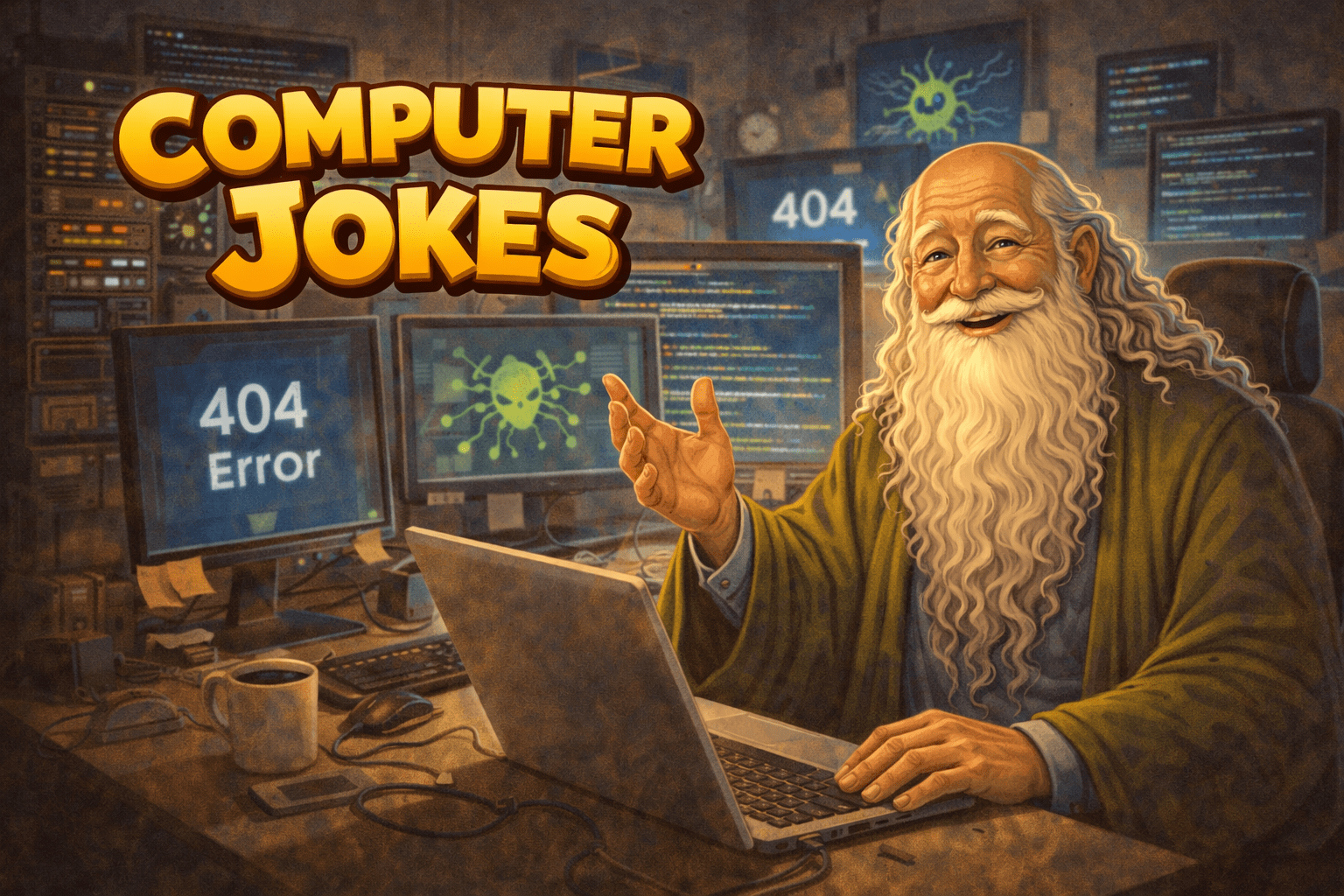
Computers may run on logic, but the people using them don’t always follow the same rules. This collection brings together classic computer jokes, well-known tech humour, and familiar punchlines about bugs, passwords, and the everyday frustrations of modern life.
😂 Computer Jokes
Why did the computer go to the doctor? Because it caught a virus.
Why was the computer cold? It left its Windows open.
Why did the computer show up at work late? It had a hard drive.
Why did the computer keep sneezing? It had a virus.
Why did the computer go to therapy? It had too many bytes from the past.
Why did the developer go broke? Because he used up all his cache.
Why do programmers prefer dark mode? Because light attracts bugs.
Why do Java developers wear glasses? Because they don’t see sharp.
Why did the computer cross the road? To get a byte to eat.
What do you call a computer that sings? A Dell.
Why was the computer tired when it got home? Because it had too many tabs open.
Why did the computer get glasses? To improve its web sight.
Why did the computer freeze? It left its Windows open.
What do you call a group of musical computers? A band-width.
Why don’t computers take their hats off? Because they have bad caps lock.
Why did the IT teacher go to jail? Because he was caught hacking.
Why did the computer get angry? Because someone pressed its buttons.
What’s a computer’s favourite snack? Microchips.
Why was the computer so smart? It listened to its motherboard.
Why did the laptop go to school? To improve its memory.
Technology promises efficiency, speed, and clarity, yet somehow manages to produce an entirely new category of confusion. Fortunately, where there is confusion, there is usually humour — and computers seem particularly generous in that regard.
Thank you for reading my writings. If you’d like to, you can buy me a coffee for just £1 and I will think of you while writing my next post! Just hit the link below…. (thanks in advance)
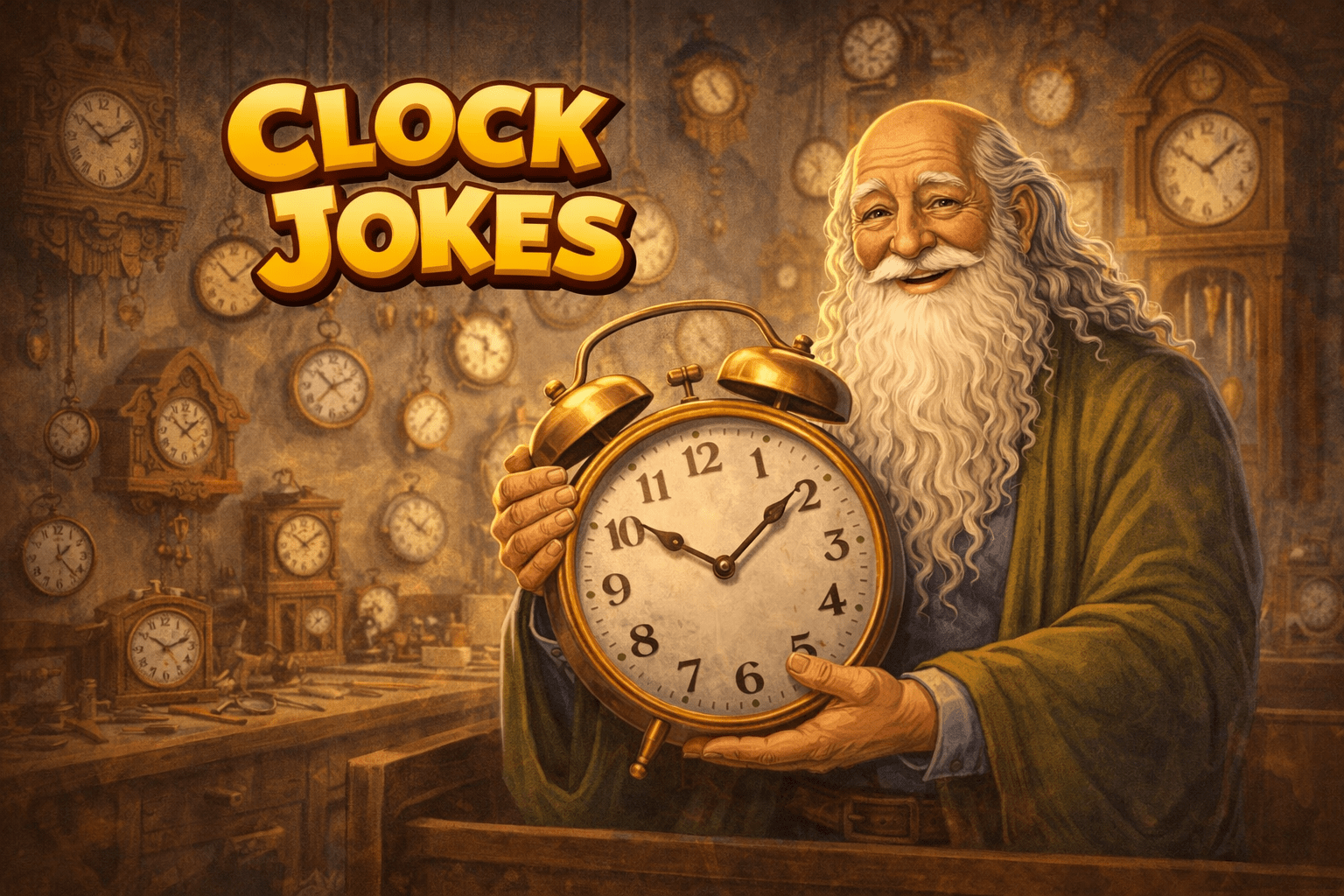
Clocks keep time, but they’ve also kept comedians busy for years. This collection brings together classic, well-known clock and time jokes — familiar punchlines, simple wordplay, and humour that has stood the test of time.
😂 Clock Jokes
Why did the man throw his clock out the window? He wanted to see time fly.
Why was the clock always hungry? Because it went back four seconds.
Why did the clock get in trouble at school? It kept tocking during lessons.
Why did the alarm clock get fired? It kept going off at the wrong time.
What do you call a belt made of watches? A waist of time.
Why did the clock go to therapy? It had too many issues with timing.
Why did the student sit next to the clock? He wanted to be on time.
Why did the clock break up with the calendar? It felt like their relationship was running out of time.
Why did the digital clock feel superior? Because it had more digits.
What did the clock say to the calendar? “Your days are numbered.”
Why did the clock get promoted? It worked around the clock.
Why did the watch go to school? To improve its second language.
Why did the clock go to the principal’s office? It was ticking off the teacher.
Why don’t clocks ever get tired? Because they always have time to rest.
What’s a clock’s favourite time of day? Any time.
Why did the grandfather clock get nervous? It felt under pressure.
Why did the clock sit in the corner? It needed some time out.
Why was the broken clock always calm? Because it didn’t care about time anymore.
Why did the clock get a medal? For outstanding timing.
Why did the clock join the band? Because it had good timing.
Time may move steadily forward, but humour has a habit of circling back on itself. And in the case of clocks, it seems that even the simplest ideas can keep ticking along, producing the same reliable laughs year after year.
Thank you for reading my writings. If you’d like to, you can buy me a coffee for just £1 and I will think of you while writing my next post! Just hit the link below…. (thanks in advance)
Churches are places of reflection, tradition, and—perhaps surprisingly—a rich source of humour. This collection brings together classic church jokes, familiar anecdotes, and well-known punchlines that have been shared for years.
😂 Church Jokes
A priest, a minister, and a rabbit walk into a blood donation clinic. The rabbit says, “I think I might be a type O.”
A pastor said, “Next week I plan to preach about the sin of lying. To help you understand, read Mark 17.” The following Sunday, he asked how many had read it. Nearly everyone raised their hand. The pastor smiled and said, “Mark only has 16 chapters.”
A burglar broke into a house one night. As he was sneaking around, he heard a voice say, “Jesus is watching you.” He froze. After a while, he continued… Again the voice: “Jesus is watching you.” He turned on the light and saw a parrot. “What’s your name?” he asked. “Clarence,” said the parrot. “Who names a parrot Clarence?” “The same people who named their Rottweiler Jesus.”
A man walked into a church and asked, “How much do you charge for a wedding?” The priest replied, “That depends on how beautiful the bride is.” The man said, “She’s average.” The priest said, “£100.” The man showed him a photo. The priest looked and said, “Oh… I didn’t realise she was so beautiful. That’ll be £10.”
A Sunday school teacher asked her class, “Why do you need to be quiet in church?” One child replied, “Because people are sleeping.”
A little boy was in church with his mum. During the service, he whispered, “Mum, I need to go to the toilet.” She said, “Wait until after the prayer.” He replied, “But my prayer has already been answered!”
The vicar’s wife was very upset. “You told everyone in your sermon that I’m greedy!” “I didn’t,” said the vicar. “I said we should be content with what we have.” “Yes,” she said, “and then you looked straight at me.”
A man told his friend, “I joined a new church.” “Really? What’s it like?” “They’re very friendly. They even have a special pew for people who snore.”
A minister was preoccupied with thoughts of how he was going to ask the congregation to come up with more money. So he announced, “After the sermon, the collection plates will be passed around. But before that, I’d like to ask the congregation to pray.” A little boy leaned over to his father and whispered, “Dad, if we pray, do we still have to pay?”
A priest was giving a sermon about honesty. Afterwards, he asked, “How many of you have read the Ten Commandments?” Everyone raised their hand. He said, “Good. Next week we’ll go through them one by one… slowly.”
A church sign read: “Don’t let worries kill you — let the Church help.”
Another sign read: “Come in and pray today — beat the Christmas rush.”
A priest said to his congregation, “The good Lord didn’t create anything without a purpose, but mosquitoes come close.”
A man walked into church late. The usher said, “You’ll have to sit in the front row.” The man replied, “No thanks, I’d rather stand.”
A Sunday school teacher asked, “Who knocked down the walls of Jericho?” A boy said, “Not me!” The teacher was shocked and told the headmaster. The headmaster said, “I know the boy—he’s very honest. If he says he didn’t do it, he didn’t do it.”
A pastor said, “I have good news and bad news. The good news is we have enough money to pay for the new roof. The bad news is—it’s still in your pockets.”
A man said to the vicar, “I haven’t been to church in years.” The vicar replied, “That’s alright… we’ve kept your seat warm.”
During a long sermon, a man leaned over and said, “How long has he been preaching?” His friend replied, “About 30 years.” “30 years?” “Yes… but don’t worry, he’ll finish soon.”
A child asked, “Why does the pastor talk so loudly?” The father replied, “So he can wake up the people at the back.”
The church choir sounded terrible one Sunday. Afterwards, someone asked the vicar what went wrong. He said, “I think they were singing by faith, not by sight.”
Tradition and humour have always had a curious relationship, and nowhere is that clearer than in church life. Even in the most solemn settings, a well-timed joke has a way of reminding everyone that a little laughter can sit quite comfortably alongside reflection.
Thank you for reading my writings. If you’d like to, you can buy me a coffee for just £1 and I will think of you while writing my next post! Just hit the link below…. (thanks in advance)
Cemeteries may be places of quiet reflection, but they’ve also inspired a surprising amount of classic humour. This collection brings together well-known graveyard jokes, familiar one-liners, and time-tested puns that have been doing the rounds for years.
😂 Cemetery Jokes
Why don’t skeletons fight each other? They don’t have the guts.
Why don’t skeletons go to parties? Because they have no body to go with.
Why are cemeteries so noisy? Because of all the coffin.
Why did the skeleton stay home from the dance? He had no body to go with.
What do you call a skeleton who won’t work? Lazy bones.
Why did the skeleton cross the road? To get to the body shop.
Why didn’t the skeleton go to the scary movie? He didn’t have the stomach for it.
What kind of streets do ghosts haunt? Dead ends.
Why are graveyards so popular? People are dying to get in.
What’s a skeleton’s least favourite room? The living room.
Why did the ghost go into the bar? For the boos.
What do ghosts drink? Spirits.
Why don’t ghosts like rain? It dampens their spirits.
What do you call a ghost with a broken leg? A hoblin goblin.
Why did Dracula become a vegetarian? Because biting necks was a pain in the neck.
What do you get when you cross a vampire and a snowman? Frostbite.
Why don’t vampires go to barbecues? They don’t like steak.
Why did the ghost get a job? He wanted to make a living.
What do you call a cemetery with strict rules? Grave regulations.
Why are ghosts such bad liars? Because you can see right through them.
There is something oddly reassuring about humour in unlikely places. Even among gravestones and quiet paths, the human instinct to joke persists — perhaps as a reminder that laughter, like memory, has a way of lingering.
Thank you for reading my writings. If you’d like to, you can buy me a coffee for just £1 and I will think of you while writing my next post! Just hit the link below…. (thanks in advance)




 The Sage Page