Quote of the Day: Silence

“The problem with silence is that most people only notice it when it’s gone.”
The Sage


The Sage has always treated silence as an old friend — patient, calm, and endlessly revealing. To him, silence isn’t the absence of sound, but the presence of space. It’s where thoughts settle, ideas form, and the world remembers to breathe. Yet, like so many quiet things, it’s rarely appreciated until it disappears beneath the roar of daily life.

He believes that silence is one of life’s great teachers. It allows wisdom to surface and humility to grow. In stillness, we begin to hear not just the world, but ourselves — the deeper rhythm beneath the chatter. For The Sage, that’s where understanding lives: not in noise, but in the hush between words.

Of course, he can’t resist a smile as he says it. The Sage knows that our noisy world fears quiet because it leaves us alone with our own thoughts — and those can be louder than any crowd. His advice is simple: learn to listen to silence before it’s drowned out completely.


Thank you for reading my writings. If you’d like to, you can buy me a coffee for just £1 and I will think of you while writing my next post! Just hit the link below…. (thanks in advance)


Advice of the Day: Bath-Night Spaghetti

“Only eat spaghetti on bath nights.”

The Sage

The Sage has many rules for living, but few are as practical — or as messy — as this one: “Only eat spaghetti on bath nights.” It’s advice born of experience, tomato stains, and a lifelong battle with gravity. For The Sage, spaghetti isn’t food; it’s a lifestyle hazard that demands both caution and a nearby source of hot water.

Spaghetti, he explains, is a treacherous meal — a slithering ambush disguised as dinner. Every forkful carries the risk of airborne sauce, accidental lassoing, or what scholars now call The Marinara Incident. That’s why the truly enlightened schedule their pasta feasts for evenings when a thorough scrubdown is already on the agenda. It’s not laziness — it’s logistical genius.

So next time you fancy a plate of spaghetti, check your calendar first. Is it bath night? Excellent. Proceed with reckless abandon. If not, step away from the pasta, for there’s wisdom in restraint — and no detergent on Earth that truly removes tomato from beige robes.


Thank you for reading my writings. If you’d like to, you can buy me a coffee for just £1 and I will think of you while writing my next post! Just hit the link below…. (thanks in advance)
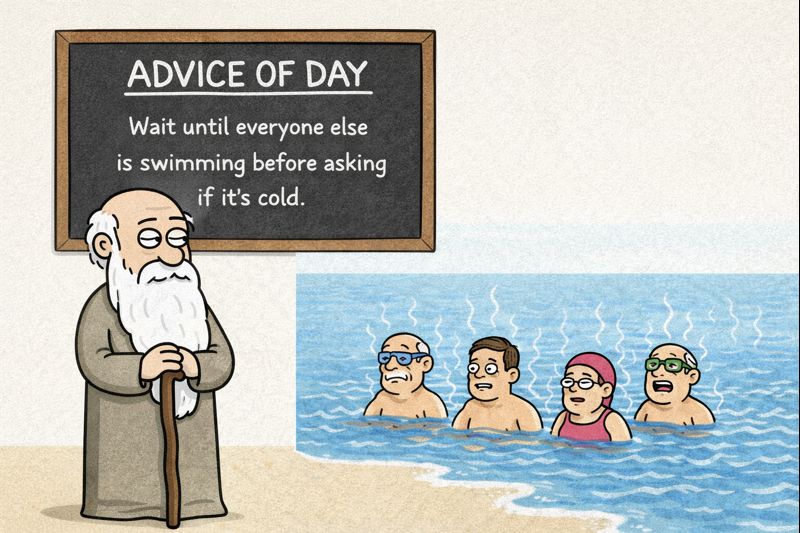
Advice of the Day: Trust Dogs

“Trust dogs. They always know who to stay away from.”

The Sage

The Sage believes that dogs possess an ancient, unspoken wisdom that far surpasses our own. As he puts it: “Trust dogs. They always know who to stay away from.” And he’s right. Dogs have an uncanny knack for sniffing out the truly dodgy — be it a deceitful salesman, a visiting in-law, or anyone who uses the word “synergy” unironically.

While humans waste time reading body language or analysing motives, dogs simply know. A low growl or a strategic retreat tells you everything you need to know about someone’s character. The Sage advises taking this behaviour seriously. If your dog avoids a person, you probably should too — or at least keep them on a shorter metaphorical leash.

Of course, this principle also works in reverse. If a dog bounds up to someone, wagging like an overexcited metronome, that’s usually a sign of good heart — or at least an owner who smells faintly of bacon. So next time you’re uncertain about a new acquaintance, don’t consult your instincts — consult your Labrador.


Thank you for reading my writings. If you’d like to, you can buy me a coffee for just £1 and I will think of you while writing my next post! Just hit the link below…. (thanks in advance)

Advice of the Day: The Art of Blame

If you do something bad, make sure there’s someone else around to blame.”

The Sage

Few people appreciate the delicate art of wrongdoing. Most amateurs commit their misdeeds alone, which is both foolish and inefficient. The Sage, however, understands that true wisdom lies not in avoiding trouble, but in ensuring there’s someone nearby to absorb the fallout. As he sagely puts it: “If you do something bad, make sure there’s someone else around to blame.”

It’s an ancient principle — as old as Eve and the serpent, or as modern as every office email chain ever sent. Why suffer the consequences yourself when you can diversify responsibility? From spilled tea to global catastrophes, history’s smartest wrongdoers have always known the power of a well-timed finger point. After all, chaos shared is chaos halved.

Of course, The Sage advises moderation. Blame should be spread with the care of a seasoned gardener, not the enthusiasm of a leaf blower. Choose your scapegoat wisely — ideally someone slow to realise what’s happened. And remember: the true master of mischief doesn’t deny wrongdoing — he simply makes it look like someone else’s idea.


Thank you for reading my writings. If you’d like to, you can buy me a coffee for just £1 and I will think of you while writing my next post! Just hit the link below…. (thanks in advance)

Quote of the Day: A Clear Conscience

“A clear conscience is usually the result of a bad memory.”
The Sage


The Sage has always viewed the human conscience with affectionate suspicion. He knows that most people sleep soundly not because they’ve led blameless lives, but because they’ve conveniently forgotten the bits that might keep them awake. To him, peace of mind is less a moral triumph and more a lapse in recall.

In his characteristic way, The Sage exposes the gentle comedy of human self-delusion. We tell ourselves stories of virtue, edit out the embarrassing footnotes, and call it “a clear conscience.” It’s not hypocrisy, he insists — it’s simply survival. Memory, after all, can be a heavy burden, and the mind is clever at lightening its own load.

But beneath the chuckle lies a note of compassion. The Sage doesn’t mock our forgetfulness — he understands it. To forgive oneself often starts with a little selective amnesia. In the grand ledger of life, he suggests, it’s the smudged entries that make us human.


Thank you for reading my writings. If you’d like to, you can buy me a coffee for just £1 and I will think of you while writing my next post! Just hit the link below…. (thanks in advance)
This Day in History: 4 November 1734 — The Linen Thief in the Basement

On the night of 4 November 1734, London was wet, smoky and full of washing lines. In a house “below stairs”, Joan Wayte hung her freshly washed linen to dry in a basement room. She stepped out between eight and nine o’clock, shut the door behind her, and thought no more of it — until she came home to find her laundry gone and her door disturbed.

Within a month, the Old Bailey would record her words and the name of the man accused: Emanuel Pim, indicted for theft and burglary against her property.


The burglary

From the surviving snippet of Joan’s testimony we know the essentials:

“I hung up some Linnen to dry in my Room below Stairs. I went out between 8 and 9 at Night, and shut my Door after me; but when I returned…”

The unwritten part writes itself. When she came back in later that evening, the latch showed signs of tampering, the door no longer sat true in its frame, and the line where her shifts and aprons had hung was suspiciously bare. In an age when linen meant labour and money — spun, woven and stitched by hand — this was no minor nuisance but a real financial blow.

Neighbours would have been the first detectives. A servant, a watchman, or a curious neighbour likely noticed a man lingering near the tradesmen’s entrance, or carrying an oddly heavy bundle away from the house. One way or another, suspicion settled on Emanuel Pim, and before long he stood in the dock at the Old Bailey.


The trial at the Old Bailey — 4 December 1734

The case appears in the 4 December 1734 Sessions as “Emanuel Pim. Theft; burglary.” with Joan named as the complainant whose linen was stolen from the basement room.

The court would have followed a familiar pattern:

  • Joan describing how she left everything secure and came back to find it disturbed.
  • The value of the linen being carefully listed: shirts, aprons, shifts or sheets, each given a shilling value to show the crime was worth the court’s time.
  • One or more witnesses tying Pim to the stolen bundle — a pawnbroker, a neighbour, or a constable who stopped him with suspiciously damp laundry under his arm.

In our reconstructed dialogue, it might have sounded like this:

Clerk of Arraigns: “Emanuel Pim, you stand indicted for breaking and entering the lodgings of Joan Wayte, and stealing her linen. How say you — guilty or not guilty?”
Pim: “Not guilty.”
Joan: “’Twas my linen, my lord, the very pieces I had washed with my own hands.”

Unfortunately, the detailed verdict line for Pim’s case is behind a technical barrier for me, so I can’t see with certainty whether he was sentenced to death, transportation, or a lesser punishment. We do know from the way the case is catalogued (“theft; burglary” in the 1734 Proceedings) that the court treated it as a serious property crime, not a mere petty larceny.

In similar linen-burglary cases of the 1730s, first-time offenders often faced transportation for seven years, while repeaters or aggravated cases sometimes received death sentences, later commuted. That’s an informed comparison rather than a confirmed fact about Pim himself.


Why this mattered

The story of Joan Wayte’s missing linen speaks to everyday life in early-18th-century London:

  • Linen was wealth. A few shirts and aprons represented days of spinning, weaving, bleaching and sewing. Stealing laundry was effectively stealing someone’s wardrobe and work.
  • Basement rooms were vulnerable. Servants and poorer lodgers often lived “below stairs,” with doors that opened straight onto alleys or yards — perfect opportunities for quick, low-level burglary.
  • The Old Bailey recorded the invisible. Without Joan’s complaint, the theft would have disappeared into gossip. With it, one woman’s laundry day became a small part of London’s legal memory.

On the night of 4 November 1734, a thief found a line of tempting linen; a month later, the court found a name to attach to that act. The detailed sentence is lost behind our present technical curtain, but Joan’s brief line — “I hung up some Linnen to dry…” — is enough to hang a whole story on.


Source

  • Emanuel Pim, theft and burglary case in the 4 December 1734 Old Bailey Proceedings, with complainant Joan Wayte, linen stolen from a room “below stairs” after she went out between eight and nine at night. oldbaileyonline.org+1

Thank you for reading my writings. If you’d like to, you can buy me a coffee for just £1 and I will think of you while writing my next post! Just hit the link below…. (thanks in advance)

This Day in History: 4 October 1815 — The Hunt Brothers and the Wine Cellar Plot

In the cool cellar of a London house on 4 October 1815, two brothers — Richard and William Hunt — decided that honest work was overrated. They were servants, or near enough, with access to their master’s stores of wine and silver. The temptation, as the court later heard, proved irresistible.


The theft

Their plan was simple: slip into the pantry after the household had retired, fill a sack with spoons and a few bottles of their employer’s best claret, and vanish before dawn. But like most simple plans, it came undone through carelessness and too much confidence.

Footman’s testimony: “They had been in the butler’s pantry after hours, and I found the cupboard door prised open. Two silver spoons were gone, and three bottles of wine had been drawn off.”

When questioned, the brothers denied everything — though they were seen the next morning rather unsteady for men who’d had “nothing but tea.”

The evidence mounted quickly: a neighbour’s servant swore he’d bought one of the missing spoons for a shilling from “a young man answering to the prisoner’s description,” and a pawnbroker produced another, bearing the same crest as the master’s silver.


The trial at the Old Bailey

The Hunts stood together in the dock on 25 October 1815, indicted for stealing from their master, Thomas Combe, in his dwelling-house on the 4th of October.

Clerk of Arraigns: “Richard Hunt and William Hunt, you stand indicted for stealing spoons and wine, the property of your master. How say you — guilty or not guilty?”
Both: “Not guilty.”

The prosecutor’s case was solid and sprinkled with irony — servants turned burglars by proximity to comfort.

Prosecutor: “They had daily the run of his pantry, and nightly, it seems, his wine.”

The defence called no witnesses. The jury took only minutes to deliberate.

Foreman: “Guilty.”


Sentence and aftermath

The court recorded both brothers as guilty of larceny from a master — an offence treated with particular seriousness. In earlier years it might have been a hanging matter; by 1815, transportation had become the preferred cure.

Judge: “The confidence of a master so betrayed admits of little excuse. You are sentenced to seven years’ transportation.”

Within months they were aboard a convict ship bound for Australia, their brief toast to freedom replaced by years of hard labour in the colony.


Why this mattered

The Hunts’ case shows the shifting tide of British justice. By the early nineteenth century, courts were replacing the noose with transportation, exporting crime and poverty alike across the seas. Yet their story also speaks of a world where a servant’s temptation could undo a lifetime of service — all for the price of a few silver spoons and bottles of wine.


Source

R v. Richard Hunt and William Hunt (t18151025-43), Old Bailey trial on 25 October 1815 for theft from their master, Thomas Combe, on 4 October 1815. Verdict: Guilty. Sentence: Transportation for seven years.
Old Bailey Proceedings Online


Thank you for reading my writings. If you’d like to, you can buy me a coffee for just £1 and I will think of you while writing my next post! Just hit the link below…. (thanks in advance)
Quote of the Day: Seeing the light

“Common sense is like a torch — most useful to those still in the dark.”
The Sage


The Sage has long been suspicious of the phrase “common sense.” He points out that it’s rarely as common as people believe, and almost never the same from one person to the next. To him, common sense is the torch we light when reason falters — a flicker of instinct to guide us through the murk.

But he’s also quick to remind us that a torch is no use at all in broad daylight. Common sense, he says, is not the peak of wisdom but its first glimmer — a tool for those still groping their way toward understanding. The wise, once they’ve found their footing, tend to switch it off.

As ever, The Sage delivers his insight with a wry grin. He knows that every generation believes it alone has mastered “sense” — yet all still stumble over the same stones. His advice? Carry your torch proudly, but don’t mistake its little pool of light for the sunrise.


Thank you for reading my writings. If you’d like to, you can buy me a coffee for just £1 and I will think of you while writing my next post! Just hit the link below…. (thanks in advance)

Advice of the Day: Budget Haircare

There comes a time in every person’s life when shampoo becomes a luxury item, and conditioner is spoken of only in hushed tones. But fear not — The Sage offers a solution as cheap as it is questionable: simply stand beneath a bird feeder during a good British downpour. The combination of seed fragments, rainfall, and opportunistic pigeons provides a natural exfoliant and protein-rich rinse that no salon could legally advertise.

Some may call this advice “dangerous” or “unsanitary,” but those are just words used by people with clean hair and no sense of adventure. Think of it instead as eco-friendly haircare — a chance to commune with nature while also scaring the neighbours. It’s an organic treatment in the truest sense of the word, occasionally involving actual organic matter.

So next time you’re caught in a storm, look up, find a bird feeder, and embrace your destiny as nature’s own hair model. If nothing else, you’ll emerge refreshed, revitalised, and with a new understanding of why shampoo was invented in the first place.


Thank you for reading my writings. If you’d like to, you can buy me a coffee for just £1 and I will think of you while writing my next post! Just hit the link below…. (thanks in advance)

The Wise Sage Gives His Advice of the Day:

“Save time watering plants — by teaching them to crawl to the sink.”

Ever the innovator, The Sage today unveils a bold new method in home horticulture: stop wasting your life lugging watering cans! His plan? Train your plants to seek hydration for themselves.

By employing a strict regime of motivational speaking, positive reinforcement, and perhaps mild shaming, your houseplants will soon learn to slither obediently toward the kitchen tap whenever they feel thirsty. “It’s all about empowerment,” The Sage explains. “If ivy can climb walls, it can find a mixer tap.”

Of course, early trials may involve slow progress, damp carpets, and traumatised visitors, but The Sage assures us it’s worth it. “The goal,” he says wisely, “is a self-sufficient ecosystem — and a very confused plumber.”


Thank you for reading my writings. If you’d like to, you can buy me a coffee for just £1 and I will think of you while writing my next post! Just hit the link below…. (thanks in advance)