Advice of the Day: Sparks of Suspicion

“You should never trust an electrician with no eyebrows.”

The Sage has met many professionals in his long, occasionally smoke-filled life, but none have concerned him quite as much as the eyebrowless electrician. His warning today is simple, practical, and based on several alarming personal experiences: “You should never trust an electrician with no eyebrows.”

According to The Sage, eyebrows are not merely decorative; they are a record. A history. A warning label, if you will. The absence of eyebrows on an electrician suggests one of two things: a mysterious genetic quirk, or, considerably more likely, a recent disagreement with 240 volts. Either way, The Sage insists this is not the person you want rewiring your fuse box, your cooker, or anything connected to the national grid.

He recommends a simple rule of thumb: if your electrician turns up looking surprised all the time, take it as a sign. Politely decline, back away slowly, and choose someone whose facial features still indicate they’ve survived their previous jobs. Remember — electricians should leave wires smoking, not their own faces.


Thank you for reading my writings. If you’d like to, you can buy me a coffee for just £1 and I will think of you while writing my next post! Just hit the link below…. (thanks in advance)


This Day in History: 9 December 1789 — The Case of the Missing Goods

On 9 December 1789, a young man named Thomas Davis stood at the bar of the Old Bailey, accused of stealing several items from a shopkeeper. The charge was simple larceny, but even small thefts mattered in Georgian London. Shops relied on trust, observation and sharp eyes — and when something went missing, suspicion travelled fast.

The printed Proceedings give us a short but telling summary:

“THOMAS DAVIS was indicted for stealing, on the 9th of December, a variety of goods, the property of a shopkeeper.”
Verdict: NOT GUILTY.
— Old Bailey Proceedings, 9 December 1789
Case reference: t17891209-94

The description is brief, but what it does confirm is crucial: Davis was brought into court on this winter day, formally accused, heard by judge and jury — and ultimately acquitted.


Here is the official trial transcript from The Old Bailey:

THOMAS DAVIS was indicted for stealing, on the 5th of December , one thickset waistcoat, value 10 s. one child’s thickset coat, value 3 s. the property of John Williams , privily in his shop

FRANCES WILLIAMS sworn.

I am wife of John Williams , who keeps a clothes shop , in Fore-street on Saturday the 5th of December, I was behind the counter serving a young woman with a blue apron; and the prisoner and another (who was taller) came into the shop: the tall one asked for some stockings, he said, he was very particular in colour, they must be pepper and salt, with a small rib; I reached one pair to the tall one; the prisoner was behind; the prisoner said, Sir, if you like them, have them; the woman gave me half a guinea to pay for her apron; the tall one asked the price of the stockings: I said, three shillings; and I heard something move behind the tall prisoner and the young woman, as I was weighing the money; that was the prisoner; he was behind the tall one till that time; I never saw his face; I looked up from weighing the money, and the prisoner went out; the tall one threw down the stockings, and ran out; and I missed the property; the prisoner was brought back in ten minutes; I am sure the prisoner is the same man; the prisoner has been at our shop before.

SARAH LLOYD sworn.

I was in the shop: I felt something at my back, and I instantly turned round and saw the prisoner with something under his left arm.

Did not you see them moving? – No, I did not; he was going off the threshold at the door, about a yard and a half from the shelf; I saw the colour of the things, but whether they were both there, I do not know; I do not know what became of the other man; I am sure this is the man that was brought back, which was in ten minutes.

PETER CUTTER sworn.

I took the prisoner and brought him to the prosecutor’s house; nothing was on him; there were some things brought in by somebody, but who I cannot tell.

JOHN CLARK sworn.

I am one of the marshalmen; I live near the prosecutor; I heard the cry of stop thief; I ran out; the prisoner was just stopped; I brought him to the house; and soon after I was there, this property was brought back, all over dirt.

Prisoner. My master is here: I was coming from my father’s house; there was a cry of stop thief; and they stopped me, and took me.

The prisoner called two witnesses, who gave him a good character.

NOT GUILTY .

The prisoner’s father appeared and promised to take care of him.

Court to the Father. You are very much obliged to the Jury.

The prisoner’s Father to the Jury. Gentlemen, I am your most obedient humble servant.

Tried by the London Jury before Mr. RECORDER.


Why this mattered

The acquittal of Thomas Davis reminds us that the Old Bailey was not simply a machine for convictions.
Even in an era of harsh punishments:

  • Evidence mattered.
  • Certainty mattered.
  • And juries — often shopkeepers, tradesmen and householders themselves — were willing to release a defendant if doubt remained.

For Davis, 9 December 1789 was not the day he was transported, imprisoned or whipped. It was the day he stepped away from the gallows’ shadow and returned to his life, cleared of wrongdoing in the eyes of London’s central court.

Small though the case appears, it is a perfect glimpse into the fairness, fallibility and humanity of 18th-century justice.


Source

  • R v. Thomas Davis, tried 9 December 1789, Old Bailey
    Case reference: t17891209-94
    Verdict: Not Guilty
    Source: Old Bailey Proceedings Online

Thank you for reading my writings. If you’d like to, you can buy me a coffee for just £1 and I will think of you while writing my next post! Just hit the link below…. (thanks in advance)

Quote of the Day: Fridge Light

“Most diets fail because the fridge is closer than enlightenment.”
The Sage


The Sage has always been amused by the human struggle with willpower, especially when it comes to food. He notes that while people dream lofty dreams of discipline, clarity, and self-improvement, the humble fridge stands between them and transcendence — humming quietly, glowing softly, and offering temptation at arm’s reach. In such a contest, he says, enlightenment doesn’t stand a chance.

He isn’t mocking the effort; he understands it. Diets demand not just hunger management but emotional honesty, patience, and a willingness to sit with discomfort. The Sage points out that the fridge, in contrast, offers immediate comfort with no spiritual requirements whatsoever. It is, as he likes to say, “the world’s most persuasive counsellor.”

Behind the humour lies a gentle truth: progress in any form requires distance — from old habits, from instant gratification, and sometimes quite literally from the fridge. The Sage invites us to treat dieting not as a punishment but as a chance to notice our impulses, laugh at them, and choose a little more wisely each time. And if enlightenment still feels far away, he assures us that it’s normal — after all, the fridge will always be closer.


Thank you for reading my writings. If you’d like to, you can buy me a coffee for just £1 and I will think of you while writing my next post! Just hit the link below…. (thanks in advance)

Advice of the Day: Workplace Worship

“If you get caught sleeping on the job, just raise your head and say — ‘In Jesus’ name, Amen!’”

The Sage has never been a stranger to the gentle art of sleeping in inconvenient places — fields, libraries, important council meetings — but even he admits that dozing off at work requires strategy. His solution is divinely inspired: “If you get caught sleeping on the job, just raise your head and say — ‘In Jesus’ name, Amen!’”

According to The Sage, this technique transforms any accidental nap into an impromptu moment of spiritual reflection. What looks like snoring becomes “deep meditation.” Drool becomes “holy water.” And that jerk awake when your neck gives out? Why, that’s the Spirit moving through you. It’s a flawless defence, particularly in workplaces that haven’t had a proper HR department since 1998.

Still, The Sage warns that this technique should be used sparingly. Too many “Amens” in one day and people may begin to suspect something. His rule of thumb: if your boss looks confused, you’re safe; if your boss starts praying with you, immediately pretend you’ve had a vision about being allowed to go home early.


Thank you for reading my writings. If you’d like to, you can buy me a coffee for just £1 and I will think of you while writing my next post! Just hit the link below…. (thanks in advance)

Quote of the Day: Dining Out

“The bill is forgotten by morning. The company is remembered for years.”
The Sage


The Sage has always maintained that the true value of a shared meal has very little to do with what’s on the plate. In his eyes, dining out is merely the excuse — the real feast is the conversation that unfolds between sips, the laughter that interrupts the menu, and the small stories traded like secret ingredients. Long after the food is gone, it’s the warmth of those moments that lingers.

He reminds us that the cost of a meal is fleeting; it fades as quickly as the taste of dessert. But the people we share it with, and the way they make us feel, imprint themselves far more deeply. The Sage often jokes that no one ever fondly reminisces about a receipt — yet everyone remembers the friend who made them laugh so hard they nearly inhaled their soup.

Behind the humour lies a quiet truth: life’s most memorable meals have little to do with cuisine and everything to do with connection. For The Sage, dining out is not an indulgence but an investment — not in food, but in friendship. And in the long accounting of life, those are the only credits that truly endure.


Thank you for reading my writings. If you’d like to, you can buy me a coffee for just £1 and I will think of you while writing my next post! Just hit the link below…. (thanks in advance)

Advice of the Day: Upstream Survival

“Always drink upstream from the herd.”

The sage

The Sage has wandered many lands, crossed many rivers, and stepped in more things than he cares to remember. From these questionable experiences comes today’s watery wisdom: “Always drink upstream from the herd.”
It’s less a proverb and more a desperate plea from a man who has, on more than one occasion, mistaken a suspiciously warm puddle for a natural spring.

According to The Sage, herds — whether cows, sheep, or anything with hooves and poor bladder control — have an impeccable talent for contaminating every water source they encounter. The Sage once learned this the hard way during what he fondly refers to as The Incident of the Unfortunate Sip. Since then, he has concluded that the safest water is always found well upstream, preferably separated from livestock by at least one hill, a fence, and ideally a small moat.

So take heed: when you come across a peaceful stream and think, “What a lovely spot for a drink,” first ask yourself a simple question… Which way did the cows go? The answer may save your day, your dignity, and your digestive system.


Thank you for reading my writings. If you’d like to, you can buy me a coffee for just £1 and I will think of you while writing my next post! Just hit the link below…. (thanks in advance)

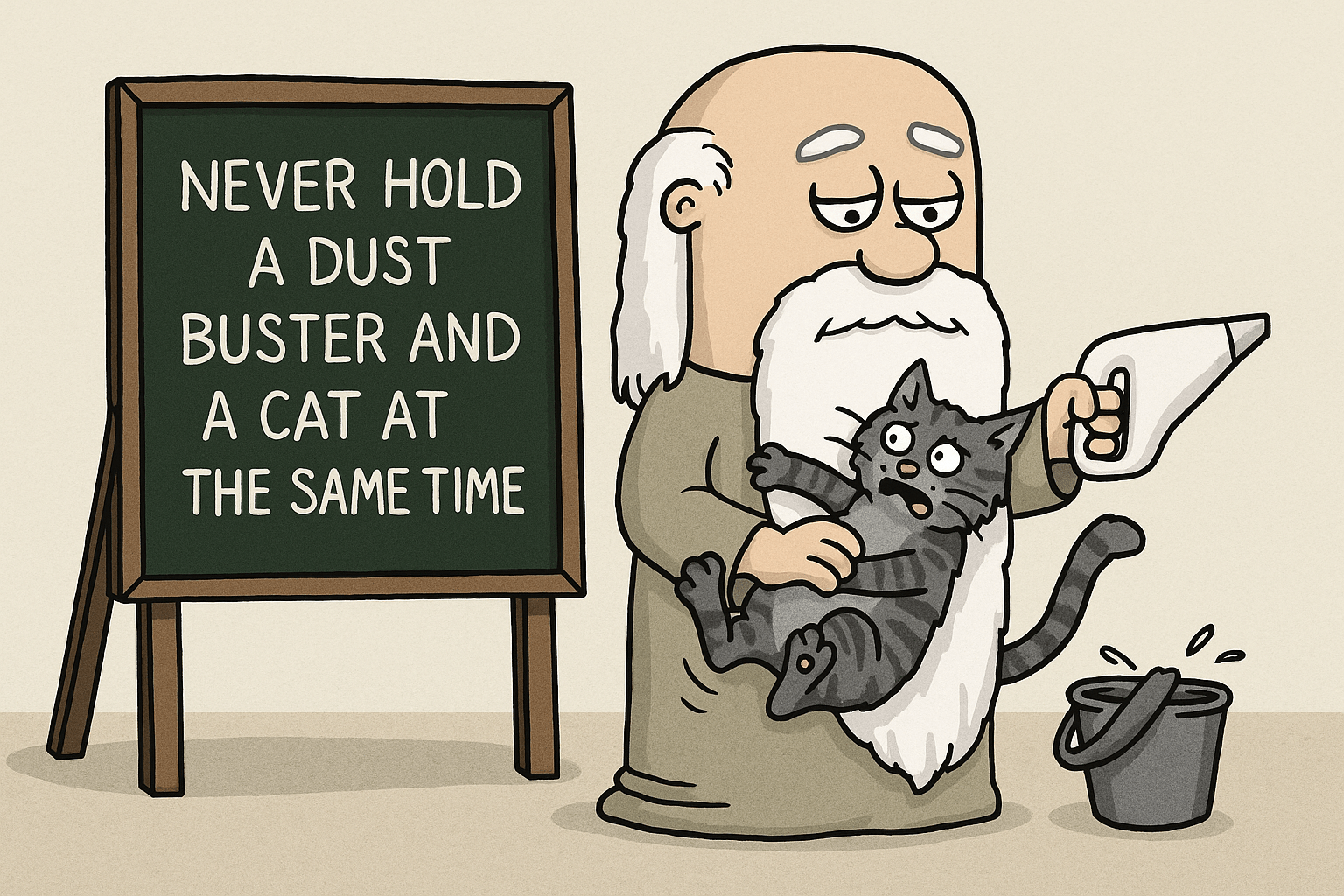
Advice of the Day: Feline Disaster Prevention

“Never hold a dust buster and a cat at the same time.”

The sage

The Sage has seen many catastrophes in his long life — exploding teapots, collapsing deckchairs, and that one unforgettable incident with a runaway wheelbarrow. But nothing, he insists, compares to the fury unleashed when you combine suction technology with an unsuspecting cat. Today’s advice is therefore delivered with both urgency and a faint smell of antiseptic: “Never hold a dust buster and a cat at the same time.”

According to The Sage, a cat’s relationship with noise is delicate and easily disrupted. A single buzz, whirr, or faint mechanical hum can turn even the laziest feline into a spiralling tornado of claws, indignation, and airborne regret. Holding the cat while holding the dust buster is essentially volunteering to become a scratching post with a pulse.

The Sage’s recommended protocol is simple: put one down. Any one. He doesn’t care which — just don’t try to juggle both unless your tetanus shots are up to date and your will is in order. Some advice saves time. Some saves money. This one saves blood.


Thank you for reading my writings. If you’d like to, you can buy me a coffee for just £1 and I will think of you while writing my next post! Just hit the link below…. (thanks in advance)
Quote of the Day: Shopping

“Most people go shopping to feel better. The wise go to find out what they can live without.”
The Sage


The Sage has long observed the curious human habit of treating shops like pharmacies for the soul. Feeling tired? Buy something. Feeling stressed? Buy two. Feeling lost? Buy whatever’s on the end-of-aisle display. Shopping becomes a kind of emotional anaesthetic — a quick dose of novelty to soothe what’s unsettled inside. But, as he likes to remind us, the receipt rarely includes long-term peace of mind.

To the wise, however, shops serve a very different purpose. They’re not treasure troves but test sites. The Sage wanders through them not to fill a basket but to examine desire itself — to see what calls to him, what fades quickly, and what no longer holds any weight at all. In doing so, he discovers that contentment grows not from accumulation but from understanding what no longer needs to be carried.

His humour softens the lesson, but the message is clear: shopping can be a mirror. It shows us our cravings, our impulses, and the little stories we tell ourselves about happiness. The Sage invites us to look into that mirror with curiosity rather than urgency. Sometimes the wisest purchase is the one we walk away from — and the simplest freedom is realising we needed far less than we thought.


Thank you for reading my writings. If you’d like to, you can buy me a coffee for just £1 and I will think of you while writing my next post! Just hit the link below…. (thanks in advance)

This Day in History: 2 December 1838 — The Boy and the Pewter Hoard

On 2 December 1838, in the busy streets off London’s Oxford Street, a sixteen-year-old called David Leary made a decision that would send him to the far side of the world.

Leary was accused of stealing 65 pounds of pewter, worth £1 10s, from a man named Uzziel Emarmel. Pewter was the everyday metal of the city — plates, mugs and measures in taverns and lodging houses — and a heavy bundle of it was as good as ready money.

That Sunday, someone noticed that a substantial quantity of pewter had gone missing from Emarmel’s premises. Suspicion quickly narrowed on the slight, red-haired youth who had been seen near the stock and who, when questioned, could not give a convincing account of his movements.


The theft

The surviving record is brief but clear:

He was “accused of simple larceny (stealing, on the 2nd of December, 65lbs. of pewter, value 1l. 10s., the goods of Uzziel Emarmel).”

We can picture the scene with some confidence:

  • Bars of scrap pewter or stacks of old pots stored in a back room or yard.
  • A narrow alley leading away from the premises.
  • A boy struggling under the weight of a sack that clanked as he walked.

Whether he intended to sell it to a metal dealer, or had been put up to it by others, the records don’t say. What we do know is that by mid-December he was in custody, listed in the Newgate calendars as awaiting trial.


The trial at the Old Bailey — 17 December 1838

On 17 December 1838, Leary appeared before the Central Criminal Court (Old Bailey). The full transcript is behind a modern access wall, but the Digital Panopticon summary gives us the essentials:

  • Charge: simple larceny, stealing 65 lbs. of pewter from Uzziel Emarmel on 2 December.
  • Age: 16, born in Oxford, 5’2″, light red hair, hazel eyes. digitalpanopticon.org
  • Verdict: Guilty, with recommendation (probably for his youth).
  • Sentence: Transportation, recorded elsewhere as ten years.

We can reasonably reconstruct the courtroom rhythm:

Clerk: “David Leary, you stand indicted for stealing, on the 2nd of December, 65 pounds weight of pewter, the property of Uzziel Emarmel. How say you — guilty or not guilty?”
Leary: “Not guilty, sir.”

Here is the complete Trial Transcript:

DENNIS BURGIN , JOHN KEEFE , and DAVID LEARY , were indicted for stealing, on the 2nd of December, 65lbs. of pewter, value 1l. 10s., the goods of Uzziel Emarmel.

MR. CLARKSON. conducted the Prosecution.

ABRAHAM EMANUEL . I am the son of Isaiah Emanuel, a rag-merchant and dealer in marine stores, No. 9, Gee’s-court, Oxford-street; he rente the house. On Sunday, the 2nd of December, I returned home between nine and ten o’clock. in the evening—I went in, as usual, at the outer door—when I got up stairs to the first nook back room, which is my bed-room, I found the door had been opened by a false key, and missed a desk and several things, which had been safe when I went out—I had locked the. desk on Saturday evening, and there was then four sovereigns, three half sovereigns, and about 2l. 10s. in silver in it, with some little bits of broken silver, and six copper paintings, called transparencies, for jelly-moulds—I missed a quantity of Britannia metal spoons from a drawer in the room, a few. brass hooks, a small lamp, one or two metal salts, and two bell-pulls—it is usual to. leave the street-door of the house unlocked, for the accommodation of lodgers—I saw Mary Ferguson on this evening, after missing the things, and in consequence of what she said, I went to the bouse of the prisoner Burgin, No. 14, Gray’s-buildings, which is about three minutes’ walk from our house—I found him in bed—I said, “I want you, Burgin”—he said, “What for?”—I said, “Concerning my father’s robbery”—he said, “I know nothing about it”—I said, “You must come with me—Mary Ferguson positively says she saw you in the passage”—he said, “Very well, I will go with you, and see whether she will say she saw me or no”—he got up, and went with me to our street-door, where I gave him in charge to a constable—Mary Mahony came up, and Burgin said to her, “You had better say you saw me”—she said she saw him, Leary, Keefe, and Burroughs in the watercloset of No. 13, which is four doors from my father’s house—Burgin made no reply to that—I went to No. 13, Gee’s-court, into the cellar, and saw a drawer there belonging to the desk in my bed-room, which had contained the money on the Saturday evening—on kicking some dirt on one side we found the lid of the desk—we searched further, and saw some ground as if turned up, and found the six pieces of painted copper about twelve inches in the ground; and one or two feet further down three ingots of metal belonging to my father, which had been safe in the shop on the Saturday evening—on looking about we saw a hole in the ceiling—the police-sergeant got up, and, among some rubbish there, found one of the spoons, the salt-cellars, and the lamp—the brass hooks I found scattered about in the dirt, and some with the spoons—in consequence of further information from Mrs. Mahoney, I went next day to No. 2, Fitzroy-place, New-road, and found the witness Burroughs.

Cross-examined by MR. DOANE. Q. When did you miss the things? 

A. Between nine and ten o’clock on Sunday night—Leary lives close by me, with his parents.

MR. CLARKSON. Q. Had your father been in the habit of employing Burgin to mind his door, and go on errands? 

A. Yes, sometimes.

MARY FERGUSON . I am the wife of Martin Ferguson, and lodge on the second floor of Mr. Emanuel’s house. On the Sunday night in question, between eight and nine o’clock, I was coming down stairs, and met Burgin in the passage—I have known him from his infancy—I said nothing to him—I do not know what business he had there.

MARY MAHONEY . I am servant to Mr. Goram, of No. 13, Gee’s-court, Oxford-street. On this Sunday evening I went to get some water, between eight and nine o’clock, from the water-butt which is opposite the stairs, and saw the three prisoners and Burroughs, two in the water-closet, and two outside—when they saw me, the two outside rushed into the inside—I knew them before, and am sure of them—I communicated to Mr. Emanuel what I had seen that night—Burgin asked me, when he was taken, if I had not seen him about the place, and I said yes, I had seen them all.

Cross-examined. Q. Is not No. 13 let out in lodgings? 

A. Yes—I know Leary’s father—he lodges at No. 14, and rents No. 13 also.

MR. CLARKSON. Q. Does he live in No. 13? 

A. No, he lives in No. 14, and lets out No. 13 to lodgers—there is a passage leading into the cellar down some stairs—there is a door which is not locked—a person might go from the water-closet into the cellar.

THOMAS BURROUGHS . I have been employed by Mr. Emanuel in watching at his door, and going of errands for him—on the Friday evening before this Sunday, I was playing about Gee’s-court, and Henrietta-street, and saw Burgin and Keefe walking down—they were talking about going to Mr. Emanuel’s shop to get some things, and asked me whether I would be with them—I said I would not say till Sunday—they said nothing more then—Leary afterwards came up to me the same evening, and said, “Tom A. if you will be in it I will be in it”—on the Saturday evening I was in Gee’s-court, and saw Leary after he came home from work—he asked me if I was going in—I said I did not know, I would not promise until the Sunday—he said, “Very well”—on Sunday morning, about eleven or twelve o’clock, I was in Gee’s-court again, and saw Burgin and Keefe there—Burgin asked me if I was going in—I said I did not know—he said he was going in—about three or four o’clock he asked me again, and I said, very well, I would go—Burgin said, if I went down into the shop, he would go,. and get something up stairs—Keefe was present when he said that—I do not know whether Leary was there or not—about four o’clock or after four I went down into the cellar, where the rags are kept, and got into the shop—I got over the water-butt, which is at the back of the passage, and into the cellar—the street-door and the back-door were open—Burgin and Keefe were round the door—there was a row there with two men, and a great mob were round the door—I believe Leary was among the mob—I saw him when I came out—when I got up the flap of the cellar into the shop, I saw the ingots of pewter—I put them on the water-butt—Burgin and Keefe took them off—I then came out, and they told me they had carried the pewter home—when I came out of the cellar, Leary was among the mob of people in the row A. not with Burgin and Keefe—I staid in the court till about half-past eight o’clock, with Burgin and Keefe, and Leary was with us—about six or seven o’clock, Burgin said he would go up stain—Keefe was present then, but Leary was in doors, at his tea—he came out afterwards, and they asked him if he was going to be in it—he said he would have nothing to do with it—that was before they went into the house—after that, Burgin and Keefe went into the house, by the same passage as I did, and went up stairs—I staid down the court with Leary, between one and two doors from Mr. Emanuel’s house—Leary asked me where they were, and I said they were gone up stairs—Leary then said to me, “Tom, there is a fight in James-street”—that got me away from the door—I went with him to look at it, but there was no fight there—we came round the other way, and when we got back, Burgin and Keefe had come out, and were down stairs in the cellar of No. 13—I did not see them with any parcels, or any thing in their hands—I can hardly say whether I did or not—let me recollect, and I will tell you in a minute—yes, I did—I saw Burgin with a parcel at the door of No. 13—Leary was with me at the time, and Keefe was there—nobody has been talking to me about this since I was examined before the Magistrate—I think Burgin said he had some brass things in the parcel—I believe Keefe had something with him—they went into No. 13—when Leary and I came back from James-street, Leary went down into the cellar, where the other two were—they all three came out together soon after—I waited in the passage, looking out—they went twice into Mr. Emanuel’s house—the second time they went in was when we ran round James-street—the first time they fetched out some paper parcels, I believe, and the next time, I think, the desk, with the money in it, but that was while I went round to James-street—I was standing opposite No. 10, to see if any body came, while they were in the house the first time—Leary came out of his house, No. 14, while I was there, and asked me where they were—I said they were gone up stairs—that was when he came from his tea—Leary told me afterwards, that he took me round to James-street because they were bringing something out of the house at the time—James-street is the next turning to Gee’s-court—they remained about a quarter of an hour in the cellar, after Leary went down—they all three came up together, and Burgin said they had got some money—he gave me 12s., and said there was 12s. a piece—Leary and Keefe were there at the time—I believe Leary had his share as well as the rest, because he was in it the same as the rest—I saw them count out the same money to him that they did to me—after this, Burgin said to Leary and Keefe that they would go up to the Cato-street dance—they went away together, and I went off home—Keefe gave me some pieces of broken silver at the time Burgin gave me the 12s., and said I was to mind it till to-morrow—I was taken in custody on Monday morning—I had then spent 18d. out of the 12s.—I gave the silver and the 10s. 6d. I had left to Abraham Emanuel.

Cross-examined. Q. They have been in prison ever since, have they not? 

A. Yes—There was a row in the court at the time I was getting the pewter out—there were a great many people there—it was after that that Leary told me there was a fight in James-street—the fight was over when I got there, if there had been one—Burgin and Keefe told me to wait at the door while they got the things out, to see that nobody came to disturb them—I knew they were gone in to get something out—I did not know what.

MR. CLARKSON. Q. How long was it after the row in the court that Leary asked you to go and see the fight? 

A. A good bit—the row in the court was at half-past four o’clock, and we went to James-street between six and seven o’clock—he told me, that when I was round there, they were bringing the things out.

COURT. Q. Did you ask any questions of either of them about gold? 

A. Yes—I asked them if there was any gold there, and Burgin said there was none—I believe Leary said the same—Keefe did not say any thing that I know of.

Burgin. Q. Did not you come up to me, and ask me to go in, and did not I say I would have nothing to do with it? 

A. No—it was on Friday you asked me about it—I did not ask you about it—I did not swear at you, nor say you were a coward, and afraid to do it—Letry had said to me on the Monday, “I shall not have any thing to do with it—I do not mean to get into robberies—I have got a good place”—I said, “Keefe will not be in it”—you said, “I know he will—he and I are going in”—I did not call you out of your aunt’s in Gray’s-buildings, and persuade you to go in—I did not tell you I had the pewter, the desk, and things—how could I, when you brought the desk out yourself?

Keefe. Q. On Sunday night, did not you come and call me out from tea? 

A. No, I was called out—I did not open the door at Mr. Emanuel’s—if I did not tell the truth, why did you not contradict me before Mr. Rawlinson?—I did not tell Burgin and you to go in, for I had done my share of the robbery—I said I had done my share when I brought the pewter out.

JOHN HARDY . (police-sergeant D 16.) On the Sunday evening, about half-past ten o’clock, I went to Mr. Emanuel’s, and then to No. 13, Gee’s-court—I went into the cellar, and found two salts, and other things, which I produce.

ABRAHAM EMANUEL . re-examined. I have looked at these things—the desk is my father’s, and the money mine—the body of the desk was given to me by a person who keeps a shop at No. 12.

—EMANUEL. I am one of the prosecutor’s sons. On the Sunday in question, I fastened the door of the back-room first-floor in the morning, and tried it—I took the key away with me—I did not return till after my brother.

ISAAC SPREADBORO . I am a policeman. Gee’s-court is in the parish of St. Marylebone—on Monday morning, I went to No. 12, and in the top attic I found Keefe—I told him the charge—he said he knew nothing at all about it—I took him to the station-house—Burroughs was afterwards brought in by young Mr. Emanuel—I produce the pieces of broken silver.

ABRAHAM EMANUEL . re-examined. This broken silver is my father’s property—it was given me by Burroughs, when I took him—it was kept in the desk.

Burgiris Defence. On Sunday afternoon, about two o’clock, Burroughs came up to me in Gee’s-court, and asked if I intended to rob Mr. Emanuel on the following evening—I said I would have nothing to do with it—he pressed me, and began swearing at me, and called me a coward—I walked away, and went to my aunt’s, in Gray’s-buildings—about four o’clock the same evening he came and called me—I came up to him—he asked if I intended to do what he asked me—I said I intended to do no such thing, which my aunt could prove if she was here—he went away, telling me he intended to do it, and he would make a good haul—I came down the court, about six o’clock, and saw Burroughs—he said he had got three ingots of pewter, some spoons, and a desk, and he had them down at No. 13—I said I would have nothing to do with them—he went down into the kitchen, came up, and told me he had got some money, and asked if I would have any part of it—I said not, and saw no more of him till I was taken—I went home about seven o’clock, to my aunt’s, No. 14, Grty’s-buildings—Abraham Emanuel came up, and accused me of the robbery—I was in bed, and had been about two hours before he came—he said Mary Ferguson could swear she saw me standing in the passage ten minutes before that, and this was about ten o’clock at night—I said I would get up and go to her with him—I did, and asked her if she saw me in the passage—she stuttered about it, and seemed to say “no” at first, but he persuaded her, I suppose, to say “yes,” but she would not go to the station-house.

(James Smith, coach-smith, Norton-street; and Hannah Joyce, of Gee’s-court, deposed to Leary’s good character; and Hannah Grover, of Gee’s-court, to that of Keefe.)

BURGIN*— GUILTY . Aged 17. KEEFE— GUILTY . Aged 16.

LEARY— GUILTY . Aged 16.—Recommended to mercy. Transported for Ten Years—to the Juvenile Prison.


Transportation and life after

The machinery of punishment moved quickly:

  • 5 April 1839: Leary was put aboard a convict ship and transported to Van Diemen’s Land (Tasmania), sentence ten years. digitalpanopticon.org
  • 23 August 1839: He arrived in the colony, still only 17 years old. digitalpanopticon.org
  • 26 August 1850: Having served his time, he was recorded as freed at about 28. digitalpanopticon.org

A single December theft of pewter in London had become twelve years of life as a convict labourer on the far edge of the empire.


Why this 2 December matters

David Leary’s story shows how ordinary teenage crime collided with the vast machinery of Victorian transportation:

  • The offence was not glamorous — not a bank raid or a highway robbery, but a sack of base metal.
  • The value, £1 10s, was significant to a small trader, but hardly a fortune.
  • Yet the outcome was a ten-year exile, thousands of miles from Oxford Street, family, and home.

For Leary, 2 December 1838 was the pivot point — the day a heavy bundle of pewter shifted the course of a human life.


Source

  • Digital Panopticon, “David Leary” — Life archive ID obpdef3-351-18381217:
    Tried at the Old Bailey 17 December 1838, accused of simple larceny for “stealing, on the 2nd of December, 65lbs. of pewter, value 1l. 10s., the goods of Uzziel Emarmel.” Verdict: Guilty with recommendation. Sentence: Transportation for ten years; transported April 1839; arrived Van Diemen’s Land August 1839; freed August 1850. digitalpanopticon.org+1

Thank you for reading my writings. If you’d like to, you can buy me a coffee for just £1 and I will think of you while writing my next post! Just hit the link below…. (thanks in advance)

This Day in History: 1 December 1838 — The Servant, the Spoons and the Silver Basket

On 1 December 1838, in a comfortable London house, a trusted servant crossed a quiet but very bright line.

Her name was Ludlow Tedder, aged forty-seven, born in Essex. She worked in the household of Fitzowen Skinner, a man prosperous enough to own not only fine silver spoons, but a silver bread-basket valued at a remarkable £10 on its own.

That morning, the basket and spoons were in their usual place. By evening, they were gone — and so, soon after, was Ludlow.


The theft

From the surviving records we know the essentials:

She was accused of “stealing, on the 1st of December, 2 spoons, value £1; and 1 bread-basket, value £10; the goods of Fitzowen Skinner, her master.”

The bread-basket was not just tableware. It would have gleamed in the candlelight at dinner, passed from guest to guest, a little portable display of Skinner’s wealth. For a servant paid a few pounds a year, such an object must have been a constant, silent temptation.

At some point that day, Ludlow removed the spoons and basket and slipped them into a bundle. Perhaps she told herself she would pawn them “just for a while”. Perhaps she did not think beyond the door.

When the items were missed, suspicion fell quickly:

  • Only a very small circle of people had easy access to that sideboard.
  • There was no sign of an outside break-in.
  • And Ludlow, usually steady and composed, had suddenly gone out and returned flustered.

Within days, she was under arrest.


The trial at the Old Bailey — 17 December 1838

On 17 December 1838, Ludlow Tedder stood at the bar of the Old Bailey, charged with stealing from her master.

Clerk of Arraigns: “Ludlow Tedder, you stand indicted for stealing, on the 1st of December, two spoons and one bread-basket, the goods of Fitzowen Skinner, your master. How say you – guilty or not guilty?”
Tedder: “Not guilty, my lord.”

Skinner testified that the plate was safe that morning and missing by evening; that Ludlow had remained in the house; and that no one else had legitimate cause to handle the silver.

A pawnbroker appeared next, producing the bread-basket and identifying Ludlow as the woman who had brought them in.

Servant theft was viewed particularly grimly: it was a betrayal of trust inside the household, not just opportunistic street crime. The jury found her Guilty.

The Actual Testimony from The Old Bailey:

LUDLOW TEDDER was indicted for stealing, on the 1st of December, 2 spoons, value 1l.; and 1 bread-basket, value 10l.; the goods of Fitzowen Skinner, her master.

FITZOWEN SKINNER, ESQ . I am a barrister, and live at No. 25, Keppel-street, St. George’s, Bloomsbury. I rent the house—the prisoner was in my service as cook since March last—I missed fourteen forks and eleven silver spoons, on Saturday night, the 1st of December, after the prisoner and her daughter were gone to bed—her daughter had the charge of the plate, but she had access to it—on the Sunday night her daughter came to me, and said her mother would drive her mad—I went down into the kitchen, and asked the prisoner what was the matter—she said it was about the plate that was missing—I asked her where it was—she said the had pawned it, but she would get it back on Monday morning—I had said nothing to induce her to confess—I asked her for the duplicates, and she gave them up—I sent her and her daughter to bed, and locked the house up—next morning I found my wife had missed table-cloths and other things—I asked the prisoner if she knew any thing about them—she denied all knowledge of them—I said, “Justice must take its course”—I went out to the Temple, to get a friend to be in the house, and locked the door, as I supposed, but when I returned the prisoner was gone, and I did not see her again till Tuesday the 16th, when she was in custody at Bow-street.

JOHN WENTWORTH . I am a pawnbroker. I have a bread-basket, pawned on the 1st of December by the prisoner—this is the duplicate I gave for it—I have also eleven spoons, pawned by her at different times.

MR. SKINNER re-examined. I did not miss the bread-basket till she gave me up the duplicates—this is my bread-basket—(looking at it)—I had seen it on the Thursday-week previous—I gave the duplicate she gave me to the policeman.

RICHARD LESLEY . I am a policeman. That is the duplicate of the bread-basket Mr. Skinner gave me.

GUILTY . Aged 47.— Transported for Ten Years.


Sentence and transportation

The court did not hang her, but the punishment was still devastating:

  • She was sentenced to ten years’ transportation.
  • In May 1839 she was shipped to Van Diemen’s Land (Tasmania).
  • She arrived in Australia in September 1839, aged forty-eight, one of many middle-aged women starting life again as a convict.

In the colony she served out her sentence and, by July 1844, applied for permission to marry — a brief line in the records that hints at resilience after catastrophe.


Why this 1 December matters

Ludlow Tedder’s story shows how a single day — 1 December 1838 — could divide a life in two:

  • A moment of temptation in a well-to-do London dining room.
  • A swift investigation inside the household.
  • And then the long machinery of trial, sentence and transportation.

For her master, it was the loss of silver and the sting of betrayal.
For Ludlow, it was the beginning of a 15,000-mile journey from Essex to Van Diemen’s Land, all for two spoons and a shining bread-basket.


Source

  • Digital Panopticon, “Ludlow Tedder” – Tried at the Old Bailey on 17 December 1838, charged with stealing “on the 1st of December, 2 spoons, value £1; and 1 bread-basket, value £10; the goods of Fitzowen Skinner, her master.” Verdict: Guilty. Sentence: Transportation for ten years to Van Diemen’s Land; transported May 1839, arrived September 1839, later applied to marry in 1844. https://www.digitalpanopticon.org/life?id=obpdef1-301-18381217

Thank you for reading my writings. If you’d like to, you can buy me a coffee for just £1 and I will think of you while writing my next post! Just hit the link below…. (thanks in advance)