A Suspicious Midnight Meeting in Wood Street
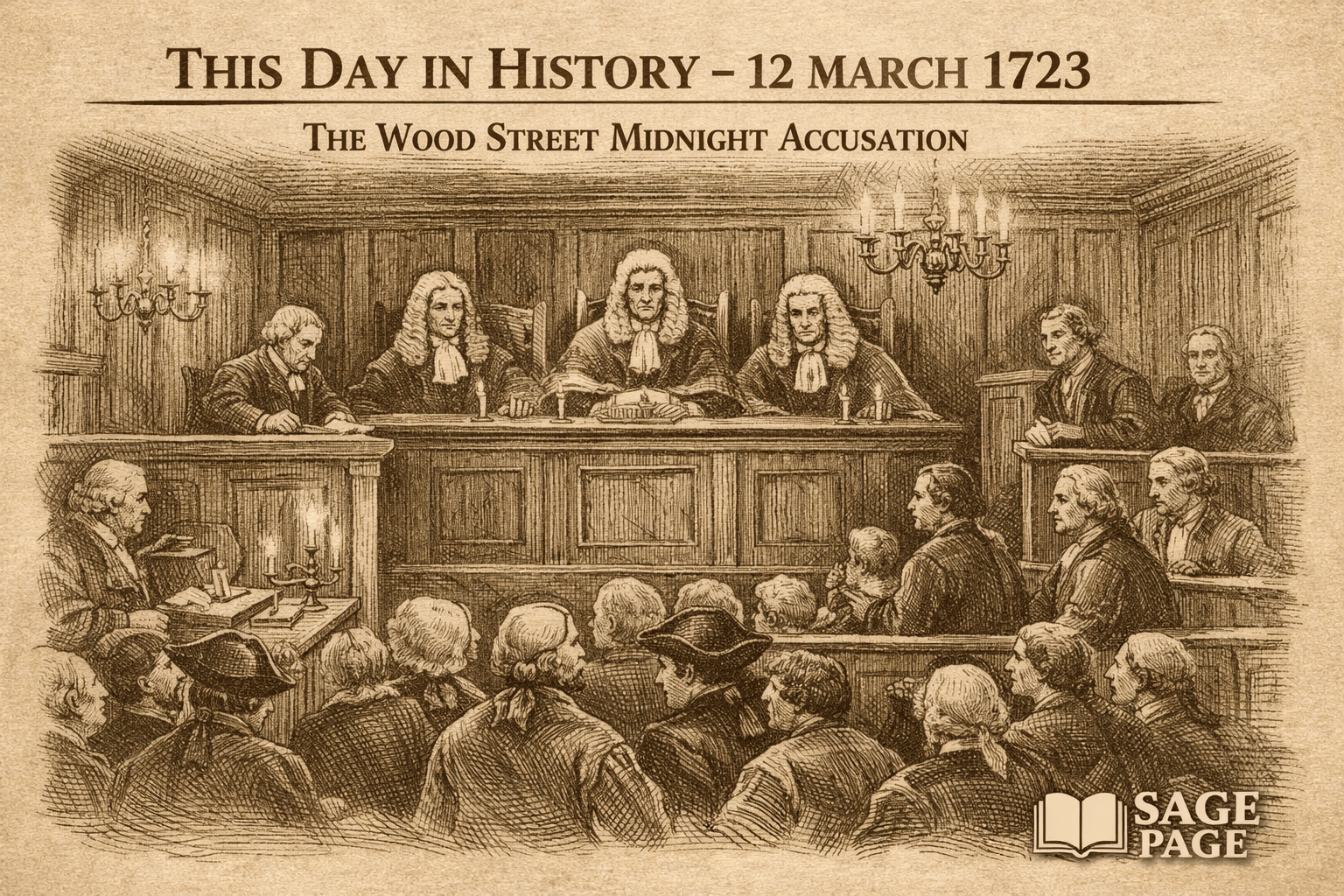
In the early hours of 12 March 1723, a schoolmaster named Charles Banner was accused of making an indecent assault on a teenage messenger in the streets of London.
The case that followed at the Old Bailey reveals much about how early eighteenth-century courts handled accusations of sexual misconduct—particularly when proof was uncertain.
A Late-Night Encounter
The complainant, Nicholas Burgess, was a boy of about fifteen years old.
He told the court that around midnight, while carrying letters for his father—who worked for the Post Office—he was approached in the street by the prisoner.
According to Burgess, the man began speaking to him and quickly behaved in an improper manner.
The boy stated that Banner:
- spoke to him in the street late at night
- kissed him
- pushed him against the gate of the Cross Keys in Wood Street
- behaved in ways he described as indecent
Banner allegedly suggested they go together to an ale-house or tavern, and later proposed that the boy meet him again another night.
Burgess refused the invitation but immediately reported the incident to his family.
The Planned Trap
Rather than ignore the encounter, Burgess’s father decided to set a trap.
Knowing that the boy regularly carried letters through the city at midnight, they expected Banner might attempt to meet him again.
On the next postal round, the boy went about his usual route while his father and several acquaintances quietly followed at a distance.
When Banner appeared and walked with the boy toward Wood Street, the watchers moved in and seized him.
The Arrest
The arrest happened at the very place where the boy claimed the earlier incident had taken place.
The witnesses told the court they believed they had caught Banner keeping the arranged meeting.
However, they admitted they may have intervened too quickly to observe anything more clearly.
Banner’s Defence
Charles Banner strongly denied the accusations.
He insisted that:
- he had never seen Nicholas Burgess before the night of his arrest
- he had done nothing improper
When asked about his background, a witness testified that Banner worked as a schoolmaster in Swedeland Court near East Smithfield.
The witness added that many parents—including himself—trusted Banner with the education of their children, describing him as:
“an honest, sober person.”
The Court’s Dilemma
The judges acknowledged that the testimony suggested suspicious behaviour.
The boy had clearly given a detailed account of the earlier encounter, and the arranged meeting seemed to support his story.
Yet the court faced a problem common in such cases.
The evidence did not fully prove the specific charge contained in the indictment.
Under the law at the time, accusations involving attempted sodomy required very strong and explicit proof.
The Verdict
Because the evidence did not meet that strict legal standard, the jury returned a verdict of:
Not guilty.
The judges made clear that while the circumstances were troubling, the proof did not reach the level required for conviction.
Charles Banner therefore left the court a free man.
A Window into Early 18th-Century Justice
The case highlights the difficulty of prosecuting sexual offences in early eighteenth-century England.
Courts required:
- clear testimony
- strong corroboration
- and proof that matched the exact wording of the indictment.
Without it, even suspicious circumstances could not secure a conviction.
For modern readers, the trial offers a glimpse of London’s midnight streets, postal runners, and the uneasy balance between accusation and proof in Georgian criminal law.
In early 18th-century English law, the offence of sodomy (then called “buggery”) was governed primarily by the Buggery Act 1533 (25 Henry VIII c.6), which remained the basis of the law throughout the period.
1. What had to be proved
To secure a conviction for sodomy, the prosecution had to prove two elements:
- Penetration
- Emission (ejaculation)
Both had to be demonstrated for the act to be legally complete. Without proof of emission, the crime was treated as attempted sodomy or indecent assault, not the capital offence itself.
Because these elements were extremely difficult to prove, many indictments instead alleged:
- “Assault with intent to commit sodomy”
- “Attempting the detestable and abominable crime of buggery”
This is exactly what we see in the Charles Banner case—the indictment avoids the completed act.
2. The evidentiary standard
There was no statutory requirement for two witnesses, unlike the law of treason.
However, courts developed a very cautious evidentiary practice because the charge carried the death penalty.
Judges repeatedly warned juries that:
- The testimony of a single accuser was dangerous
- There should be strong corroborating circumstances
In practice this often meant:
- Two witnesses, or
- One witness plus corroboration (physical evidence, witnesses to suspicious behaviour, confession, etc.)
So while not legally required, the courts effectively treated sodomy accusations as requiring very strong corroboration.
3. Why the Banner case failed
In the case you posted, the court says:
“The Evidence against the Prisoner was not strong enough to prove the Assault and Intention…”
The reasons are typical:
- Only the boy’s testimony proved the indecency.
- The father and others only witnessed the apprehension, not the alleged act.
- There was no physical evidence.
- Banner had good character evidence as a schoolmaster.
So the jury acquitted.
4. Conviction rates
Because of these evidentiary hurdles, many indictments failed unless there was:
- Caught in the act
- Confession
- Multiple witnesses
When convictions did occur, the punishment was death by hanging at Tyburn.
5. A fascinating side note
The Old Bailey judges were often suspicious of accusations made by youths, especially in cases involving:
- attempted entrapment
- revenge
- extortion
That caution is visible in the Banner case.
Sources
- Old Bailey Proceedings, 24 April 1723, trial of Charles Banner.
- Testimony of Nicholas Burgess and other witnesses.
- Early eighteenth-century criminal court records.
Epilogue: The Molly House Raids of 1725–1726
Within only a few years of the Banner trial, London magistrates were confronted with what they believed to be a growing subculture of men meeting in private houses and taverns for same-sex encounters. These establishments became known as “molly houses.”
The word molly was an eighteenth-century slang term for an effeminate man, and the houses themselves functioned as clandestine meeting places where men could socialise, drink, and sometimes engage in sexual relationships.
The Raid on Mother Clap’s House
The most famous of these establishments was run by Margaret “Mother” Clap, whose house in Field Lane near Holborn became the centre of a major police investigation in 1725.
Authorities organised informers and undercover watchers, who spent months gathering evidence. Eventually a raid was launched on the premises, and numerous men were arrested.
At the subsequent Old Bailey trials, witnesses described scenes that shocked the court:
- men greeting one another with kisses,
- mock “marriages” between participants,
- and gatherings where the men adopted female nicknames and manners.
These descriptions were repeated in court testimony and printed in pamphlets, making the trials widely known across London.
The Trials and Sentences
Several men arrested in connection with the raids were prosecuted for sodomy or attempted sodomy. Because the completed offence still carried the death penalty, the trials focused intensely on whether the act itself could be proved.
Some defendants escaped conviction when the evidence was considered insufficient. Others were not so fortunate.
In 1726, three men—William Brown, Gabriel Lawrence, and Thomas Wright—were convicted and executed at Tyburn for sodomy. Their cases were among the most notorious of the period and drew large crowds.
Mother Clap herself was not charged with the capital offence but was convicted of keeping a disorderly house. She was sentenced to imprisonment, fined heavily, and placed in the pillory.
What the Molly House Cases Reveal
These prosecutions provide historians with rare insight into urban social life in Georgian London. The trial records reveal that, despite severe legal penalties, networks of men continued to find ways to meet and form communities.
They also illustrate how cautious courts remained when dealing with accusations. As in the Banner case, juries often refused to convict unless the evidence clearly demonstrated the completed act required by law.
A Changing Atmosphere
The molly house prosecutions marked a turning point. From the 1720s onward, authorities began to treat such gatherings as a public order problem, using informers, raids, and surveillance to gather evidence that would stand up in court.
Yet even with these efforts, the strict legal standard required for conviction meant that many defendants were acquitted, just as Charles Banner had been.
Sources
The events described above are drawn primarily from the records of the Old Bailey, particularly the trials relating to the raid on Margaret Clap in 1725–1726. These proceedings remain among the most detailed surviving accounts of early eighteenth-century policing and social life in London.
Further Reading
Modern historians have examined the molly house prosecutions in detail, using surviving trial records, pamphlets, and newspaper reports to reconstruct this hidden world of early eighteenth-century London.
One of the most accessible sources is the work of historian Rictor Norton, whose research into the molly houses provides detailed reconstructions of the 1725 raids and the subsequent Old Bailey trials.
Another important scholar is Randolph Trumbach, who has written extensively about how attitudes toward sexuality changed in Britain during the seventeenth and eighteenth centuries.
The primary evidence for these events comes from the records of the Old Bailey, whose printed trial proceedings remain one of the richest sources for understanding everyday life, crime, and social attitudes in Georgian London.
For readers interested in exploring further, many of these records are now searchable through the Old Bailey Proceedings Online, which contains thousands of trial transcripts from 1674 to 1913.
A Historical Note from The Sage
The trial of Charles Banner reminds us that justice in the eighteenth century often walked a narrow path between suspicion and proof. Courts demanded strong evidence before condemning a man for a crime that carried the gravest penalty, and juries were frequently reluctant to convict unless the facts were clear beyond doubt.
Only a few years later, the molly house raids showed how authorities attempted to gather that very proof—through surveillance, informers, and carefully staged arrests. Even then, convictions remained difficult.
History, therefore, leaves us with a curious paradox: a law that punished severely, yet a system that often hesitated to apply it without the strongest evidence.
As The Sage might observe:
The past is not always the story of certainty, but of people trying—sometimes imperfectly—to balance accusation, reputation, and justice.
Thank you for reading my writings. If you’d like to, you can buy me a coffee for just £1 and I will think of you while writing my next post! Just hit the link below…. (thanks in advance)








 The Sage Page