This Day in History: 19 May 1743

A Tavern Quarrel Turned Deadly

On 19 May 1743, Gabriel Beaugrand and Lewis Brunet stood trial at the Old Bailey for the killing of Lewis Legier, a cook who had, only hours before his death, been drinking and talking amicably in a London tavern.

What began as a trivial dispute over status at sea—sailor versus cook—ended in fatal violence.


“Brother Sailors”… Until They Weren’t

The encounter took place at the White Bear public house in Newport Street.

At first, the mood was friendly. Legier, who had served as a cook aboard a naval vessel, greeted Beaugrand warmly, calling him:

“Brother Sailor”

They spoke of ships, service, and life at sea. But the conversation turned competitive—then hostile.

The argument centred on a seemingly petty question:

  • Who held greater status aboard ship: a sailor or a cook?

Beaugrand insisted that a sailor outranked a cook.
Legier, with some pride, disagreed.

From there, matters escalated quickly.


The First Blow

According to witnesses, Beaugrand:

  • took up a pewter pot
  • attempted to strike Legier

Legier responded immediately:

  • pulling Beaugrand across the table
  • striking him repeatedly with the same pot

By the time others intervened, Beaugrand’s head was badly wounded, bleeding heavily.

It might have ended there—a drunken brawl, nothing more.

But it did not.


The Fatal Moment

After the initial fight:

  • tensions remained high
  • Beaugrand withdrew briefly
  • Brunet (his uncle) became involved in the dispute

Then, in a sudden and decisive moment, Beaugrand returned to Legier and struck him again—this time with a knife.

Witnesses did not clearly see the weapon, but the effect was immediate.

Legier cried out:

“I am dead”

He collapsed soon after.


The Surgeon’s Findings

The medical evidence confirmed the severity of the attack:

  • three stab wounds
  • one penetrating the liver and major blood vessels
  • another reaching the lungs

The surgeon concluded that the wound to the liver caused instant death.

What had seemed, moments earlier, a tavern scuffle had become a killing.


Brunet’s Role

Lewis Brunet, Beaugrand’s uncle, was accused of:

  • aiding
  • encouraging
  • continuing the fight

He had attempted to re-engage Legier during the altercation and was seen behaving aggressively even after the stabbing.

However, the court ultimately found insufficient evidence that he had participated in the fatal act itself.

Brunet was acquitted.


Verdict and Punishment

The jury reached a nuanced conclusion:

  • Gabriel Beaugrand → Guilty of Manslaughter
  • Lewis Brunet → Not Guilty

Rather than execution, Beaugrand received the traditional punishment:

Burnt in the Hand

This was a branding—literally marking him as a convicted felon, but sparing his life.


A Sudden Descent

This case stands as a classic example of how quickly violence could spiral in 18th-century London:

  • a friendly meeting
  • a petty dispute
  • drink, pride, and insult
  • then, in seconds, irreversible action

No long-standing feud.
No premeditated design.

Just a moment’s escalation—with fatal consequences.


Final Reflection

The law recognised the difference between murder and sudden passion.

Beaugrand was spared the gallows—but not punishment, nor the mark of his crime.

And for Lewis Legier, a man who entered the tavern as a “brother sailor,”
there was no second chance.


Thank you for reading my writings. If you’d like to, you can buy me a coffee for just £1 and I will think of you while writing my next post! Just hit the link below…. (thanks in advance)


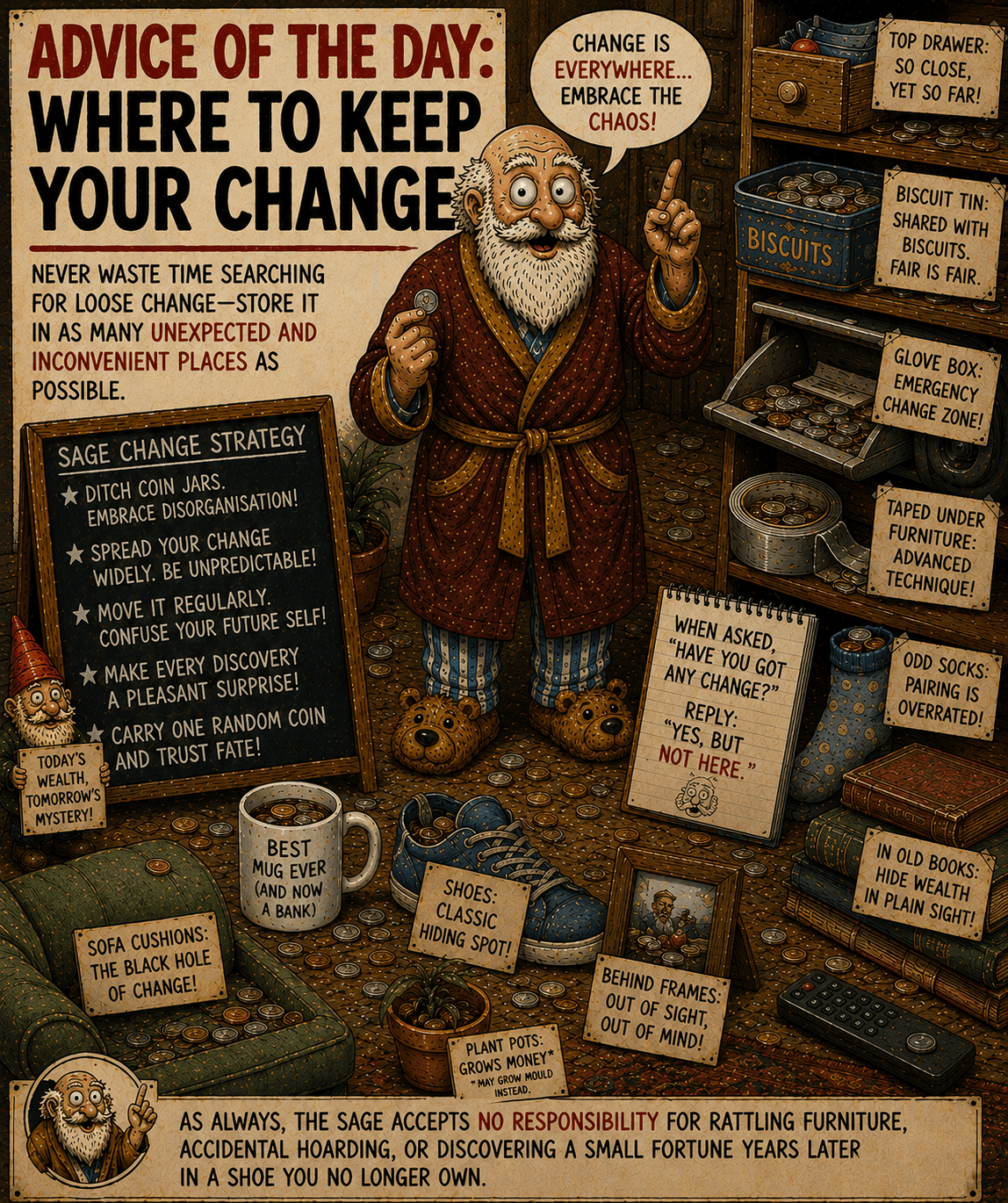
Advice of the Day: Where to Keep Your Change

Never waste time searching for loose change—store it in as many unexpected and inconvenient places as possible.

Loose change has an uncanny ability to vanish precisely when needed. The Wise Sage recommends solving this problem not through organisation, but through strategic unpredictability. If your coins are everywhere, they are, in a sense, always somewhere useful.

Start by abandoning traditional storage methods such as wallets, jars, or anything labelled “coin holder.” These create dangerous levels of efficiency. Instead, distribute your change throughout your daily environment: coat pockets, sofa cushions, old mugs, plant pots, and at least one location you will immediately forget. This creates a dynamic, ever-evolving financial landscape.

For maximum effectiveness, introduce rotation. Move your change regularly without keeping track. This prevents familiarity, which can lead to complacency. Opening a drawer should feel like a treasure hunt. Occasionally finding £1.37 where you least expect it builds character and maintains a healthy sense of mystery.

Advanced practitioners may wish to adopt “emergency change zones.” These include shoes, the car glove compartment, behind picture frames, or taped discreetly under furniture. While retrieval may require effort, the psychological comfort of knowing coins exist somewhere in your home is invaluable.

When leaving the house, avoid taking all your change with you. This creates unnecessary weight and raises expectations. Instead, carry a single coin of uncertain value and commit fully to whatever situation arises. Adaptability is key.

Finally, if someone asks, “Have you got any change?” confidently reply, “Yes, but not here.” This establishes both honesty and intrigue.

As always, The Sage accepts no responsibility for rattling furniture, accidental hoarding, or discovering a small fortune years later in a shoe you no longer own.


Thank you for reading my writings. If you’d like to, you can buy me a coffee for just £1 and I will think of you while writing my next post! Just hit the link below…. (thanks in advance)
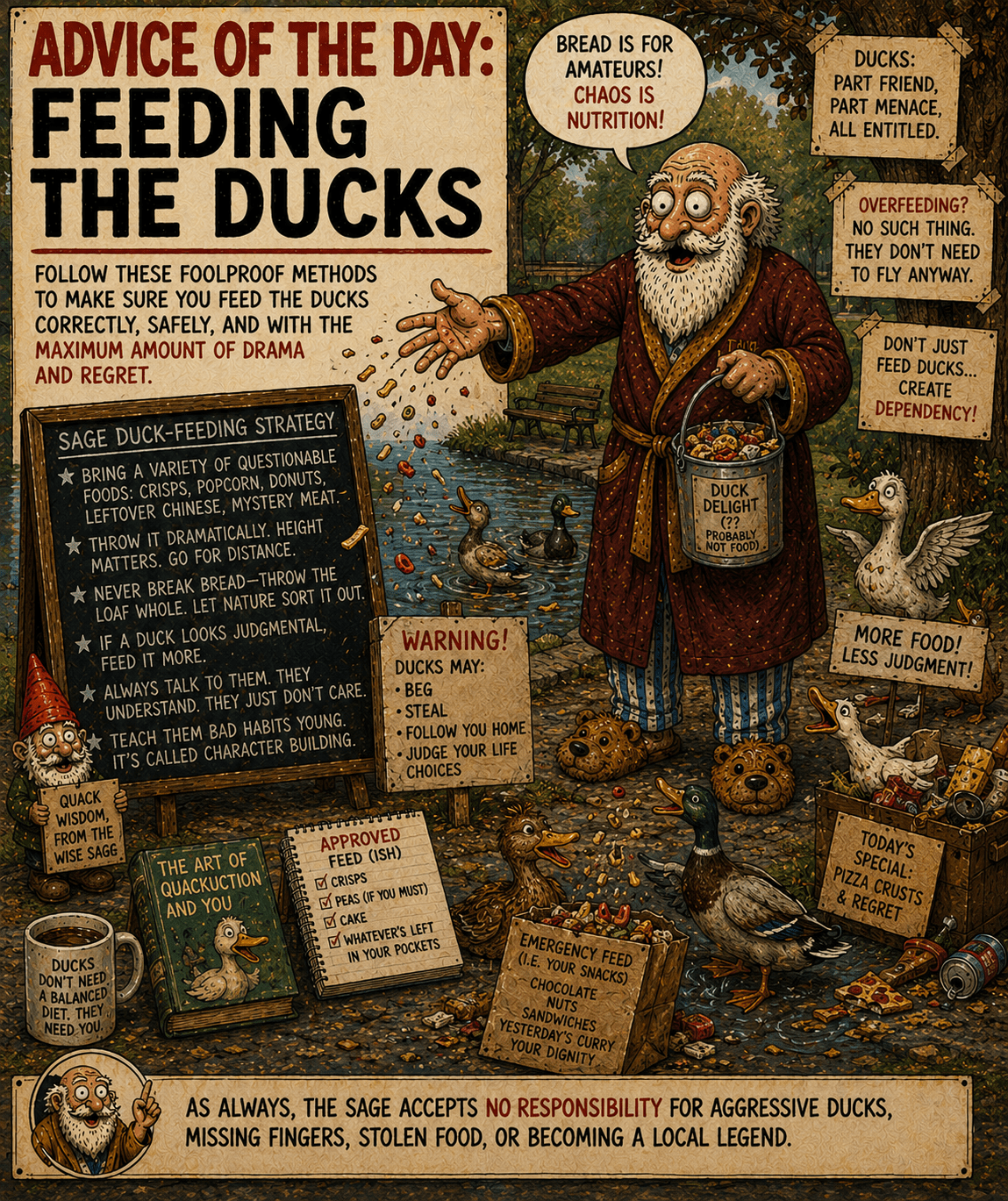
Advice of the Day: Feeding the Ducks

Forget bread—feed ducks whatever you happen to have and let nature deal with the consequences.

Feeding ducks is widely considered a wholesome, peaceful activity. The Wise Sage, however, recognises it for what it truly is: a delicate negotiation with a group of highly entitled water-based opportunists. Success lies not in careful feeding, but in asserting dominance early.

Bread, often suggested by so-called “experts,” is predictable and dull. Ducks expect it. Instead, arrive with a bold and confusing selection—crisps, leftover takeaway, questionable snacks from the bottom of your bag. Variety keeps the ducks alert and prevents them forming organised expectations, which can quickly spiral into mob behaviour.

Distribution is equally important. Do not gently scatter food. Throw it with flair. Height, distance, and dramatic arm movements all contribute to what professionals call “feeding theatre.” Ducks respect spectacle. A well-executed throw can establish you as a figure of authority—or at the very least, someone worth following.

If a duck approaches confidently, maintain eye contact and feed it more. This may seem counter-intuitive, but it reinforces the illusion that you are in control of the situation. If multiple ducks approach, increase your throwing speed and avoid showing fear. Ducks can sense weakness, and will absolutely exploit it.

Under no circumstances should you attempt to leave quietly. Once feeding has begun, you are part of the system. The correct exit strategy is to dramatically run out of food, show your empty hands, and back away slowly while muttering something non-committal. This signals closure while preserving dignity.

As always, The Sage accepts no responsibility for aggressive ducks, missing snacks, or becoming permanently followed by a small but determined flock.


Thank you for reading my writings. If you’d like to, you can buy me a coffee for just £1 and I will think of you while writing my next post! Just hit the link below…. (thanks in advance).

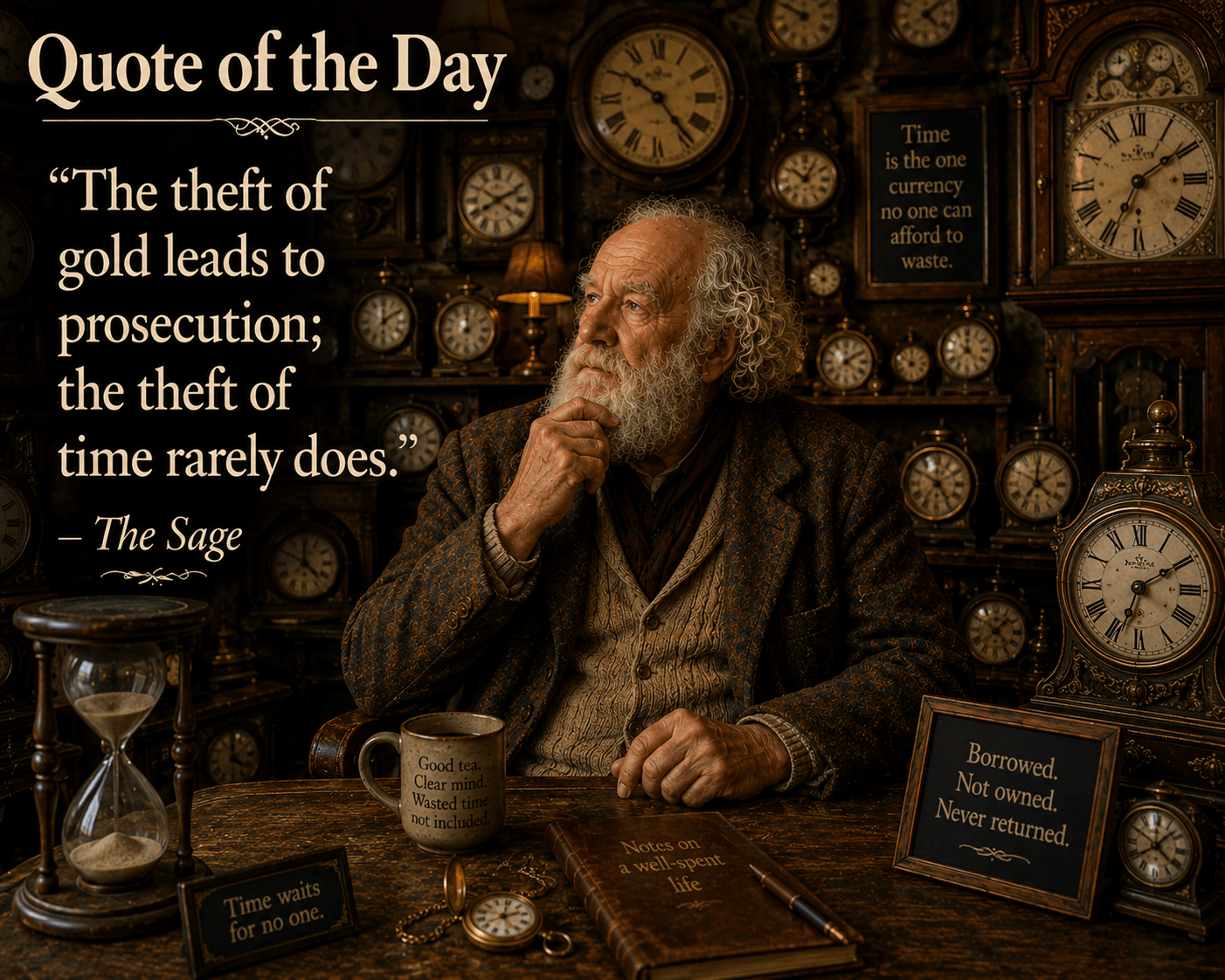
Quote of the Day: Time

“The theft of gold leads to prosecution; the theft of time rarely does.”
— The Sage


The Sage has often noted that society is very clear about what it values — and even clearer about what it punishes. Gold, tangible and measurable, is guarded closely. Its theft is obvious, actionable, and swiftly followed by consequences. Laws exist to protect it, and those who take it without permission are pursued with determined efficiency.

He observes, however, that time — far more valuable in the long run — receives no such protection. It is borrowed, wasted, delayed, and quietly taken in countless small ways. Meetings that should not exist, distractions that multiply without purpose, and moments surrendered without thought — all pass without prosecution. The Sage notes that the loss is no less real, only less visible.

With gentle irony, he reminds us that while gold can be returned, time cannot. Yet one is pursued with urgency, and the other barely acknowledged. Perhaps, he suggests, the true imbalance lies not in the law, but in what we have chosen to measure. And in that quiet oversight, The Sage finds one of life’s most curious priorities.


Thank you for reading my writings. If you’d like to, you can buy me a coffee for just £1 and I will think of you while writing my next post! Just hit the link below…. (thanks in advance)
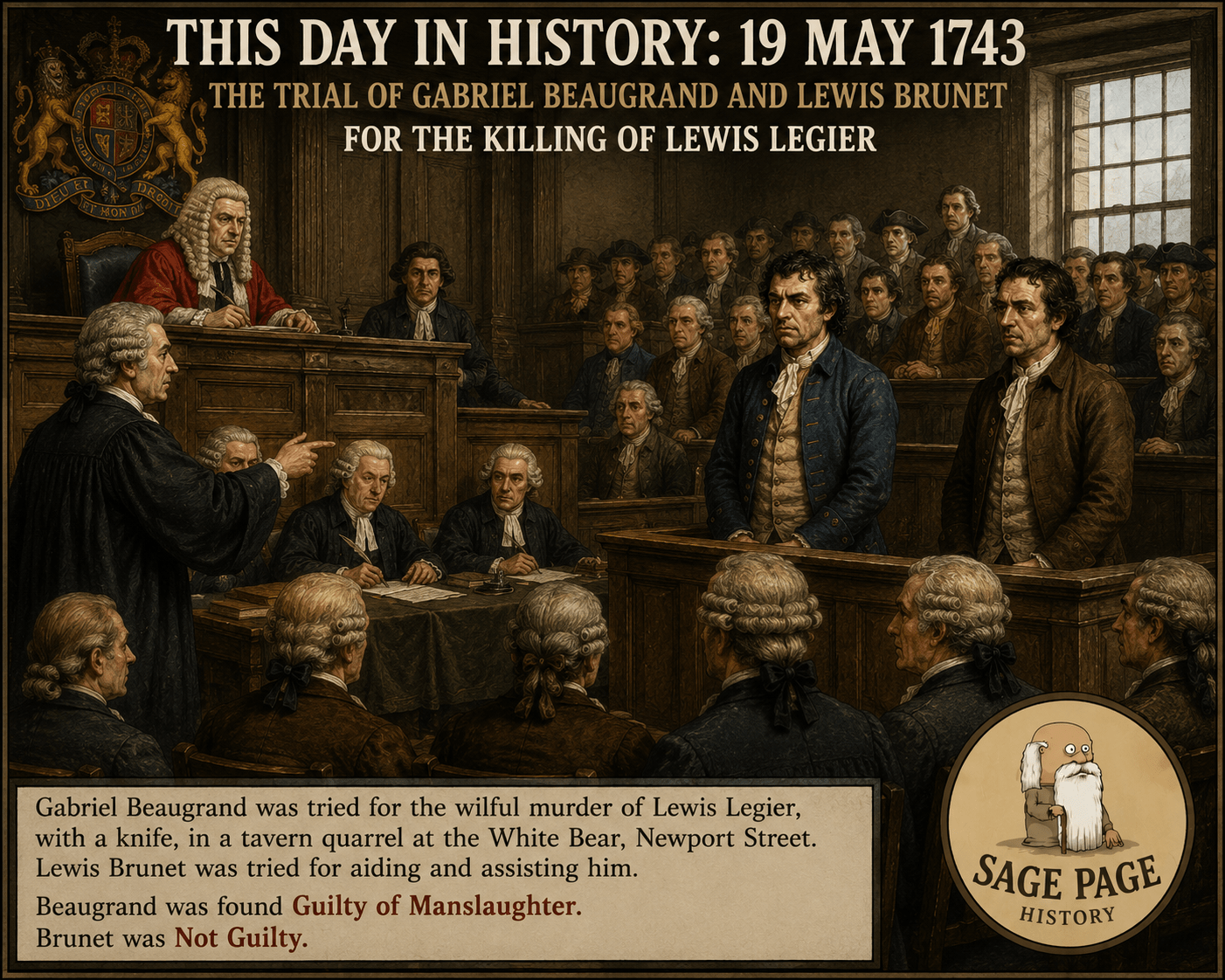
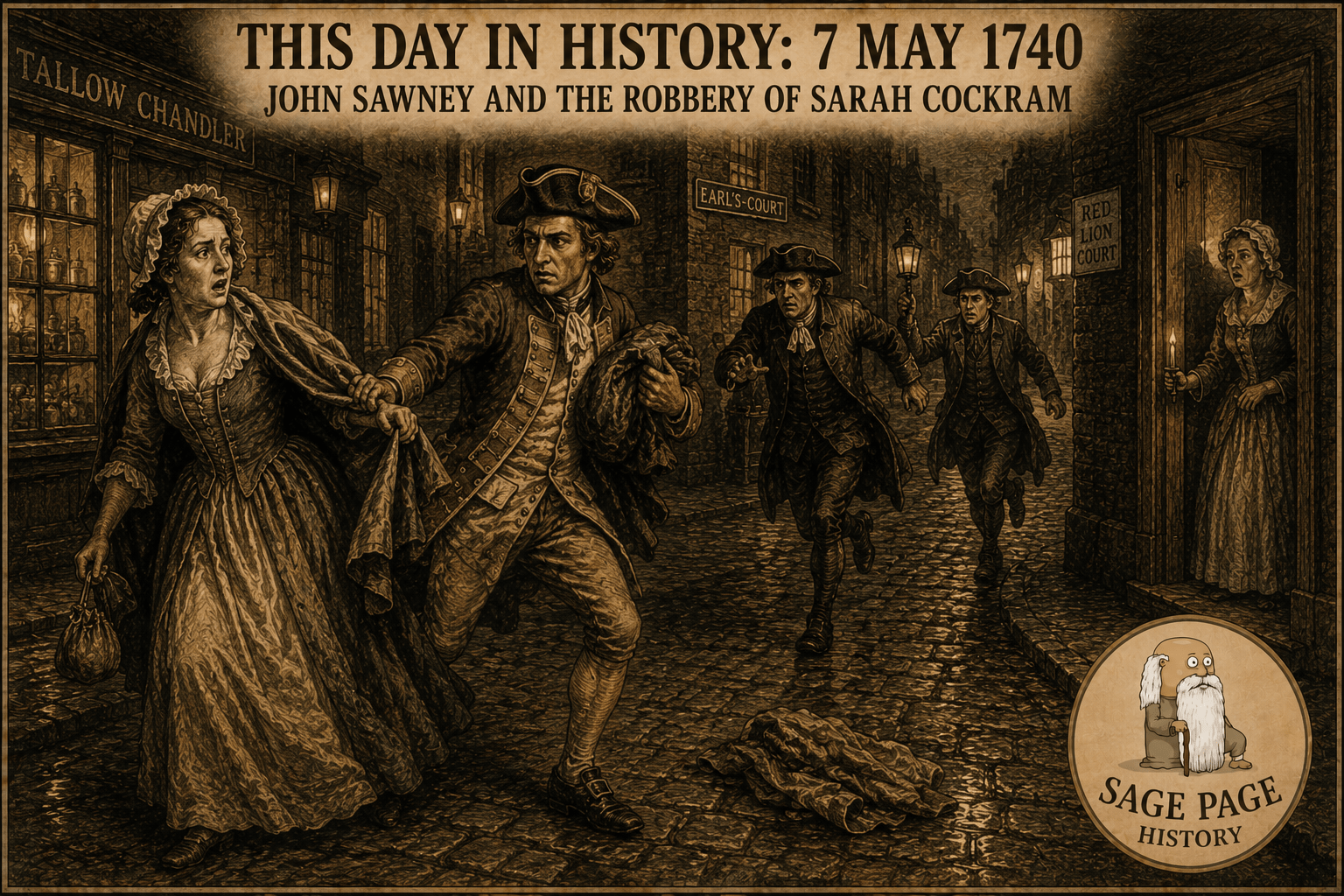
This Day in History: 7 May 1740

A Cloak, a Cry, and a Noose

On 7 May 1740, John Sawney met his end for what, at first glance, appears a modest crime: the violent theft of a woman’s cloak. Yet, as so often in 18th-century London, the law drew no gentle distinction between robbery and ruin. A single act on a dark street could carry a man from the King’s Highway to the gallows.


A Life at Sea, A Fall on Land

Sawney was just 25 years old, born in Cork to what the Ordinary described as “honest parents.” He had received a sound education—able to read, write, and keep accounts—and was raised in the Christian faith. His early life showed promise.

He was apprenticed to the sea and served honestly and with approval, travelling widely:

  • Gibraltar
  • Spain
  • France
  • Portugal
  • the West Indies

For a time, he lived the industrious life expected of him. But restlessness—and drink—proved his undoing.


The Night in Drury Lane

On the evening of 29 January 1740, just after seven o’clock, Sawney encountered Sarah Cockram in Drury Lane.

What followed was swift, crude, and violent.

He first attempted conversation:

  • asking directions
  • probing whether she was local
  • inviting her for a drink

When rebuffed, his tone turned.

Without warning, he seized her cloak, wrenching it from her shoulders so forcefully that:

  • the fastening tightened at her throat
  • she was nearly choked
  • she cried out in terror

He tore the garment free and fled into the dark.


“Stop Thief!”

Cockram’s cries brought immediate attention.

Men from nearby shops—lit by candlelight—took up the pursuit:

  • through Earl’s Court
  • into narrow passages and turning courts
  • finally into a dead-end

Sawney, perhaps unfamiliar with the maze of London streets, made a fatal mistake:
he ran into a court with no escape.

Moments later, he was discovered:

  • hiding behind a door
  • the stolen cloak discarded nearby

He was seized and brought before a magistrate.


Defiance and Denial

At his examination, Sawney showed neither humility nor restraint.

  • He insulted those who had apprehended him
  • Threatened the victim
  • Claimed innocence, despite overwhelming evidence

Most damning of all, he reportedly declared:

he could “own the fact” when he pleased—and deny it just as easily in court.

The court was not persuaded.


Conviction and Sentence

The evidence was clear:

  • the victim’s testimony
  • eyewitness pursuit
  • immediate capture
  • recovery of the stolen cloak

The jury returned a verdict:

Guilty. Sentence: Death.

For the theft of a cloak valued at 12 shillings, a man’s life was forfeit.


The Ordinary’s Account

In the days before his execution, Sawney expressed repentance.

He blamed:

  • drink
  • poor judgment
  • a life grown unsettled after leaving the sea

He declared himself:

  • penitent
  • reconciled to God
  • “in peace with all men”

Whether this repentance was born of faith or fear, we cannot know. But it followed a familiar pattern in the Ordinary’s accounts—regret arriving at the edge of the scaffold.


Final Reflection

John Sawney’s story is not one of grand villainy, but of small decisions compounding into catastrophe:

  • a life unsettled
  • a night of drink
  • a moment of violence

And from that moment, there was no return.

In 18th-century London, justice was swift, public, and unforgiving.
A cloak could cost a life.


Thank you for reading my writings. If you’d like to, you can buy me a coffee for just £1 and I will think of you while writing my next post! Just hit the link below…. (thanks in advance)
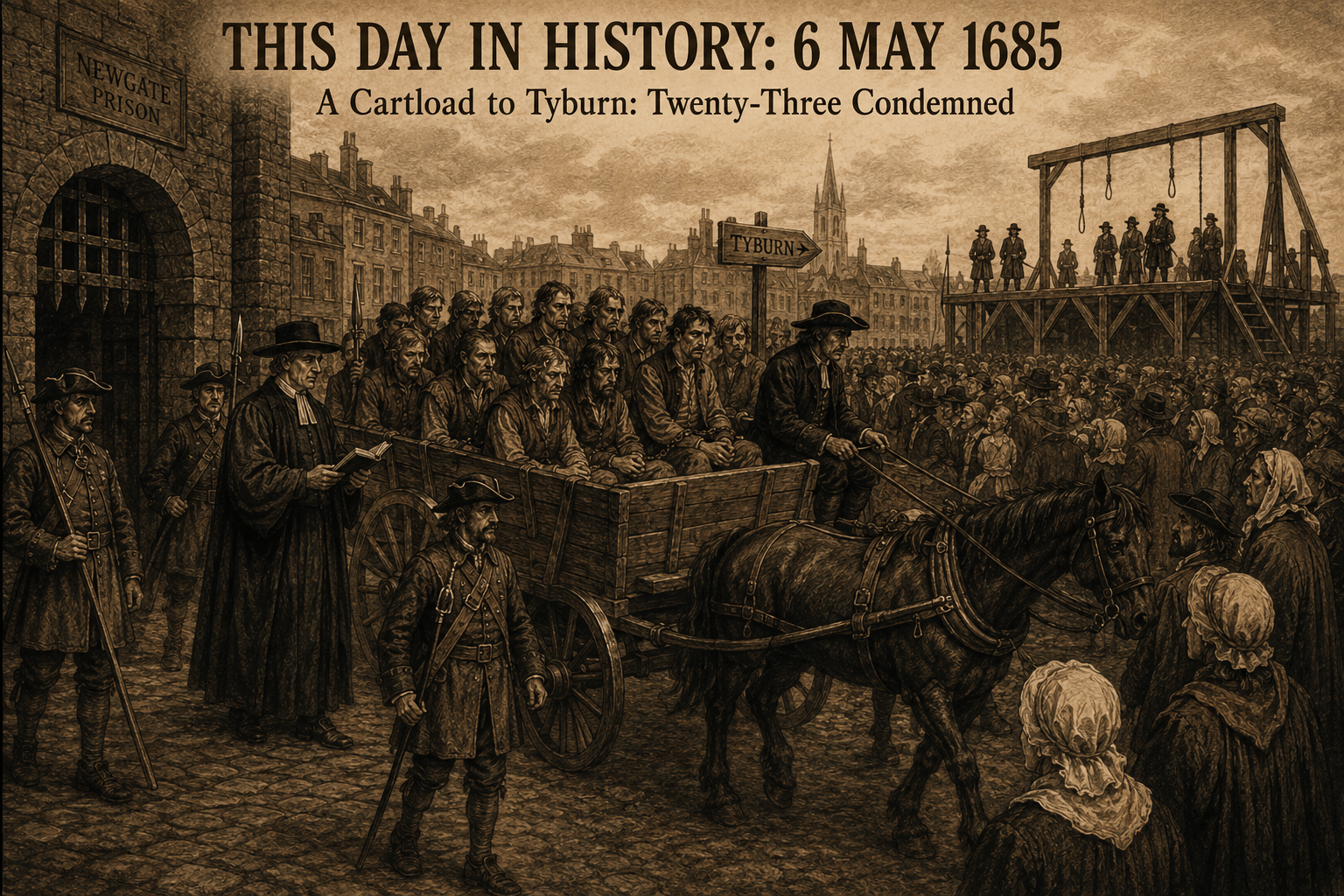
This Day in History: 6 May 1685

A Cartload to Tyburn

On 6 May 1685, one of the most sombre sights of the Old Bailey era unfolded: a mass execution at Tyburn following a session in which twenty-three prisoners had been sentenced to death.

There is no single dramatic crime to focus on today—no lone villain or shocking act—but rather something quieter, and perhaps more unsettling: a procession of condemned men and women, many of them resigned, some defiant, and others simply unprepared for what awaited them.


The Ordinary’s Frustration

The account is dominated not by the prisoners themselves, but by the voice of the prison chaplain—the Ordinary of Newgate—who struggled to prepare them spiritually for death.

He describes a troubling scene:
many prisoners remained “obdurate”, clinging to the hope of a last-minute pardon rather than confronting their fate.

Despite repeated sermons, prayers, and personal exhortations, some refused even to speak with him:

“Some refused it with greater obstinacy than ever any did… presuming they should be pardoned.”

For the Ordinary, this was not just disobedience—it was spiritual peril. To die unrepentant was, in his view, far worse than the execution itself.


A Few Who Listened

Not all resisted.

Among those who did engage was William Peddington, a soldier condemned for desertion. His story is brief but telling: a poor man, burdened by debt, who enlisted out of necessity and fled out of discontent.

He expressed regret:

  • for abandoning his duty
  • for disappointing both God and King

In a day filled with hardened silence, even this modest confession stood out.


The Final Journey

By late morning, the condemned were brought out from Newgate Prison and placed into carts.

This was the final ritual.

The journey through London to Tyburn was public—deliberately so. Crowds gathered to watch, reflect, or simply be entertained. The condemned, now visible to all, became living warnings.

The Ordinary records that:

  • many appeared “very penitent” along the route
  • prayers were said openly
  • psalms were sung

At the gallows, the prisoners addressed the crowd:

urging them to “take warning” from their fate

It was a familiar formula—part confession, part performance, part moral theatre.


The Moment at Tyburn

At Tyburn, the ritual reached its end.

  • Final prayers were offered
  • The condemned prayed individually
  • They asked the crowd to pray for them

Then, without further ceremony:

they were all executed.


A Quiet Kind of Tragedy

What makes this account striking is not violence, but absence:

  • No detailed crimes
  • No vivid final declarations
  • No singular narrative

Instead, we are left with a procession—twenty-three lives reduced to a single paragraph of conclusion.

It is tragedy not in spectacle, but in scale.


Final Reflection

The Ordinary closes his account with a familiar moral: sin leads to ruin, and repentance must not be delayed.

But reading between the lines, another truth emerges.

Some hoped for pardon.
Some refused reflection.
Some prayed.
Some did not.

And in the end, all met the same fate.


Thank you for reading my writings. If you’d like to, you can buy me a coffee for just £1 and I will think of you while writing my next post! Just hit the link below…. (thanks in advance)
Quote of the Day: Transparency

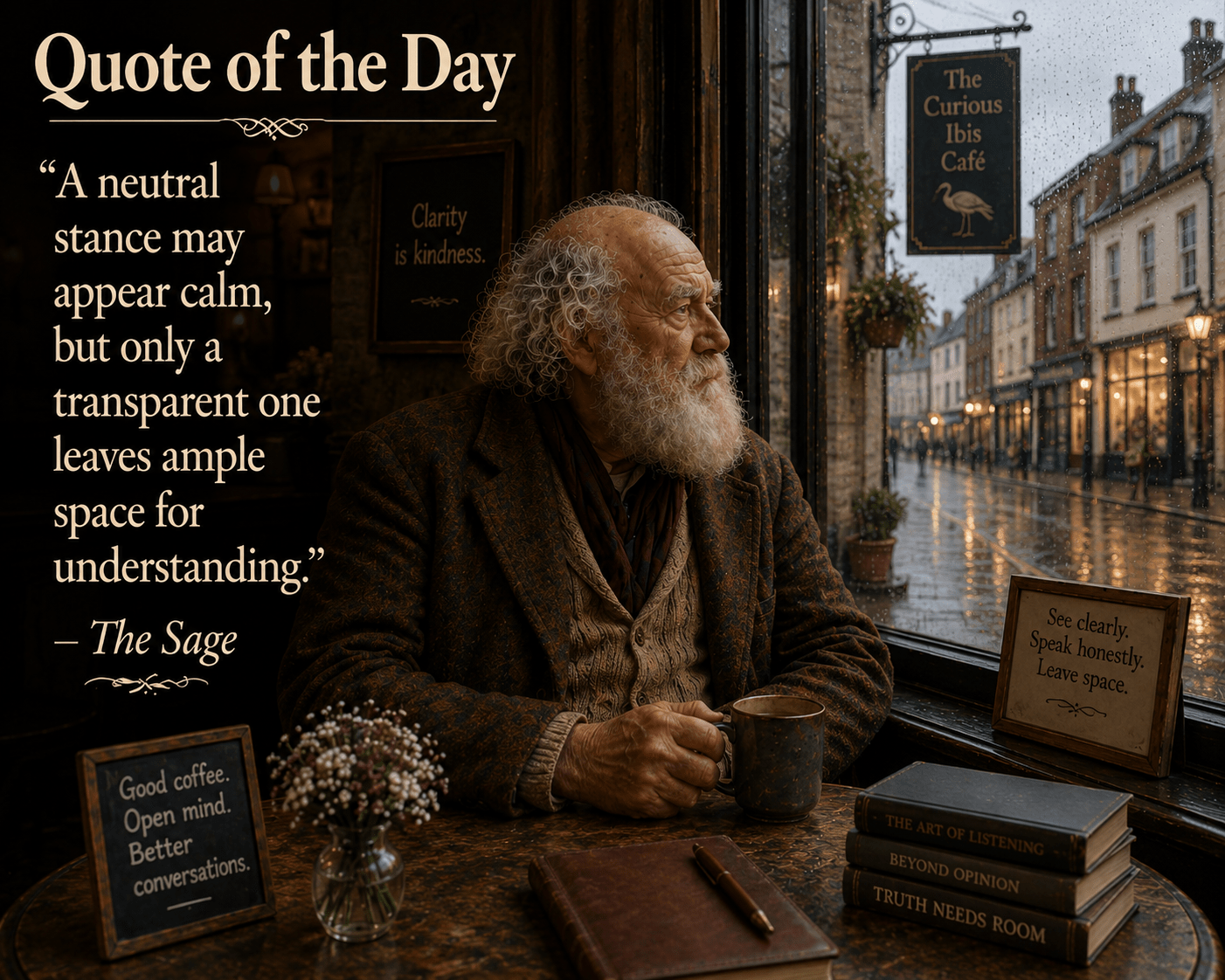
“A neutral stance may appear calm, but only a transparent one leaves ample space for understanding.”
— The Sage


The Sage has often noticed that calmness can be misleading. A neutral stance, while outwardly peaceful, does not always reveal what lies beneath it. It can create the impression of fairness or balance, yet sometimes it simply avoids engagement altogether. Neutrality, he suggests, can be as much about withholding as it is about observing.

He observes that transparency demands more. To be transparent is not merely to remain still, but to be open — to allow others to see the reasoning, the uncertainty, and even the flaws behind a position. This openness creates space, and in that space, understanding has room to grow. Where neutrality can close a conversation, transparency often invites one.

With gentle clarity, The Sage reminds us that true understanding rarely emerges from silence alone. It requires visibility — a willingness to be seen and, perhaps more importantly, to be questioned. A calm exterior may soothe, but it is transparency that offers the ample ground on which genuine understanding can stand.


Thank you for reading my writings. If you’d like to, you can buy me a coffee for just £1 and I will think of you while writing my next post! Just hit the link below…. (thanks in advance)
Advice of the Day: Securing Your Property

Deter burglars by making your home so confusing, alarming, and mildly hazardous that even you stop wanting to enter it.

the sage

Home security is often approached with dull practicality—locks, alarms, lighting. The Wise Sage considers this unimaginative. True security lies not in keeping intruders out, but in ensuring that once they approach, they immediately regret all life choices that led them there.

Start by installing as many misleading signs as possible. “Beware of the Dog” is standard, but far more effective is “Beware of the Geese,” “Caution: Experimental Traps,” or simply “They Know You’re Here.” The goal is not clarity, but unease. A burglar should feel as though they’ve wandered into the opening scene of something they will not survive.

Next, remove all predictable pathways. Replace your front garden path with loose gravel, garden gnomes at irregular intervals, and at least one inexplicable rake. This creates what security professionals refer to as a “tactical ankle environment.” Motion-sensor lights can be replaced with motion-triggered noises—preferably something unsettling, like distant whispering or a kettle that never quite boils.

Doors should also be psychologically fortified. Instead of a simple lock, consider attaching multiple unrelated objects: bells, wind chimes, a saucepan, perhaps a bicycle horn. Not only does this create an audible alert system, it ensures that opening the door becomes a memorable event for all involved.

Windows, often seen as a vulnerability, can be enhanced by making them deeply unappealing. Leave a mannequin staring out at all times, or occasionally replace it with yourself, unmoving, holding a torch under your chin. Consistency is key—unsettling consistency.

For advanced protection, answer unexpected knocks wearing a crash helmet and holding an object that cannot be explained—pineapple, traffic cone, ornamental sword. Say nothing. Simply maintain eye contact. Most intruders, salespeople, and distant relatives will withdraw immediately.

Finally, remember that security is about reputation. Once word spreads that your home is “not worth the trouble,” you have achieved peak deterrence. Admittedly, this may also deter friends, family, and delivery drivers—but sacrifices must be made.

As always, The Sage accepts no responsibility for startled neighbours, lost postmen, or accidentally securing yourself out of your own home.


Thank you for reading my writings. If you’d like to, you can buy me a coffee for just £1 and I will think of you while writing my next post! Just hit the link below…. (thanks in advance)
Advice of the Day: Sticking to a Diet

Avoid the stress of dieting altogether by simply redefining what counts as “on a diet.”

the sage

Dieting is, at its core, a matter of perspective. The modern world insists on rigid definitions involving restraint, discipline, and a suspicious lack of biscuits. The Wise Sage rejects this entirely. Instead, he recommends embracing a more flexible interpretation—one where the diet adapts to you, rather than the other way around.

A key strategy is the removal of all scales. Numbers are notorious for lowering morale, and without them, progress becomes wonderfully unmeasurable. If you cannot quantify your success, then technically, you are succeeding. This is known as “quantum dieting,” where results exist only when observed—and preferably not even then.

Equally important is food classification. The Sage advises that foods consumed while standing, walking, or thinking about something else do not count as meals. Similarly, anything eaten after 9pm falls into the category of “night research” and is therefore exempt from dietary consequences. Biscuits, for example, are not snacks—they are morale maintenance tools.

Hydration also plays a vital role. Drinking large amounts of water before meals can reduce hunger, although it may increase the likelihood of needing the bathroom at inconvenient moments. This creates a natural distraction from eating, which is widely regarded as a win.

Finally, remember that willpower is a finite resource and should be conserved for more important tasks, such as deciding what takeaway to order. If temptation strikes, simply eat the item quickly to remove it from your environment. You cannot be tempted by what no longer exists.

As always, The Sage accepts no responsibility for tighter waistbands, confused nutritionists, or the gradual reclassification of trousers as “optimistic.”


Thank you for reading my writings. If you’d like to, you can buy me a coffee for just £1 and I will think of you while writing my next post! Just hit the link below…. (thanks in advance)
Quote of the Day: Imagination

“Orientation tells you where you stand; imagination tells you what sort of inhabitant you might become.”
— The Sage


The Sage has often reflected that knowing where you are is only half the story. Orientation provides position — a sense of place, direction, and context. It answers the practical question: Where am I? But it rarely ventures further. It does not ask who you are within that space, or what you might yet become.

He observes that imagination performs a different kind of work. It is not concerned with maps or coordinates, but with possibility. Where orientation fixes you to a point, imagination loosens the boundaries of that point entirely. The Sage suggests that it is imagination that transforms a person from a passive occupant of space into an active inhabitant of life.

With gentle clarity, he reminds us that both are necessary. Without orientation, we drift. Without imagination, we stagnate. But when the two are held together, something more interesting happens: we not only understand where we stand, but begin to shape who stands there. And in that moment, The Sage notes, life becomes something we participate in, rather than merely occupy.


Thank you for reading my writings. If you’d like to, you can buy me a coffee for just £1 and I will think of you while writing my next post! Just hit the link below…. (thanks in advance)